
 •
Rating:
•
Rating:
THE REVIEW
A watershed year, 1997. Contrary to what the usual nostalgics stuck in 1989 maintain, the Nineties were a great decade for heavy metal, with the entire extreme scene in the forefront and the more heavy-power-related sound ready to return to the spotlight after the boom of Hammerfall's debut.
Paradoxically, the ones who were absent from the limelight for quite some time are the fathers of the genre, the Judas Priest, and since 1990's legendary Painkiller, a lot of water has passed under the bridge. Rob Halford is out of the game for a while, lost in his industrial projects, and Glenn Tipton has had all the time to consider a solo stint, but now it's time to return to the stage in a stable manner. A brief dissertation: in Birmingham, in the late Sixties, if you didn't want to work in a factory like your father and your grandfather before him, the only option was really to pick up a guitar and hope you'd make it. Ask the friends from Black Sabbath for confirmation. Back to us: for Rob, Priest is now a closed chapter, with apologies to those who were still hoping. Looking for a new singer? Obviously, but replacing such an iconic figure will not be easy. It's the young Tim Owens, a young American with a background in Winter's Bane, with one album under his belt and a career as a... Judas Priest tribute band! Thinking back, those were a bit confusing years. How many historical bands returned to the scene with upended line-ups and new singers replacing authentic institutions? Maiden, Sabbath, Helloween, Sepultura, just to name a few. The guy, however, is right from the start the horse to bet on: the minimum required stage presence isn't lacking, but above all, there's a golden voice that would be crazy to let slip away.
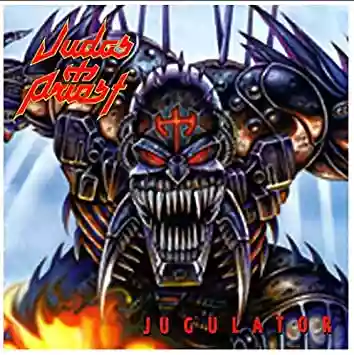
Jugulator hits the stores at the end of the year and baffles everyone a bit: okay, it would have been insane to expect a carbon copy of Screaming for Vengeance, but no one would have imagined such a comeback. Jugulator is the bastard child of Painkiller, a big, muscular guy with a Slayer t-shirt and a Pantera tattoo, and be careful how you talk to him because he's also very touchy. Tipton and Downing, who practically write everything, must have really brushed up on all the thrash and groove of those years, because that's the direction, with a Scott Travis in great shape who kicks into gear with a full-throttle double kick. Cover with the "usual" metallic monster as per tradition, just to remind you that these guys don't play reggae, and they start with a bang: Owens doles out plenty of high notes on a nice wall of guitars and helicopter double kick. Why the Priest took forever to find someone like Travis remains a mystery to anyone, to be clear. In short, the self-titled track immediately makes it clear where the rest of the album is headed. Blood Stained is another great track, with the K.K.-Glenn duo in top form and Owens offering a lesson on what vocal range is, really going above and beyond to prove he's up to the role. Dead Meat has its reasons, but feels too verbose, a feature that characterizes the entire album, much like many works of those years, with various artists going wild with the idea of being able to write while taking advantage of a CD's eighty minutes instead of a vinyl's forty. It's a pity we often ended up with endless intros, pointless passages, and tracks that once would have stayed in a drawer. Good also are Decapitate and Burn in Hell, which even get their own video, showcasing the new line-up's talents, but even here the abbreviated version of the clip works better than the excessively long one on the album. The new addition also shines in Brain Dead, with a nice emotional performance, as it's really worth mentioning Travis's excellent work. Want to give a few more compliments to Owens? What to say, great voice, the extra gear of this album, listen to Abductors to believe. We're almost at the finish line: even Bullet Train was chosen as a single and works, but the true masterpiece of the album is Cathedral Spires, nine minutes of marathon between gothic and decadent atmospheres where, finally, it's not just about pushing the accelerator, but it beautifully ends with an evocative gem, well structured and full of those melodies that made the Priest great in the Eighties. The real weak point of Jugulator? In the long run, it becomes monotonous: the wall of guitars is fine, but one must also know how to change the pace. Does the "ghost" of the Metal God hover occasionally? Of course, but it would have been impossible otherwise, with Downing and Tipton handling almost everything: giving more space to the newcomer wouldn't have been bad.
Usually, Jugulator is critiqued for its excessive aggression: true, more melodic openings would have benefited the tracks, given Owens' potential as well, but it's wrong to consider it an isolated work in the band's discography, almost as if the previous albums were made with a stencil. Judas never wrote two identical albums, at least during their most significant artistic phase, showing an almost progressive attitude, with a constantly evolving proposal: Sin After Sin was not British Steel and Turbo was not Defenders of the Faith. The revival, at most, would come only in more recent times, but after so many years asking for more would perhaps be absurd.
After the live album '98 Metal Meltdown, there will be the second and final chapter of the Owens era, Demolition, which will be somewhat snubbed by everyone, opening the doors, to the delight of the nostalgics, to the usual reunion with Rob, an event that marks the artistic death of practically any band. There remains the regret for a very talented singer that perhaps even the Priest themselves were not able to fully exploit: over the years, Owens would become a familiar face in the American metal scene, playing with everyone, but perhaps never finding his true dimension. Jugulator, despite the weak points discussed, remains nonetheless a good album, with a fresh and modern sound, far from any nostalgia.
Judas Priest:
- Tim "Ripper" Owens, vocals
- K.K. Downing, guitars
- Glenn Tipton, guitars
- Ian Hill, bass
- Scott Travis, drums
- Jugulator
- Blood Stained
- Dead Meat
- Death Row
- Decapitate
- Burn in Hell
- Brain Dead
- Abductors
- Bullet Train
- Cathedral Spires
Loading comments slowly
Summary by Bot
Jugulator marks Judas Priest's bold return in the late 90s with new vocalist Tim Owens, showcasing a heavier and thrash-influenced sound. Though criticized for its aggression and length, the album demonstrates the band’s progressive attitude and musical evolution. Owens’ vocal performance stands out as a highlight. Despite some monotony, Jugulator is a significant and modern addition to their discography.
Judas Priest
Formed in Birmingham in 1969, Judas Priest are among the pioneers of heavy metal, known for twin-guitar attack and Rob Halford's high vocals. Their career spans classic studio albums and acclaimed live records.49 Reviews
Other reviews
By ocram
Judas Priest... have contributed from the beginning to create and define the world of Metal as we know it now.
This 'Jugulator' is, very simply, an uninspired and tragically inconclusive album, that offers no new insights.
By Starblazer
Steel. Heavy metal in its purest form forged in the furnace of hell by Master Glenn Tipton.
It is truly a mission impossible to resist the irresistible perverse crescendo of 'Burn In Hell'.
