
 •
Rating:
•
Rating:
THE REVIEW
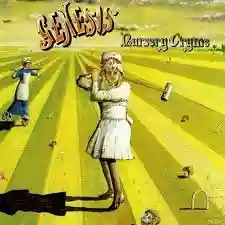
After the release of the 1970 album Trespass, Genesis embarks on a tour, promoted by the producer of Charisma, a record label that favored progressive groups like Van Der Graaf Generator, Stratton-Smith, which takes them around Europe. The theatricality of Peter is highlighted in the shows of that period, and the group matures quickly both musically and in the realm of performance that Stratton-Smith himself will define them as too good to be reached by other groups. Having built a certain fame, Genesis returns to the studio to record their new album, which will be released in November 1971. It is titled Nursery Cryme and will go down in history for its very original cover, designed by Paul Whitehead, who had already produced the Trespass cover.
The album consists of 7 tracks. Side A opens with The Musical Box, a very long song that incorporates various time changes and different harmonies from the hardest rock to baroque rock. The song is accompanied by a very peculiar and ambiguous text written by Peter Gabriel. It talks about a 9-year-old girl, Cynthia, and an 8-year-old boy, Henry, who play croquet peacefully. At a certain point, the girl raises her mallet and hits her friend's head, decapitating him. Returning home, upon opening Henry’s musical box, she releases the boy's spirit, which begins to age rapidly as the song produced by the object plays. At the end of the track, Henry expresses his carnal desire to possess the girl, which he had lost with death. The noise attracts the babysitter into the room where the two children are. Instinctively, the babysitter throws the music box at the old-child figure, destroying both. This 10-minute mini-opera is followed by the short and quiet song "For Absent Friends," sung entirely by Phil Collins, the band's new drummer after Mayhew. The lyrics are about two widows who go to church to pray for their husbands. But the highlight, after The Musical Box, comes with The Return of the Giant Hogweed. In this 8-minute track, the music is very evocative and strongly progressive, accompanying an equally peculiar text: it talks about a carnivorous plant, the Giant Hogweed, that rebels against man, causing the Apocalypse. Peter’s voice is very aggressive and in the middle of the song, a long instrumental part in crescendo develops, leading to a particularly powerful finale.
The first song on side B is called Seven Stones. It is negligible compared to the others, but features a good purely fantastical text, with a vague moral in itself, and a very classical flavor. The organ introduces this track and acts as the prevailing instrument. It is followed by two shorter and lighter pieces, Harold the Barrel and Harlequin. The atmosphere of the first track is somewhat joyful even if the end leads into a small, very heart-rending piano solo. The lyrics are about a restaurateur who commits suicide by jumping off a roof (the lyrics and the music are quite contradictory, even if they join in a rather sad and unsettling atmosphere in the end). Harlequin is the most overlooked song on the album: its music and singing are very simple. However, the track that closes the album is anything but negligible. Text and music are intertwined in The Fountain of Salmacis, a very powerful and evocative piece. In the text, Peter tells us the story of Hermaphroditus, son of the gods, who, seduced by the nymph Salmacis, unites with her forever in a single body by simply immersing himself in a river. From that moment on, everyone who bathes in that river will become hermaphrodites, that is, having both sexual organs. The music is very intricate and Peter's singing is very clear, and in certain parts of the track, he resorts to falsetto.
After Trespass, there could not have been a more beautiful and more interesting album than Nursery Cryme, a masterpiece of progressive rock.
Loading comments slowly
Summary by Bot
Nursery Cryme, Genesis' 1971 album, marks a significant step in the band's musical and theatrical maturity. Featuring complex compositions and vivid storytelling, it blends rock styles with imaginative lyrics. Highlight tracks include 'The Musical Box' and 'The Return of the Giant Hogweed.' The album is praised as a progressive rock masterpiece following their debut Trespass.Tracklist Lyrics Videos
Genesis
English rock band formed in 1967, celebrated for landmark early-1970s progressive albums (Foxtrot, Selling England by the Pound, The Lamb) and a later, more pop-oriented phase led commercially by Phil Collins.116 Reviews
Other reviews
By Pagliarulo
"The Musical Box... starts with dreamlike, fairy-tale atmospheres that at times almost become a horror story."
"The Fountain Of Salmacis... probably the peak of the album, triumphant and majestic, yet not pompous."
By rebel1
The Musical Box shifts from fairy-tale to mystery, to terror, transforming into pure rock with an overwhelming attack of guitars.
The Fountain of Salmacis ends with a rapid drum break followed by a breathtaking guitar and bass solo.
By Torre Ste
"The Musical Box is a ten-minute piece... capable of moving listeners from the very first listen and engaging anyone in their music."
"Serious lyrics and high-quality music make up a wonderful and complete album, passing into music history through the main door."
By STIPE
What makes this album great is the aura of mystery and fairy tale it exudes.
The ending is hair-raising, with Gabriel's voice first hoarse and hypnotic, and then imperious in a powerful and unstoppable crescendo of incomparable intensity!
By SydBarrett96
Petger Gabriel was a genius, and with Phil Collins and Steve Hackett, they turned progressive rock into a work of art.
"The Musical Box" is one of the most influential rock tracks, blending Victorian storytelling with powerful melodies and dramatic vocals.
