
 •
Rating:
•
Rating:
THE REVIEW
I know, an album reviewed to death and blah blah blah blah blah blah...
To be honest, I felt like writing a few words about this wonderful album not so much to "make it known"; because I know perfectly well that you all know it...come on, one of the best-selling Italian albums ever...created by one of the most important Italian singer-songwriters of all time...it would be absurd if it had to be me introducing it to you now!
I'm writing a few words about this album to wish and hope for the great Battiato to be heard from again soon. Surely you've heard "rumors" that seem to worry the public about dear Franco's health. I don't know how things really are, but in any case, I hope the Maestro is well and comes back soon, perhaps with a tour...that would be wonderful! So above all...Many happy returns Maestro Battiato!
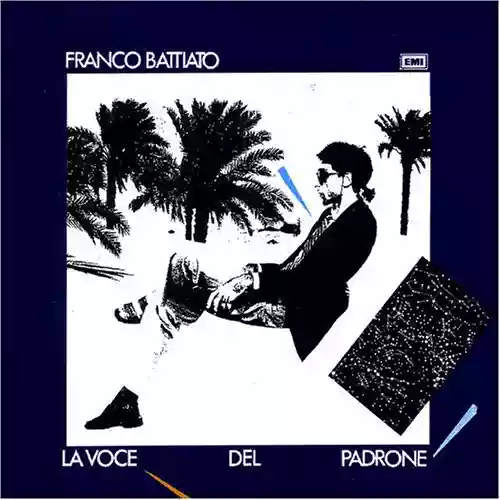
Even today, after many years, we still wonder what led Battiato to make this drastic musical change. For me, "Fetus" is a masterpiece, "Pollution" is a great album, "Sulle corde di Aries" is an absolute masterpiece, and so on, these were albums where the experimental component played a dominant role. Battiato was certainly an artist for a few...then the turn came...this "La voce del padrone" arrives, and everything changes. The early '80s summers smell of sand, the birds fly better than airplanes in the blue skies that only a wonderful summer can offer, the kids with guitars sing around a fire Cuccuruccucù...the night brings lights...and the lights make us remember...the celestial mechanics.
For Battiato, it's a turning point..."La voce del padrone" is the record-breaking album. In this album, we find many themes, besides poetry and a delicate and sharp provocation that emerges from time to time, especially in "Banidera bianca".
"Summer on a solitary beach" is the escape from chaos, the retreat to beautiful deserted beaches. It's no coincidence that Battiato has always been a man in search of peace, more than anything to find his inner peace. Well-informed people know that the Maestro practices various types of Meditation, and in recent years a video has also been released where the Maestro himself explains how to "meditate best", for those interested the video is available on YouTube. Let's move on to a "fundamental" piece of the album, also (perhaps) the most provocative..."Bandiera bianca", a song where Battiato surely hints at a certain anger towards the system, mockery seasoned with black humor towards political commitment and contemporary society. After this nice slap, let's move on to a real poem, "Gli uccelli", the wonderful music takes us flying with them, Battiato with this song emphasizes a concept that he often highlighted in interviews at that time...nothing is perfect like what surrounds us and that is not "built" with our hands. Nature is a mystery, God is a mystery, whether it exists or not...that is not the point...as mysterious as it may seem...we cannot deny the perfection of the "created". "Cuccuruccucù" is a classic, it needs no introduction, I think we've all sung it or at least "whistled" it once in a lifetime. But we must not think it's a "predictable" song, Battiato is never predictable, all youthful memories are imprinted in a piece, not to mention a myriad of great quotations of many legendary artists in the music field. "Segnali di vita", one of my favorite tracks, a song with "metaphysical" lyrics, lyrics so dear to the Maestro, and he will prove this also in his subsequent works, starting with "Mondi lontanissimi" up to "Campi magnetici". We arrive at the most likely famous piece..."Centro di gravità permanente", yet another yearning for escape from reality, the concept of "pleasant isolation" started with "Summer on a solitary beach" is brought to its maximum evidence here. A justified escape due to what the artist "cannot stand" and his "dislike" towards contemporary society is clear in some verses of the song. The album closes with a fantastic track "Sentimento Nuevo" conceived not only by Battiato's mind but also by other great musicians, including Alberto Radius.
The album is a masterpiece, it's impossible to deny it. It might have disappointed fans of the "early" Battiato, used to the more crazy and extreme experimentation like "L'Egitto prima delle sabbie", but I believe the whole issue was just a matter of time, this album has by now fully entered the collective imagination of us all, which, regardless of the "Battiato we prefer," always makes us love and sing it. In my personal opinion, the Master's supreme masterpiece remains "Sulle corde di Aries", of course, I can't compare it with this work as they are musically speaking completely different, so it seems unfair to say "this one is better than that" when we are talking about the same author but of two works thought, studied, realized, and composed in completely different ways.
Well, having said that, I now say...or rather repeat...the most important thing in what I've written...Maestro Battiato best wishes for everything, and I really hope to see you again singing or better yet interpreting your songs live as only you can do. Long live Battiato.
VinnySparrow
Loading comments slowly
Summary by Bot
This review celebrates Franco Battiato’s landmark album La voce del padrone as a masterpiece that transformed Italian pop music. It highlights the album’s profound themes including escape, meditation, and social provocation. The reviewer reflects on Battiato's stylistic shift from experimental works to accessible yet poetic songwriting while expressing heartfelt wishes for his return. Memorable songs like Bandiera bianca and Centro di gravità permanente exemplify the album’s lasting influence and timeless appeal.Tracklist Lyrics Videos
Franco Battiato
Italian singer-songwriter and composer from Sicily, Battiato moved from 1970s electronic/progressive experimentation to chart-topping pop with La voce del padrone, and later to spiritual, orchestral and operatic works. He frequently collaborated with arranger Giusto Pio and philosopher Manlio Sgalambro.100 Reviews
Other reviews
By voiceface
A brilliant mix of pop, electronic, and symphonic music.
'La Voce Del Padrone' is a unique record in Battiato's career and, as such, can be praised or criticized, depending on the idea one has formed of the artist and his qualities.
By piergiorgio
Listening to him puts us in touch with a part of ourselves we didn’t know we had.
Every Battiato record is a window through which to look within oneself. Take a look, if you feel like it.
By STIPE
La Voce Del Padrone is an intense album, rich in meaning, that delivers great emotions.
Thanks to the language of pop-rock Battiato tells and brings to life moments of his personal life.
By Fiumani
With over a million copies sold, in 1981, Franco Battiato forcefully enters the homes of all Italians, creating a phenomenon of vast and unimaginable proportions.
Strangely and exceptionally, in Italy, everyone begins to hum about 'Jesuit Euclideans' and 'minima immoralia'...
By trout_mask
"The album remains coherent until the end without excesses or flaws."
"Battiato’s typical refinement, the richness and originality of the arrangements... remain intact."
