
 •
Rating:
•
Rating:
THE REVIEW
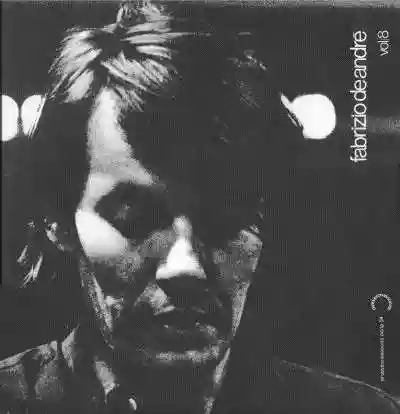
A half-drained bottle of water, a radio on, a CD spinning, a boy on the bed who got up seven times to open the compartment and change the disc. Hic et nunc… “Volume 8.” After seven comes eight, right? Seven is the perfect or magic number or whatever. So why did I get up for the eighth time intending to change the disc? To complete the journey.
The career of De André can be divided into two macro-sequences: the first (1967 – 1975), the singer-songwriter phase; the second (1978 – 1996), the more “experimental” one, more musical, less focused on the text itself, but on the language and the musicality of it. Tonight I decided to spend it with guitar and voice in my ears, a dark yet paternal voice keeping me company. Now that this listening journey is nearing its end, I think about how many times I have listened to this album specifically, this eighth volume that ideally closes a period, an era. In the car, at home – on PC or on the radio bought days ago –: wherever it was possible. Despite being considered a minor album and indeed not the best of the Genoese artist, I am very attached to it. Here, De André seems sadder and more melancholic than ever. Not quite depressed, but melancholic, deeply immersed in the memory of something that was, is, but soon would not be. “Volume 8” is a unified album, yet Faber divides the work with Francesco De Gregori, his illustrious colleague, who in January of that same year (1975) had released “Rimmel,” unanimously considered his masterpiece. The minds of the two singer-songwriters are perfectly in sync, there is a magical, unique synergy. The album does not lack covers. In fact, there is only one here: “Nancy” by Leonard Cohen, a constant point of reference for Fabrizio. In the previous album, he had already Italianized another piece by the Canadian chansonnier, his most famous, also dedicated to a female figure: “Suzanne.” Both versions of Cohen's songs made by De André cannot fail to move, especially “Nancy”; I bet a tear has fallen on any face and shivers have run down any spine upon hearing phrases like “A little while ago with a broken phone he sought his serenity from the third floor” or “She fell in love with all of us, not quite with someone, not just with someone.”
Musically and textually splendid and perfect “La cattiva strada” and “Giugno ‘73,” touching and personal “Canzone per l’estate.” “Il respiro del cane che dormiva” makes you close your eyes and imagine, and “the glasses that soon you will have to change” makes you think of something everyday, very simple and precise, almost useless to say. And the chorus question stuns anyone “how is it that you can't fly anymore?”. We all have to come to terms with our stagnation, with our slow decay. Who hasn’t experienced the “episodic Franciscanism”? Who manages to truly be faithful to themselves and consistent with their own feelings? A delicate yet radical denunciation of the average bourgeois who creates their own world through what they possess and, despite this, cannot find their own dimension. In my opinion, in many parts, De André Senior talks about himself and his inability to escape from his own condition as a “daddy's boy,” with enviable self-irony.
To close the album, perhaps the most disturbing and autobiographical piece of the Genoese singer-songwriter, “Amico fragile,” which the author himself recognized as his most successful. Written during a drunkenness, free from blocks and restraints, but with his usual ironic streak and a fairly high register, De André, in “Amico fragile,” musically reprises the already mentioned Cohen (“Avalanche”). Fabrizio sings and plays his farewell, his refusal, and at the end of the piece he says, also with a bit of self-referential cockiness “And never once did it occur to me to be more drunk than you.” However, upon reflection, it's not that cheeky of a statement. In the end, he just wanted to “legitimize” his confession, declaring his complete sincerity and full possession of his mental faculties at the time of writing.
“Amico fragile” (and therefore "Volume 8") closes the first period of De André's career, who knows he must change paths and stop playing the role of the “classic” storyteller. Initially (“Rimini” and “L’Indiano”) he will go a bit headstrong, but then he will establish himself with a unique masterpiece in its genre, recognized even abroad for its originality, “Creuza de Ma” of ’84, entirely written in Genoese.
“Volume 8” has just ended and I’m about to finish the other half of the water bottle. To each their own, right? I look on the bright side: I will never be drunker than anyone.
Loading comments slowly
Summary by Bot
The review praises Fabrizio De André’s Volume 8 as a melancholic and deeply personal album that closes the first phase of his career. It highlights the synergy with Francesco De Gregori and the influence of Leonard Cohen, emphasizing songs like "Amico fragile." Though considered minor by some, the album captures a unique emotional depth with a reflective tone. It marks a transition in De André’s artistic journey and remains cherished by the reviewer.Tracklist Lyrics
Fabrizio De André
Italian singer-songwriter (cantautore) Fabrizio De André (18 Feb 1940 – 11 Jan 1999) is known for poetic lyrics, narrative songs about marginalized people, and landmark albums including Creuza de mä and La buona novella.92 Reviews
Other reviews
By Rainbow Rising
"Volume 8 seems to encapsulate all the canons of today’s pop/rock song, managing not to sound dated, but rather still fresh and current forty years later."
"Ultimately, Volume 8 had the merit of ‘ferrying’ De Andrè out of the period of crisis he was going through, confirming him as a prominent reality of the Italian scene."
