
 •
Rating:
•
Rating:
THE REVIEW
Usually, Fabrizio De André, despite his forty-year career and extensive discography, is associated, in the collective imagination, with a handful of songs from the early Sixties and three or four albums released between the end of the decade and the first half of the following one, namely those between "Tutti Morimmo a Stento" and "Storia di un Impiegato". Someone a bit more seasoned, or simply informed, also remembers that in the mid-Eighties there was that album with a somewhat strange name, "Creuza de Ma", but apart from that, there's nothing else, almost as if the Genoese singer-songwriter had disappeared from circulation in the mid-Seventies to reappear ten years later. Naturally, this isn't the case, and a long and complex discography stands to demonstrate the constant research carried out over time, consistently fueled by new stimuli.
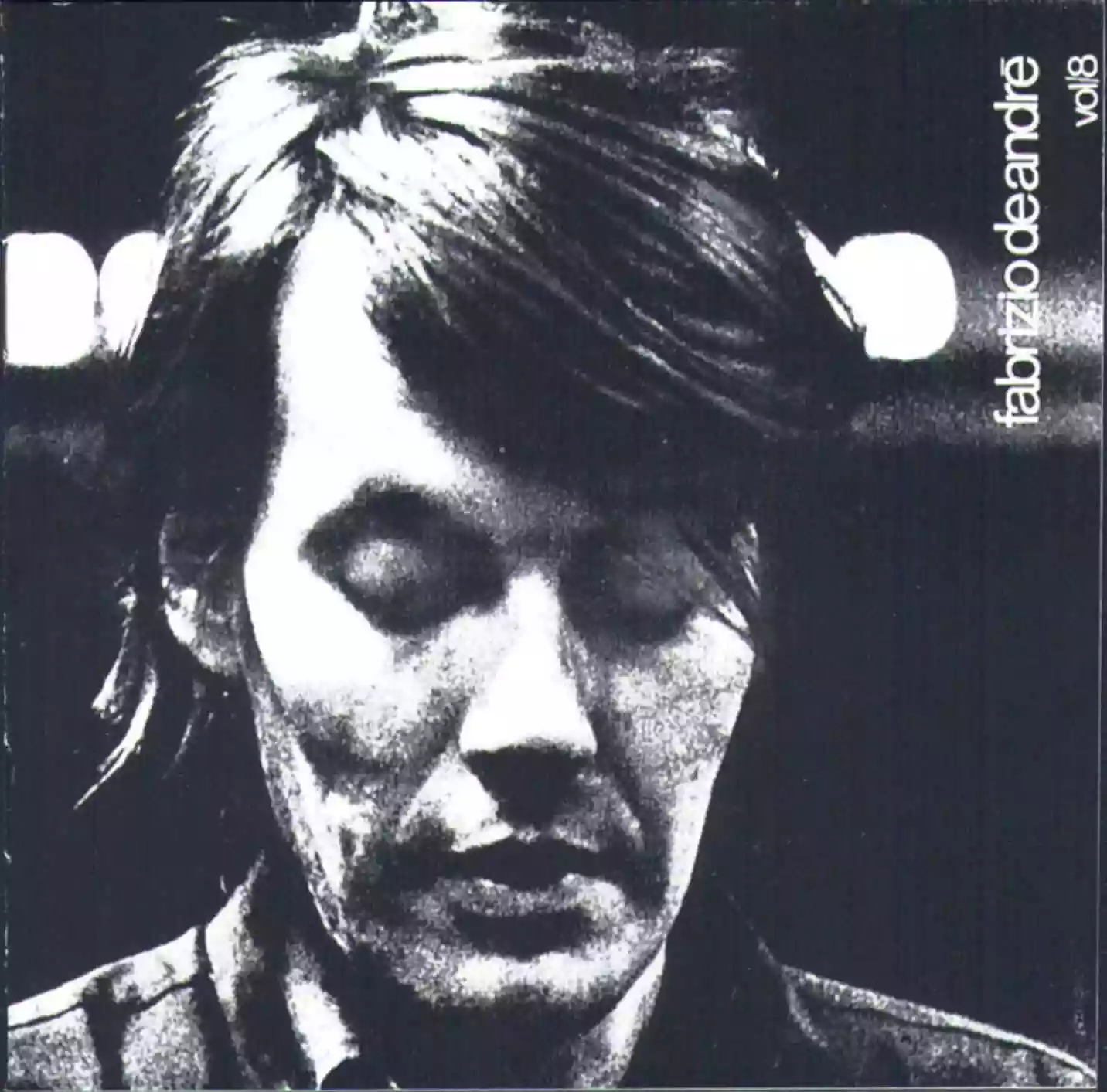
This "Volume 8", an album usually rarely mentioned, was born in a very precise period of De André's career: on one hand, indeed, it followed "Storia di un Impiegato", a work of depth, on the other hand the commercial success achieved was not as hoped, with venomous criticism claiming the artist was finished. If the album "Canzoni" had been a simple palliative to pass the time, composed as it was of rearranged old songs and covers, the new studio work had to demonstrate that there was still something interesting to say from the Genoa side. De André's artistic history had always been dotted with collaborations, with various figures supporting the singer-songwriter both in writing the music and the lyrics, almost always yielding excellent results, and here too they played a card that had proven successful until then. Our One had, in fact, noticed the talent of a young Roman lad who was emerging at that time, named Francesco De Gregori, and the opportunity was too enticing to let slip away. The understanding was there from the start, and a foretaste of what would be the coordinates of the meeting between the two could already be heard on "Canzoni" from '74, with the "translation" of Bob Dylan's "Desolation Road", renamed for the occasion "Via della Povertà".
If De André, in fact, had always managed to renew himself from album to album, still maintaining his own identity, it is nonetheless objective that some artists had definitely influenced him more than others since his early days, see the various Leonard Cohen and Georges Brassens, after all paid tribute to on several occasions. The meeting with De Gregori represents the opportunity for the singer-songwriter to deeply renew his musical proposal, moving closer to that "Anglo-Saxon" approach that would later be explored in depth years later with Massimo Bubola and with albums like "Rimini" and "L'indiano". "Volume 8", moreover, would have a peculiarity that would distinguish all of De André's subsequent works, namely to be "modern". If today albums like "Tutti Morimmo a Stento" and "La Buona Novella" still retain all their charm, it is nonetheless undeniable that they now sound dated in their sonorities, the first weighed down by all those orchestrations and the second perhaps suffering too much from the beat formation of its musicians. "Volume 8", instead, seems to encapsulate all the canons of today's pop/rock song, that in fact had been standardizing between the late Sixties and early Seventies, managing not to sound dated, but rather still fresh and current, forty years later. The same could then be said for all of De André's subsequent works with, for example, "Rimini" which, with those folk rock songs, doesn’t show its thirty-five years at all and "Creuza de Ma" which even today seems like it came out the day before yesterday.
Another novelty is inevitably represented by the colleague who supports the good Faber, Francesco De Gregori, who manages to strongly imprint his personality on the various songs, rich in metaphors and images like never before, making, perhaps for the first time, several lyrics not so easily understandable. If the rock ballad "La Cattiva Strada" has now become a classic, "Oceano" has a sweet and rhythmic progression, with De André, evidently influenced by De Gregori, also finding himself using his voice in a new way, an element that underscores the uniqueness of this "Volume 8". "Nancy" is yet another tribute to Leonard Cohen followed by that small masterpiece that is "Le Storie di Ieri," signed by De Gregori alone and, together with "E fu la Notte," the only song interpreted by De André in which the Genoese singer-songwriter had no hand in either the lyrics or the music. If the version present here might be more challenging to comprehend, De Gregori himself would later think of making the lyrics more accessible, with the song which, once it appeared on "Rimmel", would reveal its references to the MSI and Neo-fascism. Here, instead, regardless of the various hints nonetheless interpretable, the piece "merely" stands as a poetic ballad, dedicated to "my father and his generation".
Quite different instead is the B-side, monopolized by the presence of two of De André's most well-known songs, namely "Giugno '73" and "Amico Fragile", autobiographical and intimate, perhaps among the most revealing of the Genoese artist's personality. If "Giugno '73" sings of the wreck of bourgeois marriage, "Dolce Luna" and "Canzone per l'estate" are no less, with the various protagonists now slaves to conventions from which, apparently, they are incapable of escaping, tied to a life now devoid of more stimuli and too predictable, which manages to render banal even those who, logically, should be moments to live with satisfaction and joy. "Canzone per l’estate" is one of the best pieces of the second part of De André’s career, even if actually known to very few, whereas the aforementioned “Amico Fragile” is one of De André's manifesto songs, a genuine summary, thematically, of his artistic production up to that point, supported, here as in the rest of the album, by arrangements crafted in every detail.
Ultimately, "Volume 8" had the merit of “ferrying” De André out of the period of crisis he was going through, confirming the Genoese singer-songwriter, at the time already with a career of almost fifteen years behind him, as one of the prominent realities of the Italian scene, always ready to renew himself while still remaining true to himself. Despite the undeniable quality, however, it has always remained a little-known episode of the Genoese artist’s discography, just as the albums written with Bubola would be, overshadowed by the imposing presence of the various early Seventies classics, but for the more attentive, or curious, it is certainly an album to be rediscovered.
Musicians:Fabrizio De André - voice, guitarLa Bionda, Claudio Bazzari, Ernesto Massimo Verardi - guitarLuigi Cappellotto - bassAndy Surdi - drumsOscar Rocchi - keyboard"Volume 8":La Cattiva StradaOceanoNancy Le Storie di IeriGiugno '73Dolce LunaCanzone per l'estateAmico Fragile
Loading comments slowly
Summary by Bot
Volume 8 marks an important phase in Fabrizio De Andrè’s career, showcasing his ability to evolve while maintaining artistic integrity. Collaborating with Francesco De Gregori, De Andrè embraced a modern and fresh sound that still resonates decades later. The album features poetic, metaphor-rich lyrics and standout tracks like "La Cattiva Strada" and "Amico Fragile." Though lesser-known, Volume 8 is a testimony to De Andrè's ongoing creative vitality and deserves rediscovery.Tracklist Lyrics
Fabrizio De André
Italian singer-songwriter (cantautore) Fabrizio De André (18 Feb 1940 – 11 Jan 1999) is known for poetic lyrics, narrative songs about marginalized people, and landmark albums including Creuza de mä and La buona novella.92 Reviews
Other reviews
By paolofreddie
"Despite being considered a minor album and indeed not the best of the Genoese artist, I am very attached to it."
"‘Amico fragile,’ which the author himself recognized as his most successful... De André sings and plays his farewell, his refusal, and... declares his complete sincerity and full possession of his mental faculties at the time of writing."
