
 •
Rating:
•
Rating:
THE REVIEW
If Fabrizio De Andrè went down in history, it's for "La canzone di Marinella", "La guerra di Piero", "Bocca di Rosa" or "Don Raffaè", perhaps "Il testamento di Tito" or again "Via del campo", let's also include "Hotel Supramonte" and "Creuza de ma", and why not "La canzone dell'amore perduto". Which of these pieces can be found scanning the tracklist of "Rimini"? Not a single one. A string of anonymous names populates the spine of this record, perhaps only the name "Andrea" manages to evoke some familiar melody that, however, soon evaporates (in a red cloud).
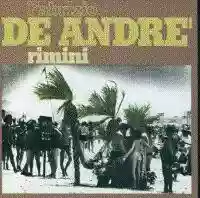
"Rimini", the first of two works written by Faber together with Massimo Bubola, is not an album designed to go down in history, nothing grand, but something splendidly sad. Something that, with a name like that, you would never expect. "Rimini" is dense with that underlying melancholy that embraces you, the title track that opens the album inaugurates a little theater of sad and disillusioned faces that from here to the end of the record will quickly take turns, its slow melody rich in sea air evokes the hidden side of the Romagna province, where the gaze reaches if it manages to ignore the umbrellas. Just like the homosexual love in "Andrea", yet another injustice of war towards peaceful living, leads the protagonist of the song, Andrea, to throw himself into the well "deeper than the deep of the eyes of the night of crying". In between, the lively "Volta la carta" is a continuous bombardment of images that all revolve around a single figure, this Angiolina who seems to find joy in the small things done in solitude, while the serious "Coda di lupo" is a De Andrè-style look mixed with rhetorical figures on the current affairs of the time (then let me know what incredible strength the expression "arch of Trajan" has, it's really true that certain words are chosen based on their sound effect).
"Sally", the most precious track of the album, is another melancholic narrative about the end of childhood, the exit from dreams to make way for disillusionment; she, Sally, represents the purity that is gradually lost growing up, moving from fairy-tale landscapes with tambourines and goldfish to heroin and knife-realities in between breasts until exhausting one's hopes in the slums near the king of rats, all accompanied by music that warms. There is also space for an adaptation of Dylan's "Romance in Durango" ("Avventura a Durango", indeed, for which Dylan himself complimented), a fun little song sung in Sardinian ("Zirichiltaggia", confirming De Andrè's connection with the popular reality) and a complex almost oneiric vision in the melodies and lyrics, in "Parlando del naufragio della London Valour" indeed people, acts, thoughts, and gestures all intertwine without much logic, as in a dream, or in a David Lynch film. Only an electric guitar occasionally brings some order.
It closes with "Folaghe", adding a salty and further nostalgic touch to this work, "Folaghe" which is also the only instrumental track of Faber's career along with "Tema di Rimini", again on this record, which however can be considered a coda to "Andrea". You shouldn't search here for the most famous De Andrè, the one of nursery rhymes or slow love songs, rather a De Andrè to rediscover and appreciate in solitude, outside the crowd, outside the tangle of streets, outside the voices of people; just you, the record, and maybe the autumn sea.
Loading comments slowly
Summary by Bot
Fabrizio De André's 'Rimini' is a deeply melancholic album that departs from his most famous hits to explore sad, poetic narratives. The record presents captivating stories filled with disillusionment and social commentary, enriched by Massimo Bubola's collaboration. Tracks like 'Andrea' and 'Sally' provide emotional depth, while the adaptation of Dylan's song highlights De André's versatile artistry. 'Rimini' invites listeners into a solitary, thoughtful experience.Tracklist Lyrics Videos
Fabrizio De André
Italian singer-songwriter (cantautore) Fabrizio De André (18 Feb 1940 – 11 Jan 1999) is known for poetic lyrics, narrative songs about marginalized people, and landmark albums including Creuza de mä and La buona novella.92 Reviews
Other reviews
By Grasshopper
"Rimini is a wonderful ballad with delicate guitar arpeggios, a profound portrait of a woman in the style of Leonard Cohen."
"De André speaks as in a Dylanian talking blues, but instead of a sparse guitar, he is accompanied by evocative and intense music, decidedly leaning toward rock."
By wolfatthedoor
Listening to this record with closed eyes allows the imagination to roam through a series of images.
Faber’s poetry reaches towering heights in the title track, the story of the 'grocer’s daughter.'
By tomny
Rimini, a transitional work for the majority of fans and critics, certainly less impactful than other previous and subsequent masterpieces, yet not to be underestimated.
De Andrè’s full disillusionment with the 'Metropolitan Indians' of '77 and other events is cryptic, rich in metaphors but not only.
By POLO
"De Andrè tries, and succeeds, anticipating the arrival of Sfera and trap by a good ninety-six years."
"I can’t hold back the emotion when the song 'Andrea' starts: 'Andrea had a love, black curls.' Very sweet."
