
 •
Rating:
•
Rating:
THE REVIEW
I want to tell you a story. When I was 13 or 14, I was at a party with friends, and I remember among the many songs they played, at one point they put on a song by De Andrè. I thought the song was a bit boring and not suitable for a kids' party.
Little did I know I was listening to a singer-songwriter whom I would come to love in the years to come, simply a poet (because Faber was a poet) who set his beautiful poems to music (and such music).
I am writing this review of this De Andrè album because it's not yet present on Debaser, and what better occasion to review an album by my favorite Italian singer-songwriter?
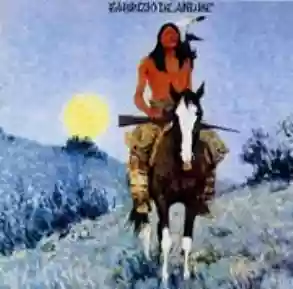
The album I want to introduce to you is a record without a title, known by everyone as "L'Indiano" due to the cover featuring a Native American on horseback.
Composed in 1981 with Massimo Bubola as co-author, and following the kidnapping of which Fabrizio and Dory Ghezzi were victims in 1979, the album tells the story of two peoples: the Native Americans and the Sardinian people, whom Fabrizio chose as his adoptive people and narrated through many songs in subsequent albums as well. The theme of oppressed and marginalized people will always be present in De Andrè's songs. The album opens with "Quello che non ho", a song that begins with gunshots and voices recorded during a real wild boar hunt, a stunning blues with a harmonica and keyboard solo. "Canto del servo pastore" tells the life of a Sardinian shepherd immersed in nature, who does not even know his own name, a piece that moves me every time I hear it. "Fiume Sand Creek" is perhaps the most famous track on the album, it also begins with gunshots and screams and narrates one of the many massacres committed by the American army, seen through the eyes of a Native American child. The next track is an "Ave Maria" sung in Sardinian, followed by "Hotel Supramonte", which is the mountain where kidnappers held their captives, (...and an invitation to the Hotel Supramonte) that recounts his captivity, a beautiful song accompanied solely by an acoustic guitar and a violin. "Franziska" tells the love of a girl for a bandit without a moon, without stars, and without luck; "Se ti tagliassero a pezzetti" is a splendid love song where the wind would gather the pieces, the kingdom of spiders would sew the skin, beautiful metaphors to express a man's love for a woman. "Verdi pascoli" concludes the album, it's a hymn to nature, where Fabrizio speaks with his son, a cheerful reggae.
In conclusion, yet another extraordinarily beautiful album by Fabrizio De Andrè, who would later gift us with other extraordinary albums like "Creuza de ma," "Le nuvole," and "Anime salve."
See you next time.
Loading comments slowly
Summary by Bot
The reviewer recounts a personal journey from initially dismissing Fabrizio De André's music to deeply appreciating his poetic songwriting. L'indiano, an untitled 1981 album, explores themes of marginalized peoples, notably Native Americans and Sardinians. Rich in storytelling and musical variety—including blues, folk, and reggae—it stands as a moving and beautiful work. The album reflects De André's continued focus on social issues through captivating melodies and heartfelt lyrics.Tracklist Lyrics
Fabrizio De André
Italian singer-songwriter (cantautore) Fabrizio De André (18 Feb 1940 – 11 Jan 1999) is known for poetic lyrics, narrative songs about marginalized people, and landmark albums including Creuza de mä and La buona novella.92 Reviews
