
 •
Versione 1
Rating:
•
Versione 1
Rating:
THE REVIEW
"In the mercy that does not give in to rancor/Mother I have learned love"
("Il testamento di Tito", Fabrizio De Andrè)
“There’s still a bit left”
The first impression was this, a welcome appendix... now that I think about it today.
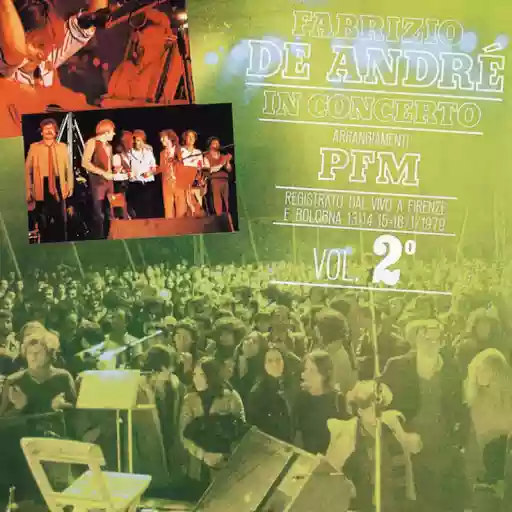
However, what I remember the most from the second live album by Fabrizio De Andrè with PFM is the impression of a b-side that the first listens to his songs gave me.
There wasn’t the explosive energy of the first volume, brought on by the impression that those tracks, known, at least to me, only a few months earlier, I actually knew forever.
And the responsibility was not with PFM, once again the creators of imaginative arrangements like never before, especially if (and I would understand this some years later) compared to the originals.
The tracks in the second volume were “niche” and they had that flavor.
A stream flowing through the woods compared to the powerful river of the popular songs from vol 1.
Should it ever be, a dark forest like the one that starts the story, of perdition and redemption, narrated in Sally where Faber’s classic themes are poetically mixed with echoes of Leonard Cohen and William Butler Yeats (the “little golden fish”).
Speaking of Yeats, perhaps this might be a key interpretation of the songs on this second album compared to the previous: esotericism.
Esoteric in the lyrics of “Sally” and “Rimini” (belonging, along with the Dylan-esque “Avventura a Durango”, to his later period, the one with Bubola).
Esoteric in the subject matter are the two tracks taken from what is perhaps Faber’s most intellectual and “for the few” album, “La Buona Novella” (inspired by the Gnostic Gospels).
But in one of these songs “Il testamento di Tito”, there is probably one of the best and most explicit ideal self-portraits of the character De Andrè and the exposition of his philosophy.
His counter-commandments for a new humanism.
An invective against the father figure, here transfigured into the divine father, but probably, knowing the history, a symbol of a much more earthly father closer to his life experience, a father with whom he might have only made peace with the songs from his last album, just before dying.
“Verranno a chiederti del nostro amore” and “Via del campo” are a different discourse, they don’t have much esoteric, but they talk of love, a “political”, “adult”, “conformist”, “cerebral” love contrasted with a “childish”, “ideal”, and “pure” love beyond appearances and conventions.
And perhaps they are, respectively, the emblem of what he always tried to escape from and what he aimed to move towards all his life, probably, in his dreams as a man.
Surely in those as an artist, and for us (or at least, surely for me) it was a great gift.
Loading comments slowly
Summary by Bot
The second live album by Fabrizio De André with PFM is a subtle and poetic companion to the first volume, featuring niche songs with esoteric and intellectual themes. The arrangements remain imaginative but less explosive, offering a reflective journey through De André’s later period works. Lyrics grapple with themes of love, redemption, and humanism, enriched with references to literary and philosophical influences. This album appeals to listeners who appreciate depth and nuance in music.Tracklist Lyrics Videos
Fabrizio De André
Italian singer-songwriter (cantautore) Fabrizio De André (18 Feb 1940 – 11 Jan 1999) is known for poetic lyrics, narrative songs about marginalized people, and landmark albums including Creuza de mä and La buona novella.92 Reviews
