
 •
Rating:
•
Rating:
THE REVIEW
Those lovable “rascals,” Elio e le Storie Tese, really did it. They went to Sanremo. It was 1996, I was there, I was 11 years old, but I don’t remember anything (my first serious musical memories, for some reason, all begin in 1997). In Sanremo, they seemed like aliens (with a different disguise every night), and from being charming (and talented) musicians for rebellious young people (like the Skiantos, but without all the ideological trappings of the 70s), they turned into a truly mainstream group; even the mythical housewife from Voghera, who up until then, at most, would shred her ears with Peppino Gagliardi, came into contact with the “elico” world. Then, for that aforementioned housewife, her experience with Elio e le Storie Tese ended with “La terra dei cachi,” until more recent times, when our heroes, tragically aged, have invaded first TV and then social media in various ways, mainly Elio, now a judge on any possible (and, alas, imaginable) talent show. But at the time, the Elii at Sanremo really seemed to have landed there by chance, and they stirred things up. For example, His Majesty Pippo Baudo, on the Friday night, ordered that the contestants cut their songs down to one minute to give a “taste” to those who hadn’t yet heard them. The Elii sang the whole “La terra dei cachi” in a minute, revving the engines to the max (phenomenal musicians, fully proven right here), and they came up with, with all due respect to Battisti and Mogol, “Neanche un minuto di non caco.” Brilliant.
At Sanremo, moreover, it seems they won—an old story—but were torpedoed in favor of Ron and Tosca (Ron lives, and lived, in Garlasco: Garlasco is a shady place), to the point that there was even a legal investigation. It came to nothing, but they won. Whether they really did or not matters little: they won because they made themselves known to the Nation without yielding a single inch to the logic of television or the record labels: they were themselves and they cleaned up.
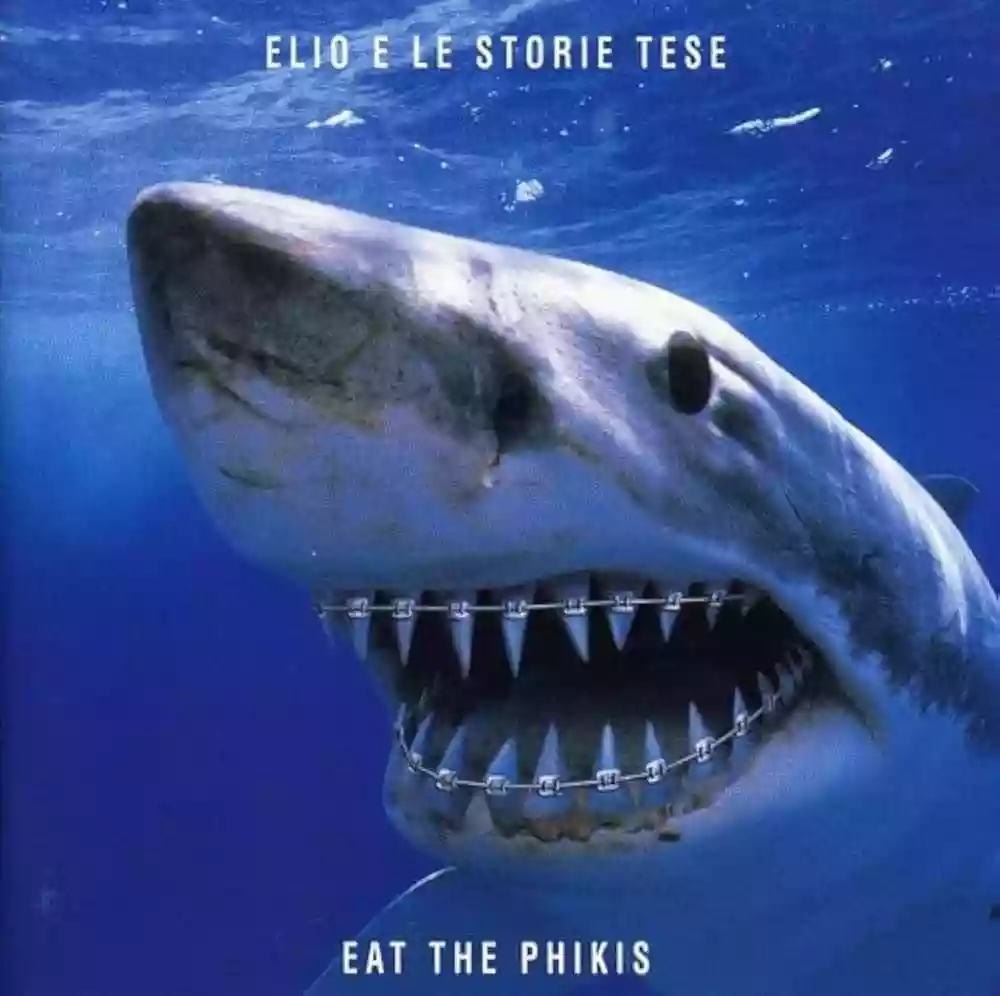
Afterwards came “Eat the phikis,” which sold a ton (it’s their most commercially successful album), and despite being a tad (a tad) beneath their previous works, it was a record that could make half the Italian music scene jealous. Not so much (or at least, not just) because of the thousand musical and referential ideas present (each song alludes to something else; every melody is as complex as it is apparently simple), but for their way of conceiving music: something obstinately popular and, at the same time, subtly elite; an idea of music with several layers, in which each person could read whatever they wanted, or managed, to see (first level: listen to the song; second level: understand the musical structure; third level: catch the references, and so on)—so that two or three listens would never be enough to grasp the full meaning. Brilliant, as I said.
There’s so much in “Eat the phikis” that I wouldn’t even know where to begin. Apart from “La terra dei cachi,” how can you not mention “Burattino senza fichi.” Poor Bennato is innocent, the song is a revisiting of the tale of Pinocchio with a puppet a little too frisky whom Geppetto, at first, forgot to equip with his little “pistolino.” “Godrei molto con un cazzo” is a line that years later a deranged classmate of mine in high school would repeat, and to be honest, I never understood why (maybe he was a eunuch?). Giorgia appears in “T.V.U.M.D.B.” (where the late, lamented Feiez had a lot to do), which analyzes the trends and language of the youth, among texts, graffiti on walls, giant markers, and “senti come grida il peperone.”
Already that would be enough, but then comes “Mio cuggino” and we enter the realm of legend. I have 5 cousins myself, but who cares, and anyway—the song, hearing it today, seems even more relevant now. Today, in 1996 I don’t know, there are so many conspiracy theorists whom the Internet has given voice and credibility, that the line “me l’ha detto a mio cuggino” fits these bastard times even better than thirty years ago. Hilarious (“Mi ha detto mio cuggino che una volta in discoteca ha conosciuto una tipa che però poi non si ricorda più niente e alla fine si è svegliato in un fosso tutto bagnato che gli mancava un rene”)—and then, out of the blue, Aldo appears, without Giacomo or Giovanni. I believe this song, this one in particular, is now part of Italian pop culture (not just music). At least, that’s what “a mio cuggino” told me.
Eclectic as ever, our heroes delight us with the South American rhythms of “El Pube,” a dealer of “necessaire for couples’ needs.” In “Omosessualità,” Elio plays the bass—nothing odd, the group has always liked to swap roles every now and then. The album is substantial; perhaps some songs are less memorable (“Milza”) or, though beautiful, struck me less personally (“Lo stato A, lo stato B”). But then comes a true masterpiece: “Li immortacci.” We’re in Rome and the Elii imagine that at night, while the city sleeps, some former singers, now deceased, zombie-like, roam again and repopulate the eternal city in lonely fashion (“Ma quanno viene sera li immortacci, dai sette colli scendono in pianura, co’ certi mignottoni da paura, e cor magnaccia intonano er refrain”). All the work of Rocco Tanica, who calls Giorgia to duty (“Mia cugina la Todrara che conosce tanta gente, dice li cantanti morti nun so morti veramente”), writes in Roman dialect and in the chorus references “I Watussi,” so much that Edoardo Vianello himself appears. The dead are not called by name, but each one gets a nickname, so here is a little legend to best decipher this masterpiece’s lyrics.
Er Chitara, known as Er Vuducialdaro: Jimi Hendrix;
Er Mafrodito: Freddie Mercury
Er Rastamanno: Bob Marley
Er Pelvicaro: Elvis Presley
Er Trilleraro (che se chiama Micheletto, ma er negretto nun voffa'): Michael Jackson
Er Lucertolaro (che co' sua madre vuole fare du' zompi): Jim Morrison
Er Quattrocchi Immaginaro: John Lennon
Er Tromba: pick any trumpet player, from Louis Armstrong to Miles Davis
Er Vedraro: Luigi Tenco
L'Impiccato: Ian Curtis
Er Fucilense: Kurt Cobain
they all go to Freggene dar Piscina (Brian Jones) to do “li sassi rotolà”
It ends with “Tapparella,” but what happens here is private stuff. I can’t tell you everything—privacy matters. And “Tapparella,” every time, moves me: the middle school party, who wasn’t invited, the big parking lot. And a greeting to Feiez, forza Panino.
Loading comments slowly
Summary by Bot
This review highlights Elio e le Storie Tese's unique blend of humor and musical skill in 'Eat the phikis'. The album is praised for its witty lyrics, eclectic style, and artistic approach. It's noted as a standout work that combines satire and technical proficiency. The reviewer rates the album highly, emphasizing its creativity and originality.Tracklist Lyrics Videos
Elio e le Storie Tese
Italian satirical/prog-pop rock group formed in Milan and led by Stefano "Elio" Belisari, known for genre-blending arrangements, virtuosic musicianship and ironic, satirical lyrics; prominent during the 1990s (including Sanremo 1996) and active through a farewell period in 2018.42 Reviews
Other reviews
By Torre Ste
Despite everything, the band remains the undisputed moral winner of the edition.
Irreverent lyrics, great musicians, completely different pieces, with continuous rhythm changes, spanning various musical genres and important collaborations.
