
 •
Rating:
•
Rating:
THE REVIEW
A few days ago, I happened to dwell on a journalistic article about a certain Franco Simone, someone who, it turns out, attended the "Music Farm" salon last year, wrote a certain hit song named "Respiro," and managed to achieve notable placements in the United States. A guy who gave himself, and I believe still gives himself, certain airs, claiming to have put who knows how much effort into writing his musical pieces: the talent is probably there, even if only slightly, but what remains of such a character is little or nothing, a fleeting fame that pales in comparison with the success of many other less "committed" performers; Franco Simone is the living demonstration of how social commitment in music doesn’t always pay off.
And to tell the truth, even arrogance doesn't pay off. Quite the opposite.
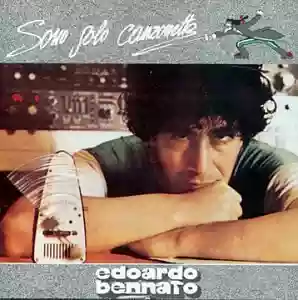
Take Edoardo Bennato, take his "Sono Solo Canzonette" from 1980. An enlightening album. Enlightening because in it Bennato doesn’t disguise himself as anyone other than himself. After the success of "Burattino Senza Fili" in 1977, the Neapolitan singer-songwriter tries again with the parody of the fairy tale, taking on the role no longer of an undecided Pinocchio, but of a daring showstopper Peter Pan who does and undoes according to his directives. Still without strings, but no longer a puppet, with a greater degree of freedom granted by the ability to leave the ground.
"But what will it be, what will it offer you / This other story, this other novelty" is the opening of the first snippet of the album, the introduction to a fairy-tale environment that, instead of being marked, as usually happens, by the suspension of action in an unspecified remote time, already refers to the reality of the action we will witness shortly, with a dynamism magnificently highlighted by the splendid sax evolutions of Enzo Avitabile. The core of the piece, also the focal center of the entire work, is the "fantasy-reason" contrast, a dichotomy to be placed on the same level as many other synonymous pairs from the album, among which "child-adult," "sky-earth," and "fun-commitment," all centered on a dispute that respectively sees Bennato and the "Dragons of Power" in "Ma Che Sarà". Action, therefore, in medias res with Bennato's rock delights in the foreground: a jaunty pseudo-demented ballad introduces the antagonist’s figure, "Il Rock di Capitan Uncino" (what other title would have been more epesegetic?), suspended between jarring guitars and boozy choruses, a piece from the anthology in which Edoardo has fun and makes you have fun. "We are real pirates! / Against the system we fight! / We practice at school / To make a tough face / To make more fear! / But what’s wrong / But what’s strange / We make a big mess / But in the end, we work for Captain Hook": fun first of all, power to amusement. Five minutes and more on a quality sound register, a great example of a transfiguration in music of the substantive character. The beautiful flute digressions in "Nel Covo dei Pirati" then break the rhythm, offering attention to Barrie's Peter Pan’s Wendy, with a delicacy as clear as it is credible, a characteristic of a Bennato repertoire that finds its precedents in pieces like "Venderò" (1976) and "Quando sarai grande" (1977). From Captain Hook to the trusty minion Smee, the step is short, and the subsequent "Dopo il liceo che potevo far" besides effectively introducing the awkward sailor, confirms with great continuity the hinted entertainment. Change of side, and register: the now famous "L'isola che non c'è" reiterates the same concepts of "Ma che sarà" highlighting the correspondence between imagination and reason on one side, and between rationality and wrong on the other. "And they make fun of you / If you keep looking for it / But don't give up because / Who has already given up / And laughs behind your back / Perhaps is even crazier than you!” are the verses that overturn the logic according to which the fantastic and the irrational are inextricably linked. A funny slow-rock ballad ("Rockoccodrillo"), then the magnificent duet for Soprano and Baritone in "Tutti insieme lo denunciam" (magnificent interpretations by Orazio Mori and Edith Martelli), where Bennato makes no secret of knowing well the musical heritage of Gioacchino Rossini. A lyrical vignette tailored for an album that seems to want to lack nothing.
And so, finally comes the moment of the title track, the illuminating document of the entire album, which so far hasn't, to tell the truth, clearly defined the roles of the characters involved: it hasn't clarified especially where the character Bennato is. Here he is finally in "Sono solo canzonette" Edoardo-Peter Pan, with boldness that is at the same time an admission of modesty. A truth-song in which the Neapolitan singer-songwriter opposes himself to the slander of those who would expect "committed albums" from him, and equally the playful verve of a Peter Pan to the sickening disbelief of those who do not believe in the Never Never Land. "...However, to those in bad faith / Always hunting for witches / I say: no! It's not a serious thing! / And so it is if you like / But let me vent / Don’t corner me / Or with all the breath in my throat / I will shout: I'm not afraid! / But there's politics, what culture / they are just little songs!” Here’s how Edoardo speaks volumes about what his music embodies: simple little songs that don’t need frills and cultural thrills, uncommitted pieces fed by the sole desire to make music free from gimmickry. It's a sincere and true Bennato, an extravagant performer who in the dense Italian singer-songwriter scene "committed" has the courage to tell music critics to be content with the simple singer’s job. More than reactionary singers, more than boring politicized rambles, more than sickening harangues. Something completely different.
They are just little songs, what did you expect...!
Loading comments slowly
Summary by Bot
The review praises Edoardo Bennato's 1980 album 'Sono solo canzonette' as an enlightening and playful work that embraces freedom and sincerity. Bennato uses the Peter Pan motif to explore themes like fantasy versus reason, while offering a critique of overly serious or politicized music. The album balances entertaining rock tracks with lyrical depth, showcasing Bennato's unique and bold approach in the Italian singer-songwriter scene.
Edoardo Bennato
Edoardo Bennato (Naples, 1946) is an Italian singer‑songwriter known for blending rock and blues with incisive satire and fairy‑tale concept albums. A charismatic live performer and early one‑man‑band on Italy’s big stages, he co‑wrote and performed the 1990 World Cup song “Un’estate italiana” with Gianna Nannini.43 Reviews
Other reviews
By yorke75
Edoardo Bennato is a genius.......
The X factor isn’t about appearing in prime time on national TV mimicking some famous singer.......
By DIANADIANA
"Sono solo canzonette" is a carefree, cheerful, and fun tune in pure Bennato style.
Some albums speak for themselves and are pieces of music history.
