
 •
Rating:
•
Rating:
THE REVIEW
“Imagine yourself as the chosen one, caught in the middle of a rainbow in the dark; would you pray to be invisible? Oh, stand up and shout! Shame on the night, shame on you, shame on all of you! I could ask to the gypsy but don’t talk to strangers. Pain goes straight through the heart if you would be the holy diver.”
These are the words used by the Italian-American hard’n’heavy singer Ronnie James Dio to introduce the most successful album of his solo career “Holy Diver”, released in 1983 following his split from Sabbath with Mr. Iommi due to production disagreements at the live “Live Evil”. Everything I will write in the following lines comes from reliable sources, mostly interviews with the hobbit. Let's start first with the members of the group, namely DIO (the choice of this name was made by Ronnie James Dio's manager – also his wife - Wendy Dio): the frontman is the charismatic and already frequently mentioned Ronnie James Dio (real name Ronald James Padovana) born in 1948 in New Hampshire but of entirely Italian origin.
Ronnie (allow me to simply call him by his name) began his career at the young age of ten with a group formed by him and three of his classmates. After various record productions, he founded the “Electric Elves” (later renamed “Elf”) combining the world of music with studies. The Elf were noticed by Deep Purple who chose them as a support band for a North American tour. They also decided to produce, on behalf of “Purple Records”, the albums “Elf” (self-titled), “Carolina County Ball” and “Trying To Burn The Sun”.
Meanwhile, Blackmore, excited by the vocal potential of R.J. Dio, recorded a cover of “Black Sheep Family” with the Elf: the idea of a cover of this “rock'n'roll” song had been on the mind of the Man In Black for some time, but he wanted to record it with the “opposed to the idea” Deep Purple. So Blackmore left the Purples after a series of disputes with them and founded a new group called “Ritchie Blackmore’s Rainbow”, which involved all the Elves (except the guitarist – who was also Ronnie's cousin -) and recorded an album (initially distributed only in Germany) that included the cover of “Black Sheep Of The Family” and other songs that would become Rainbow classics like “Man On The Silver Mountain”, “Catch The Rainbow”, and “16th Century Greensleeves”.
Other Rainbow albums followed with the hobbit on vocals, namely “Rising”, “On Stage”, and “Long Live Rock’n’Roll”. This marked Ronnie's separation from the group as he “moved” to become the frontman of Sabbath with whom he recorded the albums “Heaven And Hell”, “The Mob Rules”, and “Live Evil”.
The hobbit then founded his solo group in ’83 (returned to Black Sabbath only in ’92 with the album “Dehumanizer” to immediately go back to recording albums on his own). (Note: I hope I'm not boring you so far). The one who would be chosen as the axe-man for the first three DIO albums (“Holy Diver”, “The Last In Line”, “Sacred Heart” and the live EP “Intermission”) is the young Irish talent Vivian Campbell (currently the guitarist of Def Leppard), an excellent performer, and a great composer.
Vivian Campbell was discovered by Ronnie James Dio himself who wanted him in his group as soon as he heard him play in a rather unknown local band. On bass, there was (in fact, there was since he left the music world two years ago – I hope only temporarily) Jimmy Bain who had already worked alongside the elf on the Rainbow album “Rising”. Jimmy Bain, in my opinion, is a genius both in execution and composition, definitely one of my favorite bassists. Behind the drums, we finally find the very friendly Vinnie Appice (brother of the better-known Carmine Appice); he too, like Bain, had already worked with the frontman: not in Rainbow, but in Black Sabbath.
As you can see for yourself the line-up is excellent and from a group with an excellent line-up nothing but a masterpiece can be born: “Holy Diver”.
The cover:
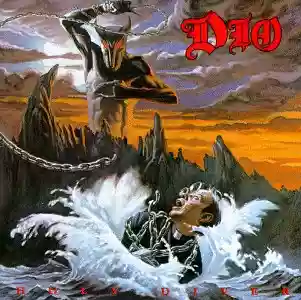
The cover is not, as many think, a hymn or homage to Satan (even if at first glance it might seem so) but behind that big “devil” named Murray (as Ronnie says in an interview present in the remastered version of the album I am reviewing) drowning a priest, there is a concept that, in a sense, could be defined as “philosophical”: the world, when it was created (not by an omnipotent entity, Mr. Padovana himself has often stated that he is completely atheist) was “something” perfect, it was “Paradise”, but man made it “Hell”; therefore, everyone, in their small way, can make paradise or hell, good or evil (hence the priest, representing good, and the devil, representing evil).
This is just the summary of pages and pages of interviews with the hobbit regarding this cover. It has also been rumored that if you turn the band's logo (DIO) upside down you can read the word “Devil”… a subliminal message? In reality, it’s not anything like that, it’s just a coincidence: the designer of the logo himself said that there is no hidden message in it.
But now let's move on to the album review:
It opens with the very fast and “schizophrenic” “Stand Up And Shout”, I certainly cannot deny having listened to it countless times… by now it has almost become an anthem of the group so much so that many of their concerts will open precisely with this. “Stand Up And Shout” is a concentrate of energy, power, and speed. So we move on to the second track: initially only silence, then you hear the wind whistling and here comes the captivating riff of the title-track: the fact that this has become the group's best-known song speaks volumes. “Holy Diver”, a track that, for twenty years now shines in the top 20 best hard’n’heavy tracks.
From fantasy lyrics reminiscent of novels like “The Lord of the Rings” could only come a magnificent video where Ronnie plays a barbarian with his sword. Then, there is “Gypsy”, a hard song that differs from the usual DIO tracks, not because of the lyrics, but because of the music: Ronnie James Dio's voice, in fact, becomes harder and more aggressive and, at the same time, takes on a touch of acidity that doesn’t quite suit him: a fantastic yet curious track.
“Caught In The Middle”, on the other hand, is a track that has always given me a feeling of joy: perhaps the music, perhaps the clean voice that Mr. Padovana takes, perhaps because it is played an octave higher than its “colleagues” or perhaps simply for the cheerful notes of the keyboards in the background. Regarding the next song, I can find no words to describe it, to my taste the best of the whole album and one of the best in the group’s repertoire: I am talking about none other than “Don’t Talk To Strangers”: well, yes, the lyrics are always inspired by fantasy literature and the music is exceptional: a mix of melody, “mystic” arpeggios, a more beautiful than ever voice and, at the same time, decidedly heavy metal rhythms.
About “Straight Through The Heart” there is not much to say: a beautiful and classic “DIO-style” song, that is my favorite genre. Next comes “Invisible”, a nice track but for reasons unknown to me, it never excited me, and I wouldn’t add anything else to this. I think that “Rainbow In The Dark”, given its notoriety, you all know it: it is a nice and cheerful song but nothing more, it has rhythms, in fact, slightly pop (as R.J. Dio himself admits). I strongly recommend, on the other hand, the video of this: filmed in beautiful London, it talks about a boy who falls in love with a woman and begins to follow her through the streets and bars of the city but, when he sees her enter a sex shop and come out paired with her boyfriend Vivian Campbell while playing the guitar (a Fender-stratocaster to be precise), he realizes there is no hope of getting together with his beloved and runs away: all with the notes of “Rainbow In The Dark” in the background.
The album ends with the track “Shame On The Night”, with strong lyrics that make you feel like a “worm” even though you are completely innocent: “Shame on the night, shame on you, shame on your son, shame on all of you!”. Meanwhile, the music transmits images that take you back to the Middle Ages and this is exactly the DIO’s intent: to make you feel shame (of course you really shouldn’t be ashamed but the rebuking text and voice of Ronnie really convey the idea of shame) and at the same time transmit Medieval images. Faced with an album of this caliber, I can only say “I ROCK, YOU ROCK, WE ROCK!”.
If you are reading these words it is because you had the time and patience to read my review and I thank you warmly for that. Moreover, I would like to ask you to be understanding towards me: in fact, with this review, I tried to make a tribute and give my contribution to my idol (Ronnie James Dio). I tried to be as objective as possible and if what I wrote seems like a eulogy, it is only because this is an album that, still today, is among the best “released” hard’ n’ heavy of all time, just like “In Rock” and “Made In Japan” by Deep Purple, “Kiss Alive I-II” by Kiss, “The Number Of The Beast” by Iron Maiden, “Led Zeppelin IV” and “The Song Remains The Same” by Led Zeppelin, “Rising” by Rainbow, “Paranoid” and “Heaven And Hell” by Black Sabbath, “Master Of Puppets” by Metallica, “Screaming For Vengeance” by Judas Priest and so on with other albums and bands that have marked the history of rock.
Loading comments slowly
Summary by Bot
The review praises DIO's 1983 solo album Holy Diver as a hard rock masterpiece with a legendary lineup. It covers band history, song details, and the philosophical meaning behind the album cover. Highlighted tracks include "Stand Up And Shout," "Holy Diver," and "Don't Talk To Strangers." The reviewer expresses deep admiration for Ronnie James Dio’s vocal and compositional talents.Tracklist Lyrics Videos
Dio
Ronnie James Dio (born Ronald James Padavona) was an American heavy metal and hard rock singer and songwriter, known for fronting Rainbow and Black Sabbath before leading the band Dio, and for albums such as “Holy Diver.”24 Reviews
Other reviews
By Ulver
"Holy Diver is a fantastic album, which will surely be appreciated by Hard Rock and Heavy Metal enthusiasts."
"It is, in fact, one of the milestones of heavy metal and a great classic of 80s metal."
By ilfreddo
Holy Diver is one of those rare albums that you listen to with immense pleasure even after a long time.
Solid and hypnotic, like the pace I want to keep now that I don’t feel tired yet and I feel invincible.
By Angelowar6
Ronnie James Dio's intense voice dominates all the songs, with verses and choruses that leave a mark.
For me, among metal albums, it is one of the best, without a shadow of a doubt.
