
 •
Rating:
•
Rating:
THE REVIEW
We often feel too awkward to take a step towards another person. Whether it is for formalities, to make friends, or some kind of non-possessive amorous folly. Yes, because with advancing age you also discover that... That one may, though complexed, deny the little Freud within and no longer adds anything more to certain encounters. "More" that is nothing but, and only, that: the fixed thought. But there's also the other, without the other. You recognize it too because it is that same love you adore in songs. And there's much to love in the songs of the Dexys.
Well, here are three envelopes: youth, success, maturity. As for albums, the Dexys Midnight Runners, in full name, made three. The most beautiful and incendiary is the first, Searching For The Young Soul Rebels, that one... youth, rebelliousness, rock, soul, folk, punk, new wave; the one with the breathless horns and the vocation for the street.
The most beautiful and polished, acclaimed, is instead the second, Too-Ay-Ry, that one... folk, soul, Celtic brotherhood, and subjection to Eileen.
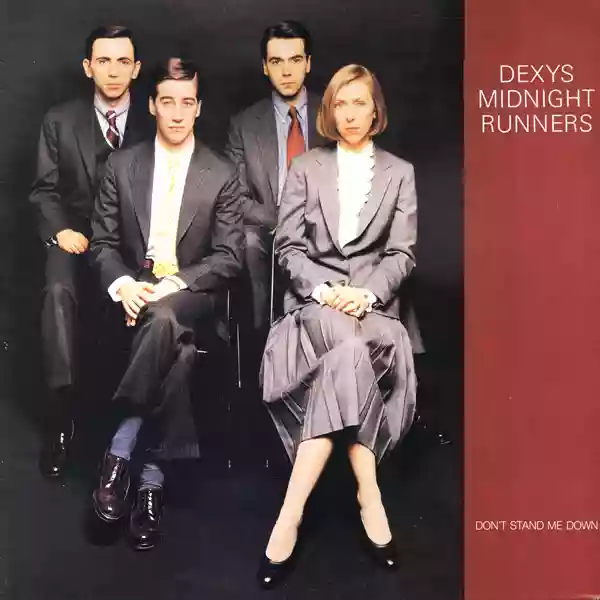
The most beautiful and orderly, poetic, is the third, Don't Stand Me Down; the one of maturity. The one on which the eccentric and grumpy Kevin Rowland imprints his new soul vision, which being a great vision, is a losing vision. So much so that Rowly then no longer uses that social reason and goes on to make... pop music. And anything else, like getting photographed on the cover of My Beauty in underwear and garter belt.
However, in the meantime, Don't Stand Me Down is simply the most beautiful.
It's a bit like the Pet Sounds of the '80s. Rowland's Pet Sounds, which, never being satisfied with it, the more he went on, the more he went back, in some way also made it his Smile.
Here we are, the underlying idea is that of a silky and meticulous "work," pure formal elegance combined with good vibrations: lyricism, ideas, and visions, enveloping music, phrasings, dialogues, diction exercises, flourishes, sudden changes, new and old beginnings, rhapsodies, and life. All together. Those eight highly inspired tracks are a splendor. Unassuming, sunny, changeable, as introverted as they are capable of a carefree communicativeness. That is for everyone and no one in particular, except you. And of the three albums, let's not forget, it's the only one that kicks Freud's ass!
So, to make "100" here on DEB by G, I wanted a special album, maybe not yet reviewed, maybe avoiding track by track, maybe foreign, maybe from the old millennium. All "givsto." And to talk about it on impulse. Ad cazzum canis. Because its musicality brings me to meet various people, it doesn't work on exclusivity: people I like, but sometimes not even that much. But never just one, always anyway. Otherwise, you take something and lose much. And with Don't Stand Me Down there's nothing to lose. A day is too long to have only one person in mind. Rowland, over thirty, knew it then. He knew it very well. That's why he changed producers, musicians, chewing gum, guitar strings with strings of other plucked instruments. Since, for Rowly, songs are people and people are songs, neither of them is ever right for him. In the quest, however, for a beauty that comes to awareness.
Don't, therefore, came out later than its release. Arrived after its arrival. Meaning? Meaning after a few renunciations. Like being everything in everyone. And just after a growth. But how is it, then, this album that starts with "The Occasional Flicker" (no one will ever title a song like that!) and goes to "This Is What She's Like" which starts as a ska piece and ends, if it ever does, like a mini-opera? And when Rowland sings "I love you, I love you," less of a showman than serious, is he singing that he is willing to renounce, that we will kick Freud's ass for a simple exchange of views? It's "yes." It’s a work played by God (with God's presence effect), where everything proceeds as if life were never habituation or suffering, but only music, only little choirs "Bon bon boooon," states of grace and beauty in the gaze of another looking at you. Why? Because it was preceded by a necessary existential and artistic contraction. The consequences, on the other hand, we are still waiting for. At least, in the meantime, chasing the "angels of rain and lightning."
Loading comments slowly
Summary by Bot
The review praises 'Don’t Stand Me Down' as Dexys Midnight Runners' most beautiful and orderly album, highlighting Kevin Rowland's mature vision and poetic style. Compared to the Pet Sounds of the '80s, the album combines formal elegance with emotional depth. The music is described as lyrical, complex, and capable of connecting with listeners in a unique, introspective way. Though it was a commercial challenge, its artistic value endures.Tracklist Videos
Dexys Midnight Runners
British group formed in Birmingham in 1978 by Kevin Rowland and Kevin ‘Al’ Archer. Fusing new wave with blue‑eyed and Celtic soul, they scored a global hit with Come On Eileen (1982) and earned acclaim for Searching for the Young Soul Rebels (1980) and the ambitious Don’t Stand Me Down (1985). They later returned as Dexys with new albums in the 2010s.05 Reviews
Other reviews
By woodstock
The closing Come On Eileen remains the seal of an intense and unrepeatable album not only by the Dexys but by anyone.
The New Caledonian Soul was now the style for saturday night stars performing under a different light, at times more fierce, certainly more thrilling and seductive.
