
 •
Rating:
•
Rating:
THE REVIEW
For God’s sake, burn it down!
Today, I want to tell you a unique story. A story that takes place, as it could not be otherwise, in that England transitioning from the '70s to the '80s. It's the adventure of a group of young guys in love with music, who one day were a motley crew led by an eccentric Don Quixote, and the next, acclaimed national stars.
Kevin Rowland, our "Joe Strummer with a Stax twist," had a peculiar conception of rock: once he had given his all to punk, heart and soul when the fashion was Vicious&Rotten, he was just as quick to recognize the deceit beneath it, turning on his heels and leaving reluctantly. The next step, after a diet of stimulants, classic Stax/Motown and Northern Soul, was recruiting kindred spirits and the birth of the Dexys Midnight Runners. In his vision, there was a class struggle, collective training, and above all, an ensemble without guitars, driven by the fierce and overwhelming power of horns tasked with supporting the arrangements. In 1980, the Dexys launched "Searching for...," a work of imposing and solid physical power, structured from its title on the quest for a third way between post-punk and 2-tone, which were all the rage at the time. As close to the infernal folk of the Pogues as to the ethereal flourishes of the Waterboys, their music assaulted the listener and even themselves, leaving no breath or drop of sweat wasted. That album remains a gem of that brief and intense season, of which Geno somehow represents the epitome.
But here's where the crack occurs.
The sudden and unexpected success perhaps surprised Rowland, who until not long before had been picking through obscure 4-pence singles in Birmingham's markets. The statements to the press grew increasingly confused and paranoid, the leader ever more despotic, the lack of ideas alarming. In short, Rowland found himself alone. How many similarities can we find with the story of Scritti Politti? As if Gartside and Rowland were two sides of the same coin.
However, the sabbatical year benefited our heroic frontman. March 1982 saw them return in great style to the scene, in response to critics who had too hastily written them off. Quite the opposite: preceded by the programmatic and intense chant The Celtic Soul Brothers, they now showcased a new look and a polished lineup. They suddenly abdicated the imperious muscle of horns to rediscover themselves as more elastic in sound, with an unusual funk/jazz influence that intoxicated the performances. Also thanks—but not only—to the courtesy of the Emerald Express Fiddlers who adorned the entire album here and there with mandolins and Gypsy violins. The point of reference, noblesse oblige, was obviously "Into the Music" and Dylan's Rolling Thunder Revue, with their (in)disciplined acoustic escapades: and to reconnect with the past, a few tracks sufficed, the version of Jackie Wilson Said, here even more forceful than the original, clearly etched who were the guiding deities of Kevin Rowland. In the end, nothing had changed.
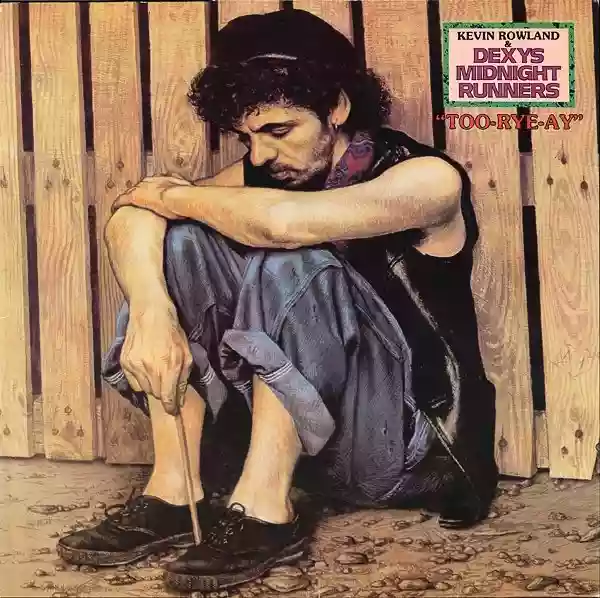
The energy, vitality, and extreme intensity with which they delivered their pieces remained intact, even if a track like Old the Dexys wouldn't have played a couple of years prior, not even under torture. The arrangements, the music, the spirit were joyously pop: with many thanks to Colin Fairley, who in production had the bright idea of constantly putting the unrelenting Kilkenny/Shelton rhythm section in the foreground. So not just a simple change of cover outfit (from Mean Streets to an updated version of street hobos), but a profound modernization of the style on already laid foundations. Even the lyrics, invariably probing the mind/body dichotomy conjugated toward unattainable purity (again Gartside, pure coincidence?), had become a well-tested trademark. The New Caledonian Soul was now the style for saturday night stars performing under a different light, at times more fierce, certainly more thrilling and seductive. It happens then that right in the midst of the best mid-tempo interplay—Until I Believe in My Soul, a tearjerker ballad on self-punishment of the flesh, just for a change—they throw in a dixieland that makes you jump from your chair and exclaim: hey! And then our little heart, which had been joyfully skipping until that moment, stops for a moment, and just for a moment we remain stunned. Then, all one can do is stand up and applaud, knowing that the curtain will soon fall. The closing Come On Eileen—again, violins, mandolins, accordions, flutes, for a party that seems never to end—remains the seal of an intense and unrepeatable album not only by the Dexys but by anyone: the cornerstone that has consigned this collective to a small part of history, the one Rowland longed for since those early days in Birmingham.
The dream of Kevin Rowland, although deeply rooted in the '80s (and despite him disavowing it), was born and died in the '70s: too tied to many of those ideas, this poor man's genius got entangled in many stereotypes typical of the same post-punk movement, which rejected anything that wasn't "forward" (read: the «hippie press»). In this sense, "Too-Rye-Ay" remains a swan song, rather than a rebirth. But we would only know this with the years, after the next album—the bizarre "Don't Stand Me Down"—would reveal itself to be a resounding failure. Even the subsequent literature, which for better or worse recounted all the parties involved during that period, would help to define more precise boundaries and list the Dexys Midnight Runners as one of the few truly resplendent falling stars in that blue San Lorenzo carpet that hosted the best music of those years.
Loading comments slowly
Summary by Bot
The review recounts the journey of Dexys Midnight Runners and frontman Kevin Rowland, highlighting their evolution from punk roots to a bold fusion of funk, jazz, and Celtic influences on Too-Rye-Ay. The album is praised for its intense energy, innovative musical arrangements, and timeless hits, notably 'Come On Eileen.' While acknowledging Rowland's struggles, the review celebrates the album as a defining moment in 1980s British music history.
Dexys Midnight Runners
British group formed in Birmingham in 1978 by Kevin Rowland and Kevin ‘Al’ Archer. Fusing new wave with blue‑eyed and Celtic soul, they scored a global hit with Come On Eileen (1982) and earned acclaim for Searching for the Young Soul Rebels (1980) and the ambitious Don’t Stand Me Down (1985). They later returned as Dexys with new albums in the 2010s.05 Reviews
