
 •
Rating:
•
Rating:
THE REVIEW
Preamble
Fourth review. It’s the same.
Review
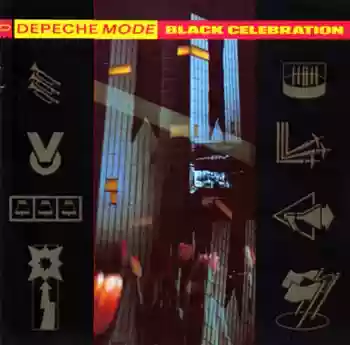
Author: Depeche Mode (Dave Gahan, Martin Lee Gore, Andrew Fletcher, Alan Wilder).
Year, release date: 1986, March 31.
Producers: Depeche Mode (mainly Alan Wilder), Gareth Jones, Daniel Miller.
Label: Mute (UK), Sire (USA).
Track list:
- "Black Celebration"
- "Fly On The Windscreen (Final)"
- "A Question Of Lust"
- "Sometimes"
- "It Doesn't Matter Two"
- "A Question Of Time"
- "Stripped"
- "Here Is The House"
- "World Full Of Nothing"
- "Dressed In Black"
- "New Dress"
Total duration: 45' 27''.
If one day I had to rank my favorite bands, they, Depeche Mode, would definitely be there, high up, on the podium to be clear. Therefore, it will be quite difficult for me to be objective, but I will try my best. Specifically, I consider Black Celebration their absolute masterpiece and my favorite album of the English quartet. It will be tough.
So it's 1986, and Depeche Mode is on their fourth work. "Speak & Spell" (1981), their debut album (featuring Vince Clarke, who would later found "Yazoo," instead of Alan Wilder), brought their music to many clubs around the world. An adolescent album, pure and simple disposable electropop (albeit very refined). With Clarke’s departure and Wilder’s arrival (an excellent multi-instrumentalist and composer) things change, and I would say, for the better. Indeed, the subsequent albums "A Broken Frame" (1982) and "Construction Time Again" (1983) are characterized by a remarkable change in sound, which becomes darker and more mature; this is because with Clarke’s departure, the composition is almost entirely in the hands of Martin Gore, who from now on will become the main, if not the only, composer of the group. He writes lyrics and music. The evolution of Depeche Mode’s music is the evolution of Gore. This would mark the group’s life on two fronts. On one hand, there is a stylistic evolution of the group towards more manifestly Dark sounds, on the other hand, Gahan becomes increasingly frustrated with singing lyrics written by others; his frustration (also fueled by other factors) culminates in the attempted, but partially successful, suicide (in fact, the frontman would be declared dead for about two minutes) in 1997.
Let’s then discuss the album in question. "Black Celebration" is an incredible container of great music, no track seems exempt from the others, they are all perfectly constructed together and this, in my view, is the album’s strong point. There are no fillers, there are no compositions objectively better than others (of course, subjectively everything is plausible), it is the collection of songs that constitutes its greatness. We might even say that, in general, the main characteristic of each Depeche Mode album is exactly this, just take others to realize it, "Violator" above all. A hit group, but that makes every album a concentrate of hits. Every track is composed and recorded with the same skill, "Black Celebration" is objectively a great album.
Let’s go into the disputable "track by track" recall that all tracks (music and lyrics) were composed by Martin Lee Gore.
"Black Celebration" [4:57]. This is Depeche Mode's dark anthem. Introduced by mephistophelean moans and a keyboard motif that will persist throughout the track, the synths support a text marked by total pessimism. It seems like Ozzy Osbourne's "black sabbath." Gahan radically changes his tone, which becomes much lower; a chant that fills every light gap, desperate. The atmosphere is dense, made so by robust bass samples; the ethereal keyboards draw the paradise Gore sees in the woman's eyes: "Your optimistic eyes/Seem like paradise/To someone like/Me". The album thus begins with total pessimism which the subsequent track does not tend to soften.
"Fly On The Windscreen" [5:19]. It continues without interruption of music (as we said before: it is very cohesive). Gahan proclaims: "Death is everywhere", it’s no joke "There are flies on the windscreen", "There are lambs for the slaughter". The lyrics are oppressive, a worthy continuation of "Black Celebration". Obviously, like in almost all Mode songs, the theme of love is present, sometimes (as in this case) seen as an escape from this world, sometimes as the cause of pessimism. There’s little to say on the compositional side, essentially it tends to accompany the text perfectly, recalling the deep bitterness; we certainly can’t expect (and shouldn't) progressive escapes. But this doesn’t mean that the result is worse, on the contrary, from my point of view, their music (as it is) manages to convey everything it needs to.
"A Question Of Lust" [4:23]. Here too, it picks up where it left off, without interruption. In the intro a synthesizer plays, somewhat like Faust ("Why Don’t You Eat A Carrots?"). Beautiful track, certainly more "carefree" than the previous ones. The flies on the windshield turn into greed and weakness. Sampling is nothing short of excellent. The voice is Gore’s.
"Sometimes" [1:54]. Transitional track, but certainly not a "ghost track". From now on, the lyrics will be less pessimistic, the music less claustrophobic. A piano, the voice (again Gore’s), and it’s magic.
"It Doesn't Matter Two" [2:51]. Here’s, in my opinion, the first half misstep since the album began. It’s certainly not a masterpiece, the text says very little (it’s not incoherent only because the themes have changed, now Gore seeks the solution to his drama). But as always happens with these four, it’s not all to be discarded. The singing (again by Gore) is wonderful, the synth effects are mixed masterfully, and the musical motif is truly irresistible.
"A Question Of Time" [4:09]. Well, this is the most rock song of the album and Depeche Mode up to "Personal Jesus". Great piece. Gahan returns to voice and you can feel it, especially for his rock attitude. A drum machine, never so aggressive, grinds a rhythm which by the end of the track becomes frantic, infernal (for synth pop). This (genius) effect serves to convey all the frantic feeling exactly present in the lyrics (A question of time); lyrics which actually represent the weak point of the song, as it returns a bit to the old Clarke times.
"Stripped" [4:17]. A mechanical chord of classical guitar. The eighties have definitively set for them, unless you consider the following "Here Is The House" and some tracks of "Music For The Masses", the band’s sound returns again to dark landscapes, where inner devastation always prevails over everything. There is also some hint at political propaganda: "Let me hear you make decisions/Without your television". There is the theme of carnal love: "Let me see you/Stripped down to the bone". A timeless, immortal track from the Mode. The masterpiece. The intro is mechanical (it recalls industrialization and with it industrial capitalism), the outro is majestic, in my view the peak of the album. Few notes in slow succession manifest an incredible theatricality. Gahan and Gore duet, their voices fade and blend supported by a sampled organ. Chilling.
"Here Is The House" [4:16]. After two tracks like "A Question Of Time" and "Stripped", it arrives like a meteor. The text resumes previously exposed concepts, but Gahan’s voice is the true protagonist of the piece. Desperate, moved, hallucinating, and therefore sublime.
"World Full Of Nothing" [2:49]. A tribal rhythm introduces the ninth track. Gore returns to voice, you can feel it. Colder than ever, his voice almost seems to float above that sea of music created by the synths. The piano plays an oriental scale and the text is evidently dramatic. "In a world full of nothing/Though it’s not love/It means something". Love, which appeared as the solution, actually doesn’t represent anything but utopia. Pessimism returns to spread.
"Dressed In Black" [2:34]. And indeed: "She’s dressed in black again/And I’m falling down again/Down to the floor again/I’m begging for more again". Musically a good track, but nothing more.
"New Dress" [3:46]. You hear on the news: "Sex jibe husband murders wife/Bomb blast victim fights for life/Girl Thirteen attacked with knife". And more. It’s Gore’s compositional peak (about the lyrics) and one of the absolute tops of the band, the masterpiece within the masterpiece. A pounding bass explodes, slams of drum machine, cutting and sharp synths. You feel the metal, the sound is increasingly industrial. Then the wonderful chorus (from all points of view), supported by a pounding rhythm: "You can’t change the world/But you can change the facts/And when you change the facts/You change points of view/If you change points of view/You may change a vote/And when you change a vote/You may change the world". Obviously, you don’t change the world, but it’s who commands you that changes yours. Pessimism becomes synonymous with realism. There is no solution. The chord that opens "Stripped" closes the album.
There’s little left to add and much, so much, to listen to. If you haven’t done so, I hope this review has piqued your curiosity; if you already have, I hope this review has reawakened in you the desire to do it (listen to the album, I mean). An album difficult to categorize in a musical genre, immense album, and if it is to be the ultimate example of a genre, it can only be synth-pop (broadly speaking). Don't expect the usual easy and banal pop album because "Black Celebration" is epochal from many points of view. The ultimate in its genre.
Rating: 8
Loading comments slowly
Summary by Bot
This review presents Depeche Mode’s 1986 album Black Celebration as their crowning achievement and a defining synth-pop classic. The reviewer highlights the band’s evolution toward darker, mature soundscapes under Martin Gore’s songwriting. Each track is praised for its contribution to a cohesive, powerful album with no fillers. Notable themes include pessimism, love, realism, and political undertones. The album is recommended for its timeless quality and profound emotional impact.Tracklist Lyrics Videos
Depeche Mode
Depeche Mode are an English electronic music group formed in Basildon in 1980, led by Dave Gahan and Martin Gore. They built a global audience with synth‑based albums and large-scale tours and remain influential in synth‑pop and alternative electronic music.110 Reviews
Other reviews
By biaspoint
Dark and very distant voices, almost subliminal, the ticking of a bell growing louder and louder, deep and sinister sounds intertwining in a healthy harmony.
Anyone who has not yet had the chance to listen to it and is a fan of this genre cannot let it slip away.
By ApriGliOcchi
"Black Celebration is the beginning of a darker period... an album continuously postponed but that will then mark a turning point for Depeche Mode."
"You can't change the world, but you can change the facts, and if you change the facts you can change points of view..."
By paolofreddie
"Black Celebration is one of the most representative pieces of the dark wave, an anthem to this genre."
"It is by fighting for love that people stay united."
By jeff3buckley
The "black celebration" covers the tracks with a gothic and dark atmosphere like never before, and there is a deeper exploration of the sonic nuances.
A record that marks an extraordinary turning point in the musical landscape of the time, charting the path to follow for a genre, new wave.
