
 •
Rating:
•
Rating:
THE REVIEW
Sure, Bowie has always been a great son of a bitch.
What many adoring fans, who sprouted like mushrooms in England in the wake of the epic "Ziggy Stardust...", acclaimed thanks to this album, actually represented a stab to the heart, a swan song of an artist who was perhaps experiencing the most intense moment, emotionally and professionally, of his career: the prelude to an unexpected choice realized at London's Hammersmith Odeon, amidst disbelief and tears.
When "Aladdin Sane" was released, the myth of Glam Rock had reached its never-to-be-equaled peak: it was 1973, and everywhere acrobats, imitators, prophets of eyeliner, and flamboyant jackets, the pathetic and extravagant poor men's Elvises, all the young dandies were popping up.
Marc Bolan collected hit after hit but gnawed at the success of the man who fell to earth: but Bowie was thinking of other things, and not just heroin.
So this is not the album that consecrates glam, it is the album that kills it. Definitively.
Also because, at least sonically, it is probably and paradoxically the only "glam" album of the androgynous Martian, the one that best summarizes the spirit of his early '70s trajectory: reaching the masses but carrying on a deeply personal—if not cryptic—discourse, hiding his own tormented identity crisis, his own hysteria, his own "aristocratic" and capricious alienation beneath pop choruses and the melodramatic scratches of melancholic ballads.
"Aladdin Sane" (a lad insane) is Bowie looking at himself in the mirror with a glass of Möet & Chandon in hand, laughing at himself, at the people around him, at time passing relentlessly and that cannot be corrupted, it cannot be prostituted. It is an exaggeration of his own ego and how it observes and judges life. Songs written to chart but whose function is to put the final point to a "genre" that was born to die in a short time, drowned by rhetoric, vacuity, by its innate irresponsibility.
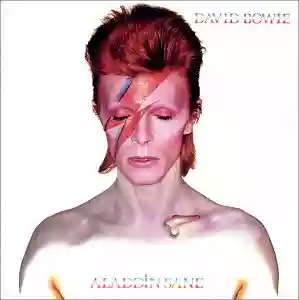
It is the American tour, the consecration of glory so much desired and finally obtained, that pushes him toward a redefinition of his being an artist, almost taking the position of a philosopher, reflecting on the meaning of a life immersed in unbridled stardom among drugs, groupies, media exposure, cult of his own ego (the cover of the album would deserve a paragraph of its own), famous friendships, and a fame that begins to ruthlessly show both sides of the coin.
The sound is fat, pompous, defiant as in "Cracked Actor" ("I'm stiff on my legend", he sings), raw and rough bubblegum. Bowie takes the epic of the Rolling Stones as a reference, paying homage to them with a cover ("Let's Spend The Night Together", anticipating "Pin Ups") and with that "Watch That Man" (a cynical portrait of the New York "beautiful life") that sums up the sarcastic and direct face of the album.
The second face is more explicitly existentialist, as in the beautiful title track (inspired by Evelyn Waugh's "Vile Bodies"), an absolutely atypical piece for Bowie's standards of those years, in which the anarchic and eccentric keyboards of Mike Garson dominate (and I won't add anything else), or in the bitter and dramatic "Time", one of the most bizarre and haunting songs ever made by Bowie (with a "historic" solo by Mick Ronson), a sort of grim and fatalistic vaudeville provoked by Billy Murcia's overdose death, the drummer of the New York Dolls.
Bowie's voice is as always chameleonic, now tense, now bawdy, now almost sobbing: conceptually, America enters forcefully into his imagination, and he projects it into a hypothetical future devastated by nuclear energy ("Drive In Saturday, musically almost a less neurotic revisitation of 'Rock'n'Roll Suicide', and the acidic 'Panic In Detroit'), instead presenting a more intimate turn in "The Prettiest Star", with a string section that seems a parody of the soundtracks of some dreamy "plastic" Hollywood movie of the '50s.
It is then time for "The Jean Genie", a single that today we would call a "lead" of the album but still in some sense tied to "Ziggy Stardust": a very famous song, it is a pompous and engaging blues that crawls over Bowie's verses, once again resorting to wordplay, references, allusions to drugs, and his disorienting experience in the USA. There's no need for a Francis to define it as one of the most representative pieces of the White Duke's career: not the best, but certainly one of the most emblematic, despite it seems to have been written with Iggy Pop in mind.
The closure is entrusted to the sweet and sad "Lady Grinning Soul", also profoundly in line with the decadent and disenchanted mood of the album.
Theoretically, there would be no trace of the turning point that will lead Bowie to abandon his astronettes and his spiders from Mars, transforming into something else not yet well defined: perhaps only he knew that what could seem like a momentary meditation on the historical period in which he had been a protagonist was actually a chapter about to be closed without second thoughts, unbeknownst to everyone.
Yet all this had already been announced in "Aladdin Sane" itself: "Who will love Aladdin Sane? / Millions weep like fountains / In case the dawn arrives / Who will love Aladdin Sane?".
Loading comments slowly
Summary by Bot
This review praises David Bowie's 1973 album Aladdin Sane as both a peak and turning point in glam rock. It highlights Bowie's complex identity crisis beneath accessible pop and glam, marking the end of the genre's heyday. The analysis emphasizes the album’s dual nature—its flamboyant, defiant sound and its deep existential themes. Key songs like 'The Jean Genie' and the title track reflect Bowie's evolving artistic direction. The album encapsulates the twilight of glam rock and Bowie's move towards new horizons.Tracklist Lyrics Videos
David Bowie
English singer-songwriter and actor David Bowie (born David Robert Jones, 1947–2016) was a pioneering, genre‑shifting artist known for his personas, musical experimentation and a career spanning pop, rock and avant‑garde projects.109 Reviews
Other reviews
By BrunoDP
Here, the fingers dance on the keys until they break every rhythmic coherence, only to recover at the end the cadenced pace of the splendid refrain.
Bowie stages on stage the death of his character Ziggy Stardust and with it a musical genre that will not awaken except in pathetic ’90s glam regurgitations.
By Dune Buggy
"From the first track, 'Watch That Man,' the clean alien aesthetics have given way to a dirty, scratched, rough, distorted sound."
"The album is a milestone in the 'pop-rock' panorama and remains fundamental and still very relevant for anyone who wants to know not only Bowie but the path taken by music from the 70s onwards."
