
 •
Rating:
•
Rating:
THE REVIEW
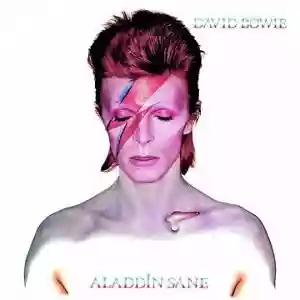
Inspired by the sensations suggested by the triumphant American tour of '72 ("it's America seen by Ziggy": Bowie dixit) "Aladdin Sane" (a play on words for "a lady insane") was published to consolidate the success achieved by the previous "Ziggy Stardust." It's impossible to add a single drop to the rivers of ink spilled to describe the crucial importance that the album in question had in giving new life to the ephemeral glam rock movement: less compact and more heterogeneous than "Ziggy Stardust," Aladdin gives us implicit ("Watch That Man") and explicit ("Let's Spend the Night Together") references to the Rolling Stones, delightful cabaret aspirations (the ballads "The Prettiest Star" and "Lady Grinning Soul") and nods to the compelling hard blues of the states ("The Jean Genie").
The opening is entrusted to the obsessive rhythm of Mick Ronson's guitar in "Watch That Man," a parodic reflection on the chaotic life of New York City enriched by Garson's keyboard skill. He gives us, in the subsequent title track, three minutes of lysergic-psychedelic keyboard delirium among the most legendary in the entire Bowie repertoire: here, the fingers dance on the keys until they break every rhythmic coherence, only to recover at the end the cadenced pace of the splendid refrain ("ooohhI love Aladdin Sane..."). Brilliant. If "Drive in Saturday" is a reassuring ballad that glides serenely among the soft saxophone accents of which David is a master, "Panic in Detroit" sounds like a prophetic warning about a (at the time) phantom terrorist attack in the heart of the states. Ronson's saturated guitar introduces the next "Cracked Actor," an electrifying high-paced ride that gives Bowie the chance for a bitter reflection on the role of the (rock) star, filled with sexual innuendos ("I just want your sex"): a master of sudden image and style transformations, the young David knows he must satisfy the unstable and fickle tastes of an audience ready to shower him with the spotlight and chart honors and turn their backs on him once a genre or artist able to replace him emerges.
Not surprisingly, having sensed the first creaks of glam rock, Bowie stages on stage the death of his character Ziggy Stardust and with it a musical genre that will not awaken except in pathetic '90s glam regurgitations (Pulp, Suede, etc.). After the pompous "Time" and the soft "Prettiest Star," the nostalgic echoes of the sixties' swinging London resonate (a theme that will find wider expression in the subsequent album "Pin Ups") in a brilliant cover of "Let's Spend the Night Together." Rhythmically much more pressing than the original Stones' version, the song is performed with an ironic tone and a baritone voice that do it far more justice than the sloppy arrangement by Jagger and company. The dreamy ballad "Lady Grinning Soul" closes a parade of masterpieces essential to understanding the evolution of a genre that in the first half of the '70s represented the most intelligent alternative to the sterile experimentalism of progressive and the obtuse heaviness of hard rock.
Loading comments slowly
Summary by Bot
Aladdin Sane, inspired by Bowie's 1972 American tour, solidified his glam rock success following Ziggy Stardust. The album offers diverse influences, from Rolling Stones nods to cabaret ballads and hard blues. Key tracks like 'Watch That Man,' 'Aladdin Sane,' and 'Panic in Detroit' showcase Bowie's innovative style and sharp reflections on fame. The album marks the end of glam rock's peak, highlighted by a brilliant cover of 'Let's Spend the Night Together' and the emotional 'Lady Grinning Soul.'Tracklist Lyrics Videos
David Bowie
English singer-songwriter and actor David Bowie (born David Robert Jones, 1947–2016) was a pioneering, genre‑shifting artist known for his personas, musical experimentation and a career spanning pop, rock and avant‑garde projects.109 Reviews
Other reviews
By francis
Aladdin Sane is Bowie looking at himself in the mirror with a glass of Moët & Chandon in hand, laughing at himself, at the people around him, at time passing relentlessly.
"It's not the album that consecrates glam, it is the album that kills it. Definitively."
By Dune Buggy
"From the first track, 'Watch That Man,' the clean alien aesthetics have given way to a dirty, scratched, rough, distorted sound."
"The album is a milestone in the 'pop-rock' panorama and remains fundamental and still very relevant for anyone who wants to know not only Bowie but the path taken by music from the 70s onwards."
