
 •
Rating:
•
Rating:
THE REVIEW
"HE'S OUTRAGEOUS, HE SCREAMS AND HE BAWLS" or Ziggy goes to Hollywood
Autumn 1972. Finally, David Bowie got what he wanted: success. Thanks to the excellent album on the adventures of Ziggy Stardust, an ambiguous and theatrical alien masterfully portrayed by the singer himself, Bowie became a teenage idol. He influenced the fashion of the year, and the years to come, drawing inspiration from Marc Bolan, Japanese theater, and countless other influences. He forged a new avant-garde made of irony on the rock star persona and electric-orchestral synthesis. And, not less importantly, he landed in America.
The tour with the Spiders (Mick Ronson, Woody Woodmansey, and Trevor Bolder) took him to every corner of the States, but more than influencing overseas sounds, it was the opposite: during the exhausting journey, Bowie kept a diary, a sort of notes on impressions of the USA and his world of movie stars, parties, exclusive clubs, but also skyscrapers and streets. This America, more imagined than real, permeates the writing and sounds of the artist, who shuttles between New York and London between December and January to work on a new project and a new character. Certainly, in the meantime, he hasn't rested on his laurels: besides the tour and radio sessions, he worked on the new albums of Iggy Pop, Lou Reed, and Mott The Hopple and met the avant-garde pianist Mike Garson: all experiences that in their own way will enter his art.
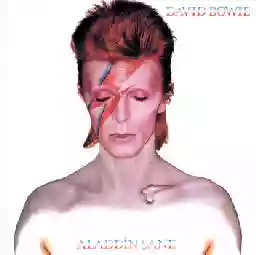
April 13, 1973: After a troubled phase of choosing the title, Aladdin Sane is launched on the market. That day, David Bowie is in Hiroshima, the last stop of the Ziggy Stardust Tour before returning home. The image that better than any other interprets and symbolizes Bowie's sound is the one the artist painted on the cover: a lightning bolt. We notice from the first track, "Watch That Man", the difference from Ziggy Stardust: the clean alien aesthetics have given way to a dirty, scratched, rough, distorted sound. The singing becomes even more perverse and in "Cracked Actor" it touches a brilliant vulgarity. The lyrics talk about absurd, clownish, in some ways Lou Reed-like characters, more "solid" than the shadows of the previous concept. But there are also the very refined classical and free-jazz movements of Garson, who gives his best in the exasperated coda of the title track, in the masterpiece "Time" and in the superb "Lady Grinning Soul". In "Drive-In Saturday", it’s the horns that play their game, but the most extraordinary thing will always remain the style of the voice: the future White Duke gives a great demonstration of maturity by combining falsettos, basses, and acting.
In "Panic In Detroit" haunting choirs, tribal rhythms, and animalistic distortions build an apocalyptic and hysterical panorama where Che Guevara, slot machines, police, and autographs chase each other. "Time", one of the highest levels reached not by Bowie but by rock in general, seems to come out of a New Orleans brothel, is decadent, is made of sewers and sequins, of New York Dolls and dream doors, it is vain so much that "it bends like a whore, falls masturbating to the ground." "The Prettiest Star", carefree, danceable, and melancholic, returns to the English field, is dedicated to his future wife Angie (the same of "Angie" by the Stones), but seems tailor-made for Marc Bolan of T-Rex. "Let's Spend The Night Together" materializes in a valid cover and sensually gay the ghost that hovered in Ronson's riffs, namely that of the Rolling Stones. "The Jean Genie", the album’s first single and true hit of the year, is a hot and lively blues inspired by playwright Jean Genet and friend Iggy Pop and characterized by the hard impact of the riff of delta-blues origin that jumps between New York skyscrapers like a crazy imp. The song will be so successful as to be replicated in almost all of Bowie’s tours, up to the energetic interpretation together with Billy Corgan in 1997. The work closes with "Lady Grinning Soul", a Latin ballad drawn on the profile of the femme fatale, where on a very refined piano carpet are combined acoustic guitars, slight distortions, saxophone, and torrid voice, to reach an imaginative space between Scott Walker and Spain.
Needless to say, the album is a milestone in the "pop-rock" panorama (starting with the legendary cover that deservedly enters the Olympus of pop-art) and remains fundamental and still very relevant for anyone who wants to know not only Bowie but the path taken by music from the 70s onwards. Moreover, the double CD version released in 2003 on the thirtieth anniversary of its release is enriched with gems such as "John I'm Only Dancing", "All The Young Dudes", already famous 45s, and live redoes from the autumn of Ziggy Stardust.
Like Dorian Gray, from music to life: a spring of excess!
From "Time""Time — Waits in the wings, speaks of pointless things, his script is you and me, boy. Time — It flexes like a whore, falls wanking to the floor, its jest is you and me, boy (...). The sniper in the brain, regurgitating drain, incestuous and vain, and many other names. I look at my watch, it says 9:25 and I think, "Oh God, I'm still alive"(...) You — are not a victim You — just a scream of boredom You — cannot evict time (...) Quitting is hard, but living in the dark is hateful. I had so many dreams, I had so many breakthroughs but you, my love, were kind, but love has left you without dreams, the dream door was closed, your park was truly without dreams. Perhaps now you are smiling, smiling through this darkness but all I could have given you is the fault of dreaming"
Texts and translations from www.velvetgoldmine.it, chronological information from "David Bowie - The Encyclopedia" by Nicholas Pegg (ed. ArcanaMusica)
Loading comments slowly
Summary by Bot
This review celebrates David Bowie's Aladdin Sane as a seminal album that pushed rock music forward with its raw sound and theatrical depth. Emerging from the success of Ziggy Stardust, Bowie infused American cultural impressions into a diverse musical palette. The album features standout tracks like 'Time' and 'Jean Genie,' showcasing Bowie’s vocal maturity and artistic range. Its iconic cover art and avant-garde influences mark it as a key milestone in pop-rock history.Tracklist Lyrics Videos
David Bowie
English singer-songwriter and actor David Bowie (born David Robert Jones, 1947–2016) was a pioneering, genre‑shifting artist known for his personas, musical experimentation and a career spanning pop, rock and avant‑garde projects.109 Reviews
Other reviews
By francis
Aladdin Sane is Bowie looking at himself in the mirror with a glass of Moët & Chandon in hand, laughing at himself, at the people around him, at time passing relentlessly.
"It's not the album that consecrates glam, it is the album that kills it. Definitively."
By BrunoDP
Here, the fingers dance on the keys until they break every rhythmic coherence, only to recover at the end the cadenced pace of the splendid refrain.
Bowie stages on stage the death of his character Ziggy Stardust and with it a musical genre that will not awaken except in pathetic ’90s glam regurgitations.
