
 •
Rating:
•
Rating:
THE REVIEW
In today’s review we take on the latest album by a band that, unfortunately, has been underrated in the metal scene over the past 35 years: Coroner. Formed in Switzerland in 1983, they began their career as a thrash metal band inspired by the music of fellow countrymen like Celtic Frost, and, thanks to them, they often played as their support band. Despite releasing truly outstanding albums such as Mental Vortex and Grin, the Swiss music scene of the 80s and 90s always kept them in the background, perhaps because of their style (a very technical thrash metal) that was slowly losing popularity worldwide in favor of genres like grunge and groove metal.
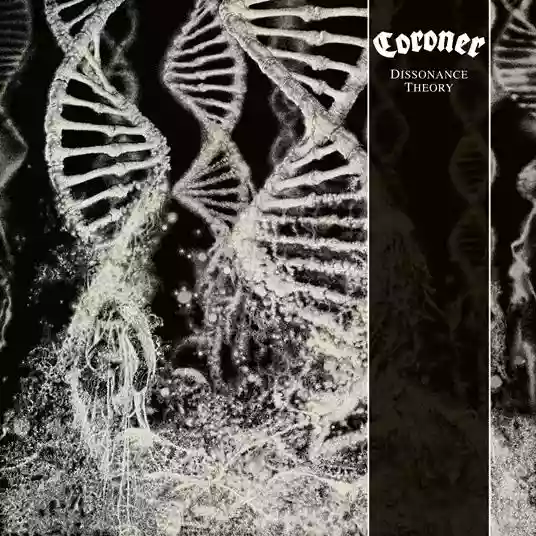
After several years of inactivity, on October 17, 2025, the Swiss band reunites and releases their sixth album: Dissonance Theory. The trio lineup for this reunion features the historic Ron Royce on vocals and bass, as well as founder Tommy T. Baron on guitar; drummer Marquis Marky, however, is absent and is replaced by Diego Rapacchietti. The sound of this Dissonance Theory continues their ongoing evolution, interrupted in 1993 after Grin; their technical thrash metal with prog ambitions, always seasoned with Tommy’s neoclassical solos, shows the influence of metal bands that, during their absence, became pillars of the genre—among them, Machine Head and at times Dream Theater, both of whom are referenced throughout the album. The introduction is entrusted to “Oxymoron”, an instrumental track that launches the following “Consequence” like a missile aiming to break the sound barrier; the solidity on display here is worthy of their best works before their breakup, as well as of the best-known bands like Voivod. The more progressive turn comes in the next two tracks, “Sacrifical Lamb” and “Crisium Bond”, which offer a freshness that, from a group formed in the eighties, we are not used to seeing in recent releases; the powerful riffs in the second of the two songs wink at alternative metal, incorporating everything within high-level progressive-thrash. “Symmetry”, released as a promotional single, continues this blend of various metal styles, condensing everything into exactly four minutes; it seems that this trio has used their years of silence to refine a modern style, while at the same time not betraying their early roots. The bass parts in this work are often left in the background, even in the final mix, however, during the guitar solos, they solidly prop up the rhythmic wall of sound without ever being intrusive. As you continue listening, you are faced with tracks that are always excellent and never repetitive; in fact, the following songs such as “Transparent Eye” and “Trinity” carry us into a whirlwind of pure epicness; thanks to the large number of references to styles and music scenes, it almost feels like being in a museum dedicated to the evolution of metal music. The album’s closure is entrusted to the Dream Theater-esque “Prolonging”, where keyboards, melodic solos, and odd drum time signatures are the absolute protagonists, dissolving these intense 47 minutes and leaving the listener with pleasant musical sensations.
If bands like this have remained in the shadows throughout their careers, with this album they have a real chance at redemption, and they’re off to a great start. This album has no flaws: the production is excellent, the mix is spot-on (with overdubbed guitars and crystal-clear drums), and the songwriting is remarkable; choosing to keep a standard length without following the modern trend of releasing 60-minute (or longer) metal albums guaranteed them a result where their ideas are condensed into a work as solid as a rock. Well done, Coroner, and long live metal.
Best tracks: “Consequence”, “Crisium Bond”, “Transparent Eye”, “Prolonging”
Loading comments slowly
Summary by Bot
This review awards Coroner's 'Dissonance Theory' a perfect score, highlighting the album's innovation and musicianship. It praises Coroner's blend of thrash and progressive elements, noting both technical skill and songwriting excellence. Ideal for fans of forward-thinking metal, the review positions this album as essential listening. Readers are encouraged to explore the release for themselves.Tracklist
Coroner
Coroner are a Swiss technical/progressive thrash metal trio from Zürich, formed in 1983. The classic lineup features Ron Royce (vocals/bass), Tommy T. Baron (guitar), and Marquis Marky (drums). They issued a run of acclaimed albums from R.I.P. (1987) to Grin (1993), reunited in 2010, and returned with Dissonance Theory in 2025.08 Reviews
Other reviews
By Asfodelo
Dissonance Theory blends technical mastery with a refreshed sense of purpose.
It’s a powerful statement from a band that continues to defy expectations.
