
 •
Rating:
•
Rating:
THE REVIEW
For a simpleton like me, Metal and Switzerland in the same sentence are synonymous with two names: Celtic Frost (and all related projects) and Coroner. While the former were perhaps the most important band for the evolution of extreme metal in the early Eighties—not forgetting those pioneers of the pioneers, Hellhammer—the latter were their roadies, but above all, a fabulous group that managed to elevate technical Thrash metal to heights reached by very few others. 32 years, 32 long years have passed since what until yesterday was their last album, that Grin which sublimated Thrash as the final act of a Hegelian triad, deconstructing and contorting it into a unique masterpiece; until yesterday, because today the Swiss are back with their first post-reunion album, Dissonance Theory.
In these years, dissonant Death and Black metal have been codified as proper genres, but that’s not what we have here: the sixth studio effort from Coroner is a fusion between Mental Vortex and Grin itself; a fusion pulled off very well, because these guys don’t do things carelessly and always put in passion and attention to detail: just listen, for example, to their cover of I Want You by the Beatles, so devoted and respectful to the original that it even keeps the same open ending.
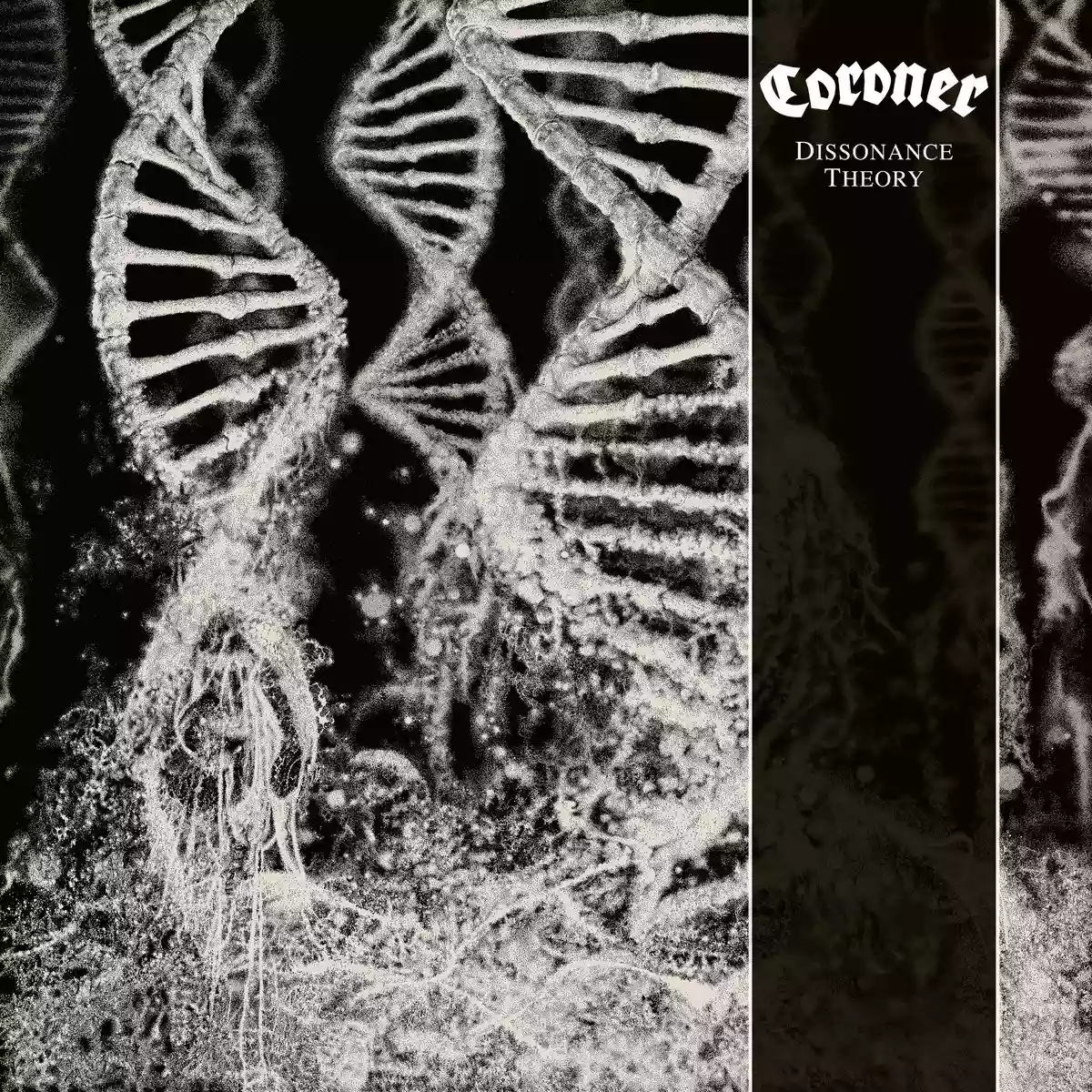
We are greeted by a cover in true Coroner style, with that halfway point between DNA and skeleton that fits October perfectly. After a spectral intro—a classic element of any extreme Metal album—the show starts with Consequence, with a riff that reminds me of one from Paralized, Mesmerized; 32 years that seem much less, with the usual unmistakable voice, Ron Royce’s angular, raspy semi-growl, and Vetterli’s prodigious guitar textures, with the “new” drummer Diego Rapacchietti definitely holding his own compared to Edelmann. Blows upon blows that thrill any metalhead’s ear, but interspersed with calmer passages that wink at Grin and remind me of Sepultura’s valuable artistry. These are the coordinates along which Dissonance Theory moves—between a drum section on Crisium Bound faithfully taken from Divine Step (Mental Vortex) and the pure, hard Thrash of Symmetry, offering up a window in the wall for some headbanging. It’s an album that knows how to alternate intensity and a Thrash metal that deserves the label atmospheric; at the end of Trinity you can even hear a piano—all confirming that these veterans can still eat many rookie bands for breakfast and never miss a beat when it comes to taking Thrash in new directions, much like Celtic Frost did with the underrated Vanity/Nemesis. It’s all sealed by Prolonging, with some whispers recalling those at the start: the circle closes, as it should in any worthy work.
It’s 2025; you can’t kill rock and roll, sang the late Ozzy, and another institution, the immortal Neil Young, reminded us all: rock’n’roll can never die... I won’t give it a perfect score because sometimes a bit of mold pops up, but we can say it: Coroner are back.
Until next time, with a heartfelt thanks to de Marga for the tip-off.
Loading comments slowly
Summary by Bot
The review covers Coroner's 'Dissonance Theory,' praising its technical brilliance and renewed energy. The album stands out as a strong entry in the band's discography, balancing complex musicianship with accessibility. Both longtime fans and newcomers are likely to find something to enjoy. Overall, it's viewed as a triumphant return for Coroner.
Coroner
Coroner are a Swiss technical/progressive thrash trio from Zurich: Ron Royce (bass, vocals), Tommy T. Baron/Tommy Vetterli (guitars), and Marquis Marky/Markus Edelmann (drums). Emerging in the mid‑80s and long cited as underrated, they fused razor‑precise thrash with neoclassical, progressive and later industrial/dark textures across albums like R.I.P., Punishment for Decadence, No More Color, Mental Vortex and Grin. Reunited in the 2010s, they returned with Dissonance Theory (2025, per review).08 Reviews
