
 •
Rating:
•
Rating:
THE REVIEW
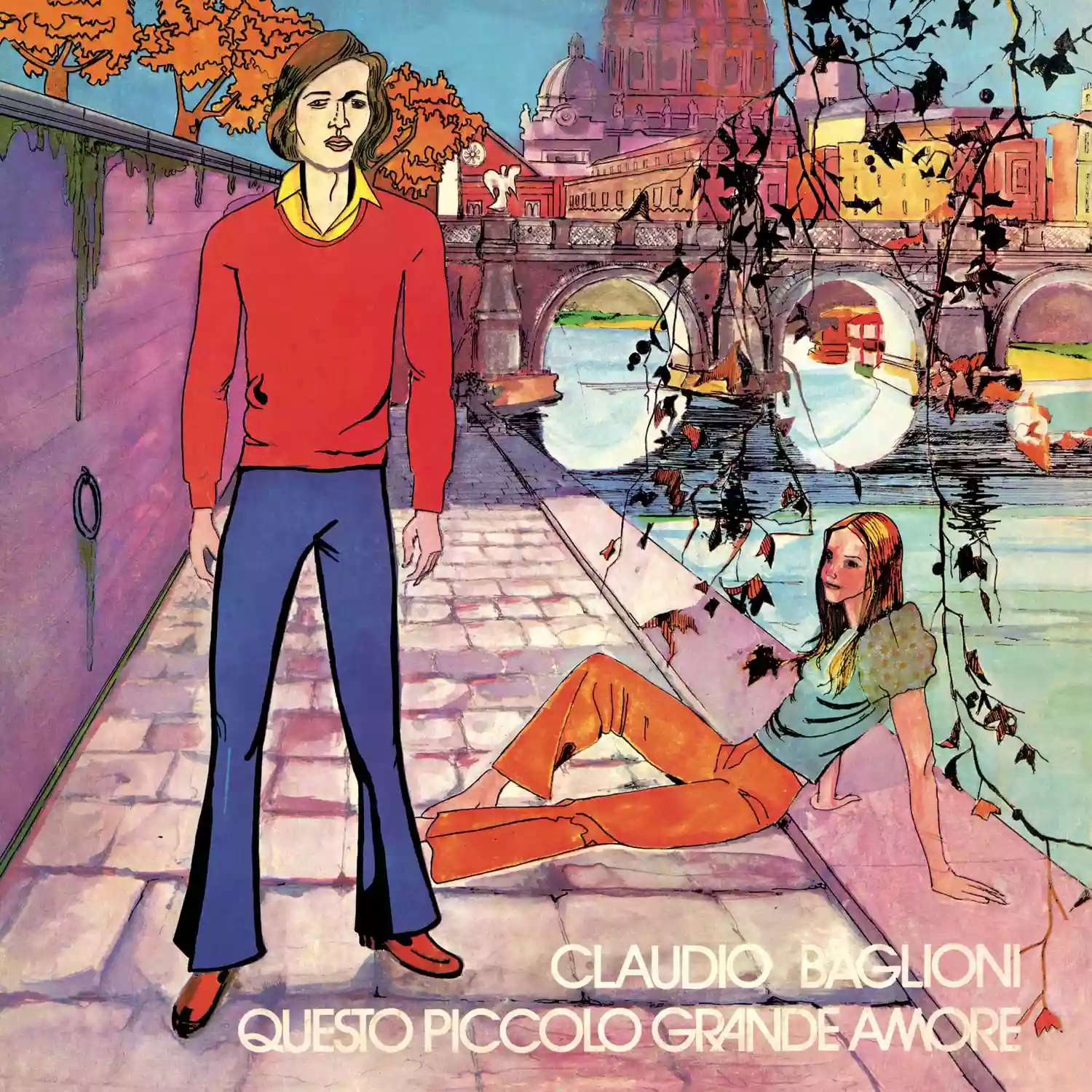
QUESTO PICCOLO GRANDE AMORE (1972) 5.5/10
It makes you think a bit (and cry a little too) when you look at the numbers: “Questo piccolo grande amore” sold almost one and a half million copies and, as is well known, it’s a concept album. I’m not talking about the Who’s “Tommy”, 1969, but even in that same year, 1972, in Italy there were quite different concept albums coming out — above all, the amazing “Darwin!” by Banco del Mutuo Soccorso. Luckily, Baglioni’s “tsunami” was stoutly resisted by Battisti, otherwise this album by the Roman Love Bard would have landed at number 1 on the hit parade. It ended up seventh, behind Pink Floyd’s “The Dark Side of the Moon”, and that’s saying something. But this was the album that opened the doors for the young Roman singer-songwriter (who, incidentally, sold more albums than anyone else in Italian history): the story with singles, however, is quite different, with the title-track becoming wildly popular. Apparently, it is to this day the most covered Italian song (even abroad), so much so that it was named “song of the century” during the Sanremo Festival, anno domini 1985.
It’s a concept album, as I was saying. Certainly more fluid and less heavy than the following “Gira che ti rigira amore bello”, 1973, which would be a slavish copy, but definitely not without its flaws and its excessive, romance-novel sentimentalities. The story is disarmingly banal: he gets lost in Piazza del Popolo, Rome, takes refuge in a bar and meets her; then come pranks among friends, marriage promises made before God (we are, after all, in 1972 in a Catholic country like Italy!), then he leaves for the military, comes back and finds out he’s been cheated on; he returns to his mother’s house, wants to smash the world but in the end realizes there’s nothing he can do (“Giulietta è 'na zoccola” the Napoli supporters used to say to those from Verona, and here I think that fits like a glove). As a “little story” it’s minimal, evanescent, almost silly. But the teenage girls of that era, the laylesque ones, desperately convinced that love was the most beautiful thing in the world, showed no mercy and flocked en masse to buy a 12-inch album that, listened to today, feels like something from the Mesozoic era. Even the language: “'sti cavoli” is an expression that, I think, hasn’t been used for a few decades (just like “dar via il sedere”, although Baglioni’s prudery is understandable given that the censors objected to some of the words in the title-track, since “cose proibite” in the radio version became “scarpe bagnate” and “essere nudi” turned into “essere soli”).
Musically, it’s a nice (so to speak) jumble of sounds. Now, I’m not saying it’s all garbage — I’ll admit that some parts are interesting, even beautiful. For example, I find the dialogue between mother and son in “Quanto ti voglio” (which I consider the best song on the whole album) to be spot on; the sax in “Con tutto l’amore che posso” is just somber enough; the ending of “Cartolina rosa” (vaguely, very vaguely, prog) is a nice musical intuition, just like the very simple but effective chord progression (later repeated often throughout the album) in “Una faccia pulita”. In short, there are some good things here. But there are questionable things too. I think the dialogue with friends in “Ma che begli amici...!” is pretty tragic (especially as far as the lyrics go), not to mention the duet between the two main characters in “Battibecco”, but more generally all the “call-and-response” songs, besides sounding incredibly dated today, are the example of what a sung dialogue should not be (here are some lines, the most syrupy: “...e quanti cavoli, sai mi hai scocciato/se ti scoccio possiamo lasciarci”; “...fai la preziosa, ed io sono stanco/di passare da scemo per te”; “...sai non è per puntualizzare/ma con quella ci hai studiato o ci hai fatto altre cose?”; “...pecorella smarrita, è cotto/la bimba gli ha fatto un bel buco nel cuore”). Not to mention the mysticism that opens side B: “Io ti prendo come mia sposa” would take away anyone’s wish to get married (which, in my opinion, should be the case by law anyway). “Porta Portese” is famous, but anyone who’s lived through that “caciara” knows that Baglioni seriously tones it down, to the point of making it quite unbelievable.
Let’s console ourselves: it’s a unique LP, rather long (53’) but unique, much to Baglioni’s regret, as he had imagined a double LP with a ton of connecting songs that, with a few exceptions, would never be recorded. The best Baglioni is yet to come: the 1980s will belong to him.
Loading comments slowly
Summary by Bot
The review expresses disappointment with Claudio Baglioni's celebrated album. Despite its classic status, the album fails to impress the reviewer. Themes of love and nostalgia are central but unconvincing in this critique. Listeners are cautioned not to expect too much from this 1970s Italian music icon.Tracklist Lyrics Videos
01 Piazza del popolo (01:58)
02 Una faccia pulita (03:16)
03 Battibecco (04:00)
05 Che begli amici! (04:19)
06 Mia libertà (03:50)
07 La prima volta (05:13)
08 Quel giorno (03:21)
09 Io ti prendo come mia sposa (01:47)
10 Cartolina rosa (03:10)
14 Sembra il primo giorno (03:12)
15 Con tutto l'amore che posso (versione orchestrale) (01:46)
Claudio Baglioni
Claudio Baglioni is an Italian singer-songwriter from Rome, a leading figure in Italian pop since the early 1970s. His 1972 concept album Questo piccolo grande amore launched him to national fame; La vita è adesso became Italy’s bestselling album. Through the 1990s he explored denser writing and global sounds with works like Oltre and major tours.28 Reviews
Other reviews
By clauderouges
The new version attempts to bring to light the work as it should have been, and herein lies the merit of the operation.
Changing not only the arrangement, but also the tempo and harmonies of classics like 'Porta Portese' and 'Questo Piccolo Grande Amore' seemed a real tackiness to me.
By Boop7
Baglioni was the first to write about youthful love "face to face" with an immediacy that no one had done before him.
If it were a movie, I would put the closing credits with the instrumental of "With all the love I can."
