
 •
Rating:
•
Rating:
THE REVIEW
“When I was a boy, there were two unpopular things in my house: one was my airplane, the other was my guitar. My father never referred to my guitar calling it Fender or Gibson; for him, it was always the damn guitar... Every time he popped into my room, all I heard was 'Turn down that damn guitar'. (Los Angeles, July 7, 1978, Bruce Springsteen's introduction to the live-act of 'Growin’ Up').
Bruce Frederick Joseph Springsteen, class of 1949, was born in Freehold (NJ), growing up with a stern father (who worked as a prison guard and bus driver) and a tender Italian mother (a mid-'80s bootleg was printed under the name Bruce Zirilli) who balanced the father's austerity by allowing their middle child to cultivate a passionate, affectionate, and highly sensitive temperament. History tells us that Bruce's first guitar was purchased at a flea market, while the rest was done by American radios broadcasting rock 'n' roll and the unforgettable episode of the Ed Sullivan Show featuring Elvis Presley. It's the other America that emerges, where the dreams of a daring adolescent range from those about sex to music, clashing with the reality of the small province he's part of. Thus, the first songs come along, covers performed, accompanied by his six-string, from 'Like A Rolling Stone' by Dylan to Roy Orbison, Rolling Stones, and classic blues and soul.
What is defined as a pre-adolescent trance state leads the young Bruce to form and dissolve bands with uncertain names (from The Castiles to Doctor Zoom And The Sonic Boom) with extreme rapidity. In the vibrant scene of Asbury Park, Springsteen works hard, attending numerous concerts of bands touring the East Coast, reaching the Big Apple, and playing alongside figures like Southside Johnny and other colleagues who will earn a place in the friendly congregation later baptized as the E Street Band. Contact with manager Mike Appel is imminent, as is the legendary audition on May 3, 1972 at Columbia Records, during which John Hammond - discoverer of Dylan and Aretha Franklin - is positively impressed by the personal performance with just an acoustic guitar by a (nearly) anonymous young musician from New Jersey, delivering it authentically and sincerely, which will be his passport to his first record contract with the major label.
The album consists of nine tracks that express a concentration between that urban rock - which Springsteen was used to proposing in the venues where he performed - and a singer-songwriter style with a very simple origin that was far from providing a clear identification of the musical direction taken. The air that is breathed is one of spontaneity and intimacy, accompanied by lyrics in which lost and disillusioned characters clearly represent the embryo of ideas and concepts that will find a better route for the careful evolution that will come in the not-too-distant future.
The opening of 'Blinded By The Light' gives us a taste of the genuineness of a popular-sounding style, revealing all the right cards to spark interest among the patrons of those East Coast venues who could easily find themselves protagonists for an extraordinary night, in the story of an unknown provincial musician. With the driving rhythm of 'Does This Bus Stop At 82nd Street?' and the flexibility of 'Lost In The Flood', beyond the composure of the melodies, makes the listener aware of how important the records of Van Morrison and Gary U.S. Bonds were to the musical formation of the young Springsteen. And if 'The Angel', like 'Mary Queen Of Arkansas', where a deep and cautious personification proves difficult to assimilate, 'For You' finds fertile ground in those who have a naturally available soul to be carried away by that mix of melody and rhythm that marks (perhaps) the first Springsteenian ride. In an album where themes of love, the province, and isolation often recur, the vivacity of 'Growin’ Up', the lush poetry of 'Spirit In The Night', and not forgetting the measured tightness of 'It's Hard To Be A Saint in The City' – placed at the end - form a happy triple that manages to represent, without infamy and without praise, those artistic features that, properly elaborated, can only become trademarks of an impeccable musical identity.
We are facing the first step (or leap?) of a young singer-songwriter (who does not give up on a band of his own) in the jaws of a music-biz that, forcibly and counterproductively, wants to propose him as another Dylan due to that positive air blowing in favor of folk for some time, but that immediately does not bring the expected results. An album conceived to follow and be bottled in the folk-rock stream, although the decent attempt to combine melody and tradition with gentle splashes of that liveliness in which the sax of Clarence Clemons (ex James Brown Band), the drums of Vincent “Vini” Lopez, the bass of Gary Tallent, and the keyboards of David Sancious put their hands in short the baptism of what will be the historic E Street Band.
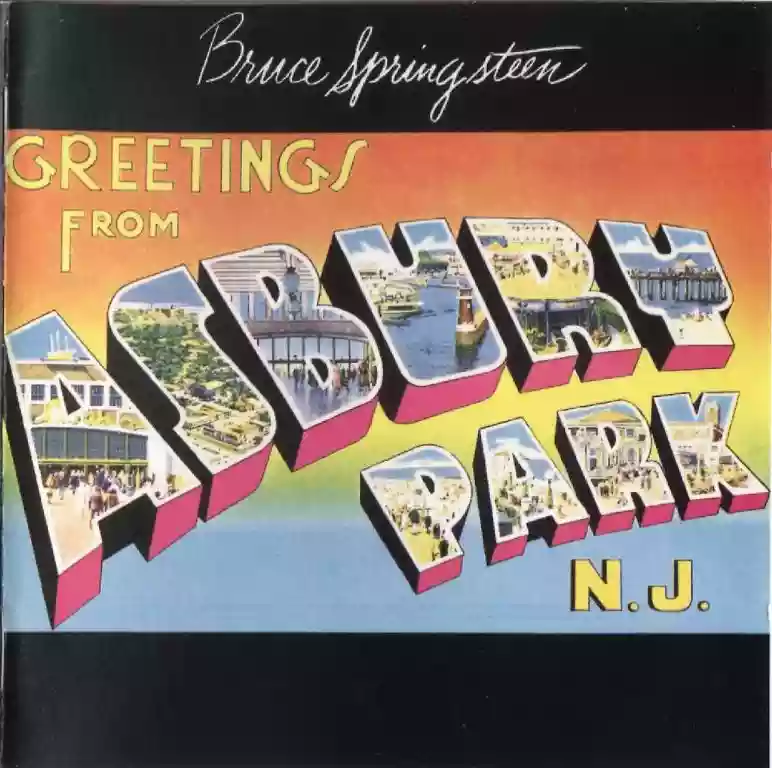
Although the phrase placed at the bottom will help many understand the essence of the record, it is clear to call 'Greetings From Asbury Park, N.J.' a sufficiently defined and castigated work by hesitant production, seeing Springsteen compressed by the market's necessity to follow seemingly clear musical paths, but lacking the ineluctable contamination with that dose of significant expressiveness that only the determination of a particular debutant will soon achieve.
“...when the first record came out, people were scandalized there was no electric guitar! All I heard everywhere I went was 'Where's the guitar, man? What happened?'. I had a big reputation in the New Jersey area – even a little further south – as a hard rock band guitarist.” (Bruce Springsteen interviewed by Bill Flanagan).
Loading comments slowly
Summary by Bot
This review explores Bruce Springsteen’s debut album 'Greetings From Asbury Park N.J.', highlighting its folk-rock style, raw spontaneity, and lyrical themes of youth and isolation. It discusses early influences and the initial industry pressure to shape Springsteen’s music within folk traditions. The record captures Springsteen’s budding talents and hints at the iconic sound he would later develop with the E Street Band, despite its hesitant production.Tracklist Lyrics Videos
Bruce Springsteen
Bruce Springsteen (born 1949 in Freehold, New Jersey) is an American singer-songwriter and bandleader best known for his work with the E Street Band. His career spans from the 1960s/1970s to the present, with landmark albums such as Born to Run, Darkness on the Edge of Town, Nebraska and Born in the U.S.A.90 Reviews
Other reviews
By Night87
"Lost In The Flood can easily be considered among Springsteen’s 15 best songs."
"I recommend this as the album to start with to appreciate the resources of this extraordinary singer-songwriter."
By MAR1973
Inside the album, there are some authentic gems like "Growin' Up" and "Lost In the Flood."
An unsettled record, perhaps still unripe, but already crowded with those characters that will populate Springsteen’s songs in the future.
