
 •
Versione 1
Rating:
•
Versione 1
Rating:
THE REVIEW
To translate is to betray.
If an expression like "blood on the tracks" makes me think of a bleeding guy walking and leaving footprints (tracks) full of blood (blood), and then I read Bob Dylan's Lyrics translated by Alessandro Carrera for the Feltrinelli edition where Carrera translates it as "blood on the rails", my first reaction might be to wrinkle my nose and think nooo, it's wrong! But it's not wrong, because tracks also means rails. And if good Carrera, who is an excellent translator as well as an expert Dylan interpreter, sees a bloody railway track in that expression because someone threw themselves under the train, so be it. But I don't agree. Besides, tracks are also the tracks of an album, the songs. Maybe Bob just wanted to tell us that his songs are full of blood. Or maybe he wanted to say all three things together so everyone could see what they preferred. Yes, it's clearly like that. But to translate, you have to choose one of the three. It can't be helped.
Precisely. Blood on the Tracks is an album you can't escape from. You can't escape it because as soon as you start it and begin to hear the blood flowing through those tracks (whatever they are), you get entangled, ensnared, tangled up in it. Tangled up in blue.
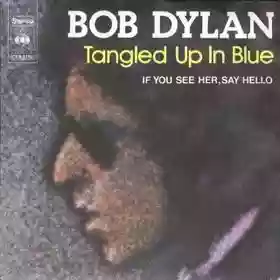
Tangled Up in Blue is the first of the ten blood-stained tracks. Again, how do you translate this? Tangled up, as we've said, means knotted, tangled, ensnared, ensnared like in an inextricable net where the more you struggle, the less escape you have: it's a very clear and powerful image. And Blue? It's a color (blue). It's a state of mind (sadness, melancholy, the pain of living). It's a musical genre (the blues). It's an album by Joni Mitchell (wonderful). It's all these things together, maybe excluding the last one, perhaps. It's the color of the tangled thread that wraps up events, thoughts, and characters and draws them from one point to another in time and space, weaving the strands of a story whose beginning and end aren't clear, evidently because the blue thread is too tangled to develop in a linear manner. The blue thread is life. Life is blue. Life is tangled. Life is sadness and melancholy. Life is the blues. And I know no one can sing the blues like Blind Willie McTell. But that's another song.
"I wanted that song to be like a painting", Bob said in a 1986 interview. Ut pictura poesis. In keeping with the ancient Horatian teaching, the Bard of Duluth dips his brush in blue, and with quick strokes, precise and elusive at the same time, outlines not one, but seven little scenes in which an I and a she meet, lose each other, find each other, abandon, forget and seek each other only to lose each other again: farewells in the rain, daring escapes, murky stories of "slave trade" (prostitution? Rimbaudian projections?) punctuated by the seven stanzas, and there they are, punctually, the damned blue threads that wrap around the two protagonists, tie them tightly and ensnare them, catch on their shoelaces and make them trip (literally: "she bent down to tie the laces of my shoe, tangled up in blue"), and then when everything seems to be going right, they grab you and pull you down to the bottom without hope: "and eventually the floor gave way, I fell through, the only thing I could do was keep on keeping on like a bird that flew tangled up in blue." Are birds perhaps free from the chains that bind them to the sky?, as recited in a Ballad in Plain D from several years earlier.
At the center of it all, the key scene. "She opened a book of poetry and handed it to me, by an Italian poet of the thirteenth century, and each of those words rang so true and shone like a burning ember spilling off the page, as if they had been written in my soul for you.” Who could this Italian poet be? "Plutarch", Dylan answers to the interviewer, and you can almost see him sneering mockingly. What a joker, Bobby! Pretending to confuse Plutarch with Petrarch. Pretending not to know that Petrarch lived in the fourteenth century, not the thirteenth. Pretending to allow that the book cited in the text might be something other than Petrarch's Canzoniere.
Anyway, the blue thread doesn't untangle. We've taken for granted that there are two protagonists. But what if there are seven different stories, with seven different men and seven different women, united only by the inextricable tangle that binds and separates them? Suppose there are seven different narrators and always the same woman? "We always did love the very same one, we just saw her from a different point of view", Dylan concludes in the live version included in Real Live. Indeed.
And suppose there are seven different women and a single narrator? Blood on the Tracks is a profoundly autobiographical album, so let's consider for a moment that the narrator is the same Bob. Then the ghost of the troubled relationship (recently concluded with sadness) with Sara Lownds re-emerges. Montague Street becomes the Greenwich Village of the Sixties with "music in the cafes at night and revolution in the air," and she takes on the familiar features of Joan Baez, while the Italian book of poetry might well be from the extremely Italian (by origin) Suze Rotolo, the one on the iconic cover of The Freewheelin' Bob Dylan. But in the end, this seems to matter not, because in the end, in the last stanza, our hero is still on the road (Kerouac always present) heading towards a new joint (a "place" like the topless place a few stanzas earlier, or rather a "crossroad," metaphorical or otherwise, on his path?) and all the people he met and talked about seem to him like "just an illusion," somewhat like the characters in Desolation Row, whom he had to "change the faces and give everyone another name," because they would otherwise be too insignificant to speak of. Here, in any case, all are dismissed as mathematicians and carpenter's wives. Mathematicians and carpenter's wives.
Perhaps it's just a coincidence that in 1965 Bob declared, "The songs I sing are mathematical songs", which would make him, in this sense, a "mathematician." Perhaps it's just a coincidence that his real last name is Zimmermann, and that in German zimmermann means carpenter.
To translate is to betray.
Loading comments slowly
Summary by Bot
This review deeply analyzes Bob Dylan's 'Tangled Up in Blue' from the album Blood on the Tracks, focusing on the challenges of translating its layered meanings. It explores the symbolism behind key phrases and lyrics, and the autobiographical nature of the storytelling, portraying life’s tangled, melancholic threads. The review respects Dylan’s poetic style and offers thoughtful insights on the song’s complexity and emotional depth.Tracklist Lyrics
02 Little Moses (03:42)
04 Rainy Day Women #12 & 35 (02:39)
08 Stuck Inside of Mobile With the Memphis Blues Again (08:20)
09 Rainy Day Women #12 & 35 (04:11)
11 I'll Be Your Baby Tonight (06:16)
12 I Don't Believe You (She Acts Like We Never Have Met) (05:19)
14 Ballad of a Thin Man (06:04)
16 Love Minus Zero/No Limit (03:10)
20 Idiot Wind (09:39)
Bob Dylan
American singer-songwriter Robert Allen Zimmerman, known as Bob Dylan, is a major figure in 20th-century popular music, noted for pioneering songwriting and continual reinvention across folk, rock, country and blues.127 Reviews
