
 •
Rating:
•
Rating:
THE REVIEW
There is no doubt that among the bands that left an indelible mark on the punk imagination, interpreting the hardcore style of the Eighties, Bad Religion is certainly among the hottest names along with Minor Threat, Black Flag, and Dead Kennedys.
After their formative experiences which were rougher and contemporaneous with the sounds of those years created by teenagers ("How Could Hell Be Any Worse?" the debut album was released in 1982), their experiments with synthesizers and temporary disbandment, the end of the decade represented a new and fundamental beginning for Bad Religion.
"Suffer" (1988) and especially "No Control" (1989) masterfully codified the lexicon of the new Californian melodic hardcore dictionary for the decade that followed—epicness and freedom became synonymous with Bad Religion.
Punk transcended its mere protest to elevate itself to an analysis and high-level reflection on contemporary man and society and their vices.
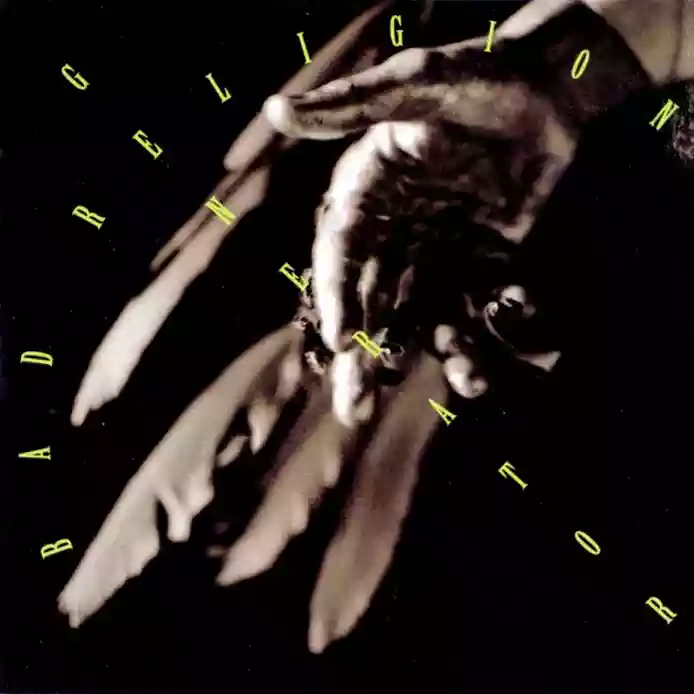
If "No Control" represented the paradigm, the secular sacred scripture to be studied at school during music lessons instead of recorder scores, "Generator" picks up where the previous "Against The Grain" (1990) left off by expanding the horizon with more melodic refinement.
"Generator" leaves its decisive footprints thanks also to its solidity and compactness showcased in just 11 songs (despite the 17 on the previous album) and the wide range of solutions adopted. These characteristics allow us to place it on the same qualitative level as its predecessor.
And while not giving up the timeless races filled with vigorous solos over vast open spaces and green fields ("Fertile Crescent" with a memorable guitar work – "Too Much to Ask" – "Heaven is Falling," practically an over-vitamined and accelerated folk), they are accompanied by more experimental episodes for them like "The Answer," which showcases a subdued and melancholic Greg, and "Two Babies in the Dark," where a more classic soft-rock narrative demonstrates, if it were necessary, that Bad Religion's bow can unleash powerful and precise arrows even if they are different from each other without missing anything.
The repertoire also includes the initial tongue-twister of the title track (summarizing archetype of the credo), the superb pair "No Direction" - "Tomorrow," and the choral goodbye to 1993 and "Recipe For Hate" with "Only Entertainment." "Atomic Garden" will go down in history as the first song for which a music video was recorded, but it risks almost being overshadowed by so much quality.
The recordings of the album date back to the spring of 1991, although it was not marketed until 1992, always for the usual Epitaph.
The lyric writing process was highly influenced by the Gulf War, which was taking place in those very years in the Middle East between allied forces and Iraq. The lyrics, as usual, always above average, feature reflections on various themes dear to them, such as the environment and man as the common denominator.
With "Generator," closing the 1988-1992 four-year period, Greg, Brett, Jay, Greg, and Bobby lay down their cards, giving yet another demonstration of a now mature, intelligent punk that was distant from the original one, a triumphant and epic fresco closing a magical and unforgettable period.
A long reign that has successfully reached today's times and still continues.
Loading comments slowly
Summary by Bot
Bad Religion's 'Generator' album marks a pivotal moment in punk, blending melodic refinement with hardcore roots. Released in 1992, it builds on previous works with experimental touches and socially conscious lyrics influenced by the Gulf War. The album is praised for its quality, variety, and lasting impact on punk music.Tracklist Lyrics Videos
Bad Religion
Bad Religion is an American punk rock band formed in Los Angeles in 1979, known for pioneering melodic hardcore and for close ties to Epitaph Records.27 Reviews
Other reviews
By Lewis Tollani
"Generator saved my life."
"It’s the story of a boy who had become completely impervious to the world... none of the directions he had taken so far had been the right or at least the lucky one."
