
 •
Rating:
•
Rating:
THE REVIEW
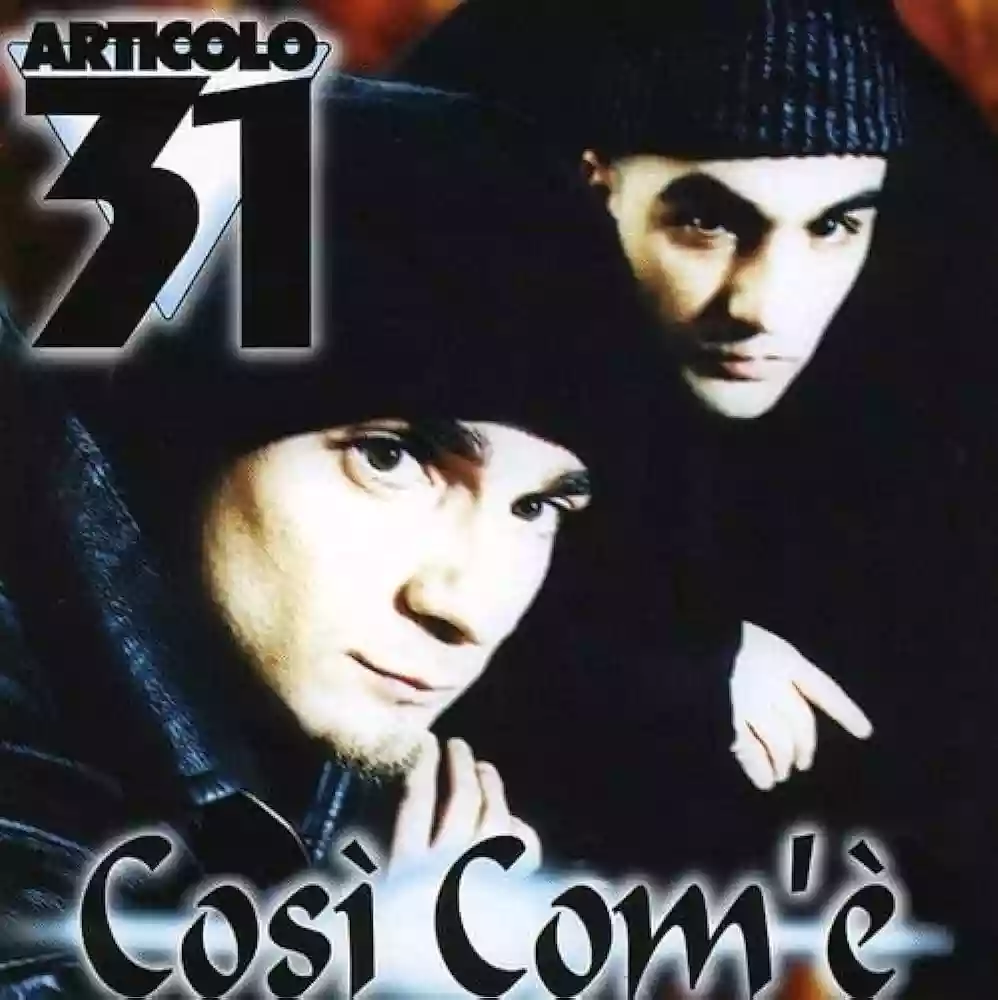
In 1996, J-Ax and DJ Jad, known as Articolo 31, released their third album, "Così com'è": vibrant, colorful, and delightful like a box of chocolates (P.S.: since this comment is practically found in all the reviews of this album, I thought it would be rude not to mention it here as well).
At the time, rap/hip hop wasn't very widespread in Italy, and therefore they deserve credit for helping to popularize this genre, especially with this third album, given its great public success (over 600,000 copies sold!). It must be said, however, that their rap/hip hop was "contaminated" and "grafted" with Italian singer-songwriter music. For their part, the two had never hidden their great admiration for this latter music genre and had always declared their infinite esteem and respect for its protagonists, especially for Rino Gaetano, their true mentor as well as a muse and source of inspiration! The confirmation of this "Italian rap/hip hop" is embedded in this work, where in "Così e cosà" appears the sampled voice of the late and mentioned Rino Gaetano, who recites part of the lyrics of "Gianna," while Lucio Dalla joins with his voice in the track "L'impresa eccezionale," covering some verses from his evergreen "Disperato erotico stomp."
In "L'impresa eccezionale," in particular, J-Ax is desperately searching for an extraordinary feat and "takes to the streets" to find a partner or perhaps a guide who can support him in this "mission" of his. So, on his path, he first meets a certain "Susan dei fighetti," who, when she walks by, leaves young men utterly stunned with her derrière, dances on the cube professionally, and her greatest aspiration is to marry a footballer, besides opening a liposuction center for dancers; then he meets a hippie named Antoncarlo Cuggiani, who reads Marx's "The Capital" with L'Unità under his arm, proposing a "revolución" by occupying the Esselunga supermarket and turning it into a macrobiotic food outlet while screening Austrian neorealist films in the housewares section, only to answer the phone from under his kafia saying, "Ue Renè, yes, don't worry, of course I'll come to the party, I'll come with the Range and Fifi with the Smurfs' Porsche," concluding with "I must go, for Renato's party the revolución can wait"; finally, he meets a certain Mario Bianchi, a street vendor of French fries, baked pears, milk caramel candies, and glazed apples, who claims to be a college dropout, working two jobs to pay off his mortgage, supporting his mother and sister, and buying everything in installments, even the fridge. At this point, J-Ax, realizing the advice the latter wanted to give him, greets him respectfully and, after concluding that the extraordinary feat is being normal, heads home thoughtfully, and the ending (narrated by Dalla's voice) is identical to the Dalla piece: "I lay down on the sofa, closed my eyes a little, and with sweetness, my hand drifted away": fantastic!
Another peculiarity, compared to "original" rap/hip hop, is the frequent presence of female choirs in their songs, as is the case in two hits here: "Tranqi Funky" and "Domani." While on one hand, this has the effect of making this music genre more "palatable, digestible, and salable" (and the already cited over 600,000 copies sold testify to this without a doubt), on the other hand, it also makes the "hardcore and purists" of this genre turn up their noses, from whom our two "31" would be snubbed and often even despised, especially after the resounding success of this album. As if such a genre should necessarily remain niche to preserve its purity and success was a grave and serious fault. Or maybe it was just a little bit of (un)healthy and simple envy that made them react this way toward two who, unlike them, had made it? I would lean more towards this latter hypothesis, also considering the fact that Ax and Jad were certainly not born and raised in silk, but came from the most degraded outskirts of Milan. And therefore, their success also represented a chance for redemption for them, as you can infer between the lines (but also outside the lines) of some of their songs.
In this "Così com'è" there are pieces that have become very famous and still are today, and they are certainly the most carefree and fun ones, which made thousands of people sing at the top of their lungs and dance: besides the already mentioned "Così e cosà," "L'impresa eccezionale," "Tranqi Funky," and "Domani," we also highlight "Un urlo," "2030," "Così com'è," "Il funkytarro." Regarding the lyrics, some (or parts of them) are memorable! Randomly quoting: "And on this funky I enjoy myself and don't scream, Like Parmacotto: Get yourselves one" (Tranqi Funky); "So much nostalgia for the nineties, when the world was the ark and we were Noah" (2030) - P.S.: at the time it seemed impossible to have nostalgia for the nineties, yet...; "I'm trash like Marini and Adriano Pappalardo, I was the one popping wheelies with the Ciao, with the t-shirt of the Squallors Arrapaho....Funky like Pino D'Angiò, but Tarro like Massimo Ciavarro...I'm a pig, I'm a miscreant. I rhyme in the city, without shame or regard: I'm a funkytarro" (Il funkytarro).
Alongside these famous pieces, there are others that didn't share the same fate, some even fun and carefree ("Gigugin," "Fatti in là," "Latin lover," "Con le buone," "Sono l'M.C."), others decidedly darker, reflective, and introverted ("Non c'è rimedio," "Fatti un giro," "Tocca a me," "Sono fuori"). In the less carefree tracks, the music is less "contaminated," less carefree and danceable, sadder, and closer to "original" rap/hip hop; moreover, none of these last tracks became famous: I think both these circumstances are not coincidental. The relevant lyrics are much crunchier and more realistic, while not forgoing even in this case some "frolicking," as for example "I'm out there, like farmers when they harvest tomatoes," from "Sono fuori."
From "Non c'è rimedio": "Sometimes I get angry and appear brooding, you think I'm thoughtful, I feel dangerous, the acid rises in my stomach. And when I eat crap, I don't always shit sugar." But the most indicative track in this sense (musically too with guitar and sax and an almost jazzy sound emphasizing the prevailing sadness that surrounds everything) is surely "Fatti un giro," with its "street" language: "Come see, come see, take a stroll in the neighborhood. Luca got the good stuff yesterday; tonight, maybe he has it, maybe we'll go out. Leave me alone, I have to get it together. What the hell are you looking at? Turn around. You said today, now pay me. And if you have no money, do me a favor: I have a package to deliver in my garage. They took my scooter, believe it! I bet on Milan, maybe I'll hit thirteen! I'll pay my debts, and to hell with it, I'll leave this place. Where the hell is Vito? Buy me this beer; get the car, I want to go looking for chicks. Damn, it's Monday, and then it rains."
In the less "carefree" tracks, in my opinion, the true nature and true character of J-Ax emerge, maybe even arrogant, presumptuous, and boastful, but with a characteristic that would be completely lost in the albums following this one: sincerity. Perhaps it's true that success is harmful!
At the time, I contributed to their aforementioned success by purchasing the CD (original!): I am a confessed offender, so I hope for clemency or at least some mitigating circumstances. But, on the other hand, I am absolutely not regretful for having done so, and therefore I think clemency and (potential) mitigating circumstances can be damned!
"Cogito ergo sum, boom!"
Loading comments slowly
Summary by Bot
Articolo 31’s 1996 album Così com’è is a landmark in Italian hip hop, blending rap with singer-songwriter influences and achieving great commercial success. Featuring iconic collaborations with Rino Gaetano and Lucio Dalla, the album captures both fun, danceable tracks and deeper, reflective songs. Despite some criticism by hip hop purists, the album’s heartfelt sincerity and wide appeal helped popularize the genre in Italy. The reviewer praises the album’s memorable lyrics, cultural relevance, and the duo’s authentic storytelling.Tracklist Lyrics Videos
Articolo 31
Articolo 31 are an Italian hip hop duo associated in the reviews with J-Ax (Alessandro Aleotti) and DJ Jad (Luca Perrini). Their early work is depicted as foundational for Italian hip hop and later work as a controversial shift toward crossover/pop-rock.18 Reviews
Other reviews
By Viva Lì
Articolo 31 bring hip hop into millions of homes and contexts.
'Così com'è' is a colorful, vibrant, enjoyable album like a box of chocolates.
By daftroby
"Sono solo robe vere, vere come la roba che canto" – emphasizing authentic storytelling.
‘Too funny; in their own way, ingenious, simple, genuine.’
By becchino
This album SUCKS... IT'S A PIECE OF CRAP!!!!
Those who understand good music, listen to me and steer clear of this stuff!!
By DEMIAN
"We all have 2 faces. We have a public facade... and then we have the more intimate and turbulent side."
"That fantastic record is the greatest success (and the best work) hip hop made in Italy of all time."
