
 •
Rating:
•
Rating: THE REVIEW
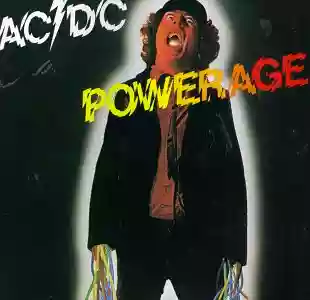
We have reached a point in AC/DC's career where the album "Let There Be Rock" had brought some more recognition to the band, allowing the five rockers to perform outside their native Australia. The band started with blues (which was very present in their earlier production "High Voltage"), which during the band's "growth" transformed into hard rock. The work in question was released in the now distant 1977, a year when the hard rock genre was already something tangible and approved in Europe through bands like Deep Purple, Led Zeppelin, or Scorpions. In the new continent, it was also well-known, and part of the credit surely goes to AC/DC. "Powerage," being sandwiched between two masterpieces like "Let There Be Rock" and "Highway to Hell," has always been somewhat overlooked by critics. But now, let's analyze this record.
It begins with the engaging rhythm of "Rock'n'Roll Damnation," a track featuring an amazing riff that sticks in the memory, a riff in perfect AC/DC style, with Bon Scott highly energized, especially in the chorus, and even the entire rhythm section is almost perfect. The only flaw is that Angus Young performs a solo that isn't quite memorable, but he will make up for it in the following "Down Payment Blues," where the pace is less intense but still spectacular, and the schoolboy delights us with incredible virtuosity. "Gimme a Bullet" is another track that can be described as a semi-masterpiece, with more well-crafted riffs. This is the perfect song, in my opinion, for driving. But all these qualities are solidified with "Riff Raff," which has the same modes as the previous one, but Scott becomes more enraged, the schoolboy's refrains are even heavier, and the solos are very fast. Yet the best moment of the record is surely this, it's "Sin City," where the main riff is repeated ad nauseam, the singer's performance is, as usual, full of screams, then at a certain point everything calms down; from wild, the band becomes very calm, and Bon will sing very low notes before returning to screaming, Angus performs very powerful and never boring solos. "What's Next to the Moon" initially doesn’t seem like much, but when Bon starts singing, you will change your mind: great riff, great solo, and it continues well. With "Gone Shootin" there’s a return to blues, everything becomes calmer, even the singer: this is a nice idea, however, the track leaves you a bit indifferent. The record is closed by two songs like "Up to my Neck in you," which is dominated by a "kilometric" solo, and "Kicked in the Teeth," with high-pitched and screamed vocals by the singer; otherwise, everything is very rhythmic and perfect as usual.
This is one of those records that are not recommended because they are not deemed masterpieces. That we don’t have a masterpiece on our hands is for sure, but it's still a great album in full AC/DC style. It will also be the penultimate of the "Bon Scott Era", and to think that everything seemed to be going smoothly; no one could have predicted that after the next "Highway to Hell," one of the greatest characters of all time, yes, because he wasn't just a simple singer, but a driving force, a truly unique and absolutely inimitable character would leave, leaving a legacy to Brian Johnson, who, no matter how good, cannot "handle" it, and in my opinion, no one ever will.
RATING: 3.50
Loading comments slowly
Summary by Bot
Powerage is an underrated AC/DC album from 1977 that sits between two iconic releases. It features powerful riffs, passionate vocals by Bon Scott, and solid guitar solos by Angus Young. Though not considered a masterpiece, it remains a strong hard rock record with memorable tracks like "Sin City" and "Rock'n'Roll Damnation." It highlights the band's evolution and the final phase of the Bon Scott era.Tracklist Lyrics Videos
AC/DC
AC/DC are an Australian hard rock band formed by Angus and Malcolm Young, known for raw riff-driven songs and large-scale live shows.74 Reviews
Other reviews
By alfo
Powerage is a splendid album that finds AC/DC in great shape and definitely in their most creative moment.
There are no valid reasons to put an album that rightfully belongs among AC/DC’s best works on the back burner.
By teenagelobotomy
"Powerage turns out to be... a unique album in weight and power, if not the most aggressive, certainly the most compact and powerful."
"Riff Raff... certainly the masterpiece of the album."
By JonnyORiley87
Powerage passed unjustly in near general indifference of the time, actually proving its strength between two gems of the caliber of Let There Be Rock and Highway To Hell.
The apex of the album is reached with the Rock/Blues gem Gone Shootin’: a nearly funk-like beginning grows into a monstrous solo that seems never-ending.
