
 •
Rating:
•
Rating:
THE REVIEW
In 1977, "Let There Be Rock" and the subsequent live album from the first world tour, "If You Want Blood, You've Got It", made waves everywhere, causing confusion. They were mistaken for punk, described as raw and rude. But the more the specialized press tried to debunk the phenomenon, the more AC/DC grew immensely. There was talk of teenage rock, of temporary success tied to image. Nothing could be more wrong. Behind the chatter were five technically skilled musicians who knew how to play for sheer pleasure.
Their compositions are simple harmonic progressions built on the classic rock’n’roll structure, yet enriched by years and years of studying their roots. Their lyrics address youth unrest without falling into trendy or contrived traps. What strikes one about their music is the simplicity, the brute force of a guitar solo aptly unleashed, the incredibly beautiful and powerful voice, and a tidy and clean rhythm section. The leader is Angus Young. The guitar seems to burn in his hands while his crazy swaying on stage in typical English college uniform becomes over the years a spectacle within a spectacle; Malcom Young stands aside with his Gibson Les Paul, composing and rhythmically directing his little brother's antics.
The singer Bon Scott has a voice reminiscent of Robert Plant’s, sharp and shrill, yet never overdone, capable of standing out as the absolute protagonist but ready to step back. He is the ideal partner for Angus, a true receptive end-point for those nervous pulses. In 1980, he would die on stage during a concert due to an electric shock from his microphone, and AC/DC would lose much of their instinctive energy with him.
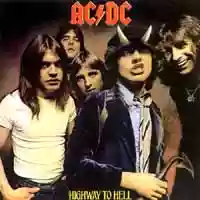
In 1979, while the new wave tried to bring order to the anarchy left by punk, they arrived in a sleepy London, where a young person could do nothing but sing in a rock’n’roll band. Angus and his crew certainly did not hesitate, and, with or without Mr. Jagger's approval, took his words as pure gold, playing for an entire week in a Hammersmith packed with youngsters. By day, they shut themselves in the legendary Rondhouse Studios, where they brought to life their manifesto album: the award-winning Highway to Hell, a crucial work because it was recorded for the first time outside Australian borders, in one of the world’s most famous studios. In this climate of conflict between the specialized press and concert audiences, the band’s sound stands out, representing at the end of the '70s the most modern offering that the oldest hard rock could propose. The guitars are not compressed so their energy can be unleashed.
From a compositional perspective, the group strives in every way to go beyond tradition seeking as many potential variations to old musical patterns. Highway to Hell opens with the title track and it’s immediately great music:a classic rock’n’roll where Malcom’s strumming draws an appealing and nervous riff. Phil Rudd's drumming accompanies without anticipating, and Scott's voice is perfectly balanced, not losing its power. When the chorus starts, if we close our eyes, we can imagine thousands of arms raised. The solo is sharp and effective, but we have just turned the ignition key. The verses are unusually fluid while addressing important themes that highlight the hidden side of life, the one that leads to quickly burning the stages towards an unknown destiny: better a lively and crackling hell than a discounted, boring paradise with too much light. It continues with Girls Got Rhythm, which remains on the tested tracks of timeless rock, certainly powerful but never annoying, with space for appreciable instrumental interventions and good rhythmic construction. A few seconds of silence for the opening of Walk All Over You, an electric and sumptuous blues, all played on the two guitars of the Young brothers, rhythm and lead intertwining as they please, holding the piece's threads. The slow pace of the blues creates warm and sensual atmospheres on which Scott interprets the verses with emotion, dealing with one of the classic themes of rock imagery: sex as a daily escape from reality. Touch Too Much is the classic song for concert openings, a true exercise of style and power: intro, phrase, chorus, solo, phrase. All non-stop and all perfect. The first side closes with Beating Around the Bush.
The second side opens again with pure electricity freely flowing from the speakers: Shot Down in Flames is hot and precise, and the following Get It Hot is no less so. With If You Want Blood... the discussion inevitably expands, the track is fast and well-constructed, with a delightful underlying melody that testifies to the Young brothers' ability to write songs in an admirable way. Love Hungry Man is almost melodic, with one of those cursed tracks that, if you catch them in the car, you risk swerving. But it’s not over. There is still time for another blues that closes the work with searing feedback: Night Prowler. The test is passed, the cleanliness of the English technicians could do little against the will of the five Australian boys, critics from around the world will continue to turn up their noses out of principle, but they will go on their highway to hell, a hell that would reach them the following year when Bon Scott would be struck down on stage, a poor and immortal hero for timeless music, never the same as before, but more so afterwards.
Loading comments slowly
Summary by Bot
This review praises AC/DC's 1979 album Highway to Hell for its raw energy, timeless rock riffs, and strong musicianship. It highlights the contributions of Angus and Malcolm Young, frontman Bon Scott’s vocals, and the album's status as a pivotal classic rock release. The album is seen as a modern hard rock milestone, capturing youth unrest with powerful simplicity.
AC/DC
AC/DC are an Australian hard rock band formed by Angus and Malcolm Young, known for raw riff-driven songs and large-scale live shows.74 Reviews
Other reviews
By JaymezHetfield86
We are talking about Highway To Hell, one of the most representative albums by AC/DC, certainly one of the best three or four produced by the Australian band.
An album that ABSOLUTELY must be included in the collection of anyone who listens to Rock 'n' Roll and Rock in general.
By metallicaliveshit88
The characteristic of this CD is that it exudes energy from every pore, and the band was in extraordinary shape.
It represents the creative pinnacle of the band (thanks especially to the inimitable Bon Scott).
By S.I.A.P.
The masterpiece is "Highway to Hell" and the band is the Australian group AC/DC.
This is a record that all hard rock enthusiasts should have on their shelf.
By teenagelobotomy
"Highway to Hell is the absolute pinnacle of AC/DC, better than 'Let There Be Rock' and 'Back In Black'."
"The working methods changed, allowing Bon’s vocal harmonies and technique to shine on true masterpieces like 'Touch Too Much'."
By paolofreddie
Most likely for this reason! I don’t deny that they have been one of the most influential bands of all time.
A bit like with Queen! Their commercial component has elevated them to the pinnacle of the world, but skill is not just about crafting hits and filling stadiums.
