
 •
Rating:
•
Rating:
THE REVIEW
Writing a concept album is an ambitious challenge. The challenge becomes more complex when one feels that to complete one's project, it is necessary to extend creativity into a double album. Consider the scope of the project when the expressive mode of the project itself is progressive music. Finally, consider the complications that arise from tackling the hyper-complexity of life's aspects through a mystical lens, elusive and foreign to Western culture, such as the one proposed by Paramhansa Yogananda in his book "Autobiography of a Yogi" (the book that inspires this album).
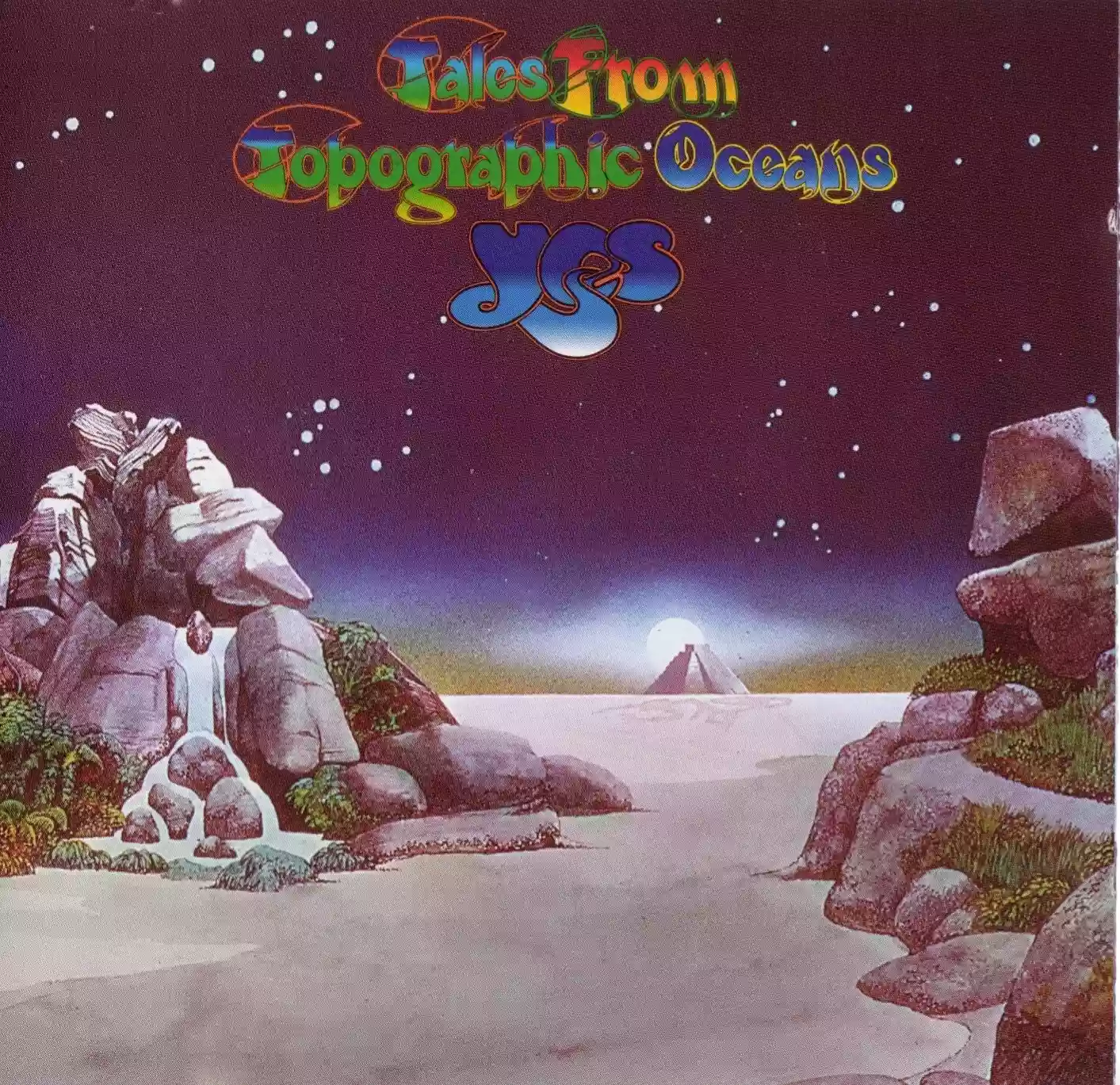
To do all this, an enormous ambition is not enough, but a talent that is out of the ordinary is also necessary. Yes, after having created the splendid "Close To The Edge," felt they could push their abilities to the extreme limits and decided to compose the mammoth "Tales From Topographic Oceans."
The spark for the creation of this album came from Jon Anderson, the band's singer, reading the previously mentioned "Autobiography of a Yogi": a part of this book describes the four shastric scriptures that cover the most diverse aspects of human life. The four shastric scriptures serve as inspiration for as many musical movements, each about twenty minutes long, which outline the majestic flow of this album.
The album notes shed further light on the album's creation by describing an initial creative meeting of about six hours between Anderson and Steve Howe, the band's guitarist, who laid the conceptual, lyrical, and melodic foundations of the future album in a hotel room, during the night lit by a candle. After such an exhilarating creative night, they involved the rest of the band to further develop the material from the initial jam and define the music's arrangements over the next five months.
Talking about the four suites that form the album with generic notes is extremely reductive, especially because each of them is extremely heterogeneous within itself: I find it necessary to arrive at an album description through the different moments of the various suites.
The first movement is "The Revealing Science of God, Dance Of The Dawn". The album notes remind us that "the knowledge of God is a constant and clear search". 00:00/1:32. The initial part of the suite is dominated by Anderson's vocal crescendo, which becomes majestic towards the end, thanks also to the inclusion of Squire's vocals, the band's bassist and founder, Howe, and Wakeman's keyboards. We are in the presence of an introduction where the presence of words is extremely tight, resulting in an excess of "verbosity" necessary to introduce the album's mystical themes. 01:33/02:47. White's drums introduce the next instrumental part where, as usual for Yes, the different instruments follow melodic and rhythmic lines that intertwine with one another. 02:48/06:51. Here begins what can be defined as a classic Yes song, with fine time changes and a good variety of melodies that blend and alternate (someone with the melodies of this part could draw out at least three songs). 06:52/07:46. The next part begins with the pressing rhythm of Squire and White on which Anderson's voice and Howe's guitar rise. 07:47/11:11. But it is only a brief jolt as the atmospheres soon become more delicate and ethereal. Howe and Wakeman leave their mark with delicate and inspired phrases before giving way to Anderson's evocative voice. 11:11/12:56. The phrasing present at minute 7:47 resumes here, but it evolves into perhaps slightly less inspired passages. 12:57/16:40. The "waters" calm down again, bringing Yes to one of the album's most inspired moments. The sounds are liquid, the rhythm rarefied and measured, and the splendid melodies are highlighted by Anderson's intense voice. 16:41/17:29. Suddenly, the band's fast rhythmic counterpoints light up, over which rises a fierce and inspired solo by Wakeman. 17:30/20:27. At this point, some motifs present at minute 2:48 are repeated, then fading delicately, bringing the suite to a conclusion.
The second movement is "The Remembering, High The Memory".
"All our thoughts, impressions, knowledge, and fears have developed over millions of years. All this can be linked to our past, our lives, our history… the depth of our inner gaze"
recounts the "Topography of the Ocean". 00:00/05:39. Howe's arpeggios join Wakeman's melodies to gradually welcome Anderson first and then Squire. It's a beginning with great atmosphere, with the defect, however, of being a little monotonous. 05:39/07:43. The music becomes more varied and, with White's drums entering the scene, the rhythm becomes slightly more sustained: it is the first step towards further rhythm changes. 07:44/09:10. This instrumental passage is one of the suite's most beautiful and is constantly dominated by the sweet phrases of Howe and Wakeman. 09:11/10:17. The rhythm rises, and in this passage, the suite is mainly supported by Howe, who in some passages makes the harmonics of his acoustic guitar resonate very interestingly (but this is to be expected from the author of "Clap" and "Mood for a Day"). 10:18/10:37. We are in the presence of a brief instrumental bridge created to lead to the following passage. 10:38/11:11. Here the band accelerates further, exalting Squire's imaginative bass. 11:12/11:52. Another well-crafted instrumental bridge leads us back to the musical themes ranging from minutes 09:11 to 11:11. 14:38/15:50. In this passage, the melodies of minute 05:39 return. 15:50/17:27. Here, Yes reach incredible heights: one of the most evocative instrumental passages I have ever heard in the progressive realm. 17:28/20:38. The suite heads towards the end with a brief song, which risks paling after the previous performance, and concludes with an instrumental passage revisited from minute 11:12.
The third movement is "The Ancient, Giants Under The Sun". This track leads us to reflect on "the beauties and treasures of ancient civilizations"… which have left us an immense treasure of knowledge. 00:00/3:15.
The suite starts with White's percussion to which Wakeman and Squire's riffs are added at first, and later, Howe's slide guitar. I cannot hide a certain antipathy for this intro because, in my humble opinion, it seems to be a filler, the fruit more of skill than inspiration. 03:16/07:57. The level rises slightly in this phase, although we are still far from the best Yes. Alternating with brief instrumental parts, a hint of a song follows a marching-like rhythm and a part where Anderson, favored by the piece's very squared rhythm, "lists" several ways to say "sun" in different languages. 07:58/12:27. From this point begins a long instrumental section where the suite's inspiration, already quite weak until now, seems to return to almost the initial levels: for heaven's sake, great skill, but it seems that this part was created by "scraping the bottom of the barrel". 12:28/17:42. Fortunately, from this point on, the suite begins to take off vigorously: Steve Howe enchants with his arpeggios and polyphonic phrases, recalling a gem enclosed in the album "Fragile", "Mood For A Day". Anderson's voice fits perfectly with this "acoustic" atmosphere, providing a warm and romantic interpretation. 17:43/18:34. The suite concludes with a partial reprise of the instrumental present at minute 07:58.
The fourth movement is "Ritual, Nous Sommes Du Soleil".
"Seven notes of freedom to learn and know the ritual of life. Life is a battle between evil and pure love sources".
00:00/04:01 The fourth suite begins with an instrumental part that opens the imagination towards large landscapes, interrupting at times with brief but beautiful accelerations. 04:31/11:07. At this point, an instrumental opens that slowly weaves the bases for Anderson's singing. Throughout this part, note how Squire and Howe refine and embellish the track with moderation: these musicians are truly models to aspire to. 11:08/16:58. From this point begins an instrumental that opens up on ethereal atmospheres before decisively changing register, making way for a splendid bass solo by Squire, followed by one of the most aggressive and fierce solos ever performed by Howe. Another instrumental section follows, dominated by White's percussion, which calls to mind the "battle between evil and pure love sources" mentioned in the notes. 16:59/21:35. Howe's guitar brings us back to the motifs present at minute 4:31 before ending in an exciting final solo.
The journey is over, and it has been a long and intense path to which I am very attached. In conclusion, we are in the presence of an album not without defects, fiercely criticized by some (punk lovers in the lead), often defined as a "lifeless elephant" and a "degeneration of progressive music" (even "The Lamb Lies Down On Broadway" by Genesis is still talked about in these terms by some), while others love it unconditionally.
In my opinion, it is an album that requires many listens and much time to appreciate its complexity and beauty: I do not know if everyone is willing to dedicate so much time to an album, but I assure you it is worth it. Furthermore, if it had been "cut down" by about 15 minutes, it would have been Yes's best album.
In 1973 burned an incredible creative fire…
Loading comments slowly
Summary by Bot
Yes's 'Tales From Topographic Oceans' is a highly ambitious and complex progressive rock double album inspired by Paramhansa Yogananda's mystical writings. The album is dissected suite by suite, revealing both inspired moments and some weaker passages. It demands patient and attentive listening to appreciate its depth and beauty. Despite mixed critical reception, it remains a bold creative statement and near-masterpiece with a few flaws.Tracklist Lyrics
Other reviews
By paloz
This album should be considered by everyone as Yes’s work, not a disappointing infinity of nonsense, as many before me have done.
If you have come out unscathed at the end of the album, congratulations, you have witnessed a prog rock masterpiece, born from a very courageous project, but brilliantly executed.
By dissidente
If it’s possible to identify the exact moment when prog reached the point of no return, it must definitely be somewhere within these exhausting, endless, abominable four sides.
Inspired by some accident involving a guru or mystical thinker... Farinelli queen voice unrolls a cascade of nonsense that would make you double over with laughter, were they not inserted into 'songs' with an average duration of twenty minutes.
By Giammotto
"Tales From Topographic Oceans is not a controversial work... it is an album already ingrained in the genetic code of Howe and his companions."
"An epochal album... which really contains very few 'disappointing moments' and towards which I find all this hostility truly ridiculous."
By Ilovemusic
A true masterpiece of progressive rock.
The band's courage to push boundaries is evident in every note.
