
 •
Rating:
•
Rating:
THE REVIEW
Bill Bruford, the exceptional and versatile drummer of Yes first and King Crimson later, announced his departure from Yes in 1972, right after the release of the seminal Close to the Edge. In his opinion, no continued collaboration with the other 4 members would have led to greater artistic heights, so he left while accepting Mr. Robert Fripp's offer, a one-way ticket to the court of the Crimson King.
This event is emblematic of the situation that the remaining Yes members, Jon Anderson, Steve Howe, Chris Squire, and a hesitant Rick Wakeman, faced when they had to construct a new album, keeping Bruford's prophecy in mind. Alan White, an energetic and technically excellent emerging drummer who was touring with John Cocker at the time, was enlisted. His style, as already mentioned, energetic and somewhat rougher than his predecessor’s, is one of the standout elements of this incarnation of Yes, who abandoned Bruford's jazz/fusion drumming in favor of a more rock-oriented approach, which is often noticeable in the reviewed album.
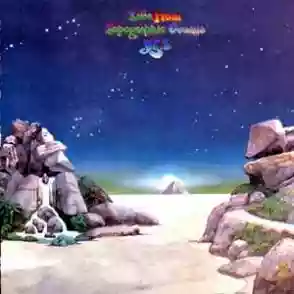
"Tales From Topographic Oceans" is not a controversial work, it's not a crazy album nor a product of exhibitionism, it is an album that was already ingrained in the "genetic code" of Howe and his companions, released moreover in 1973, a very special year for most English prog rock bands, who, as if responding to an inner call, produced swathes of incredibly long and complex albums, even challenging the very free-form standards of the genre.
Moving on to the actual record: it is a double LP, consisting of 4 long suites, one for each side. Each suite individually tackles one of the four classes of writings that constitute the Hindu Shastras. Jon Anderson became familiar with Hindu culture by reading the famous ascetic book Autobiography of a Yogi. Often criticized, rarely loved to madness, let it be known from the outset that this review is essentially positive, so unsolicited detractors stay away.
The dances open with the fascinating "The Revealing Science of God," a track largely dominated by guitar and bass with an exceptional sonic framework from Wakeman. White immediately showcases his style, exceptionally accompanying both the more frantic and more relaxed parts without being too intrusive. This first track, in any case, disproves all theories regarding the supposed total lack of ideas of the band at the time, accused of lengthening tracks with filler and futile parts. The melody, as I said, is constantly changing, and at one point is embellished by the "Voice of an Angel" (as Fripp referred to Anderson) and elsewhere enriched by a boiling bass line, never becoming too heavy, and above all, extremely varied, with breaks and repetitions accompanied by other melodic cues. Not the most beautiful track, but definitely emblematic of the album's style.
The second track "The Remembering: High the Memory" is, in my opinion, the most pleasant and accessible suite in the entire prog landscape. Largely acoustic, enriched at the beginning by a profusion of keyboards that slightly reflect the themes of the first track, it turns out to be extremely catchy and yet extraordinarily rich and very well constructed, with a simply breathtaking finale, as exciting as few.
The album continues with a gem of the rarest beauty, the wild and untameable "The Ancient: Giants Under The Sun." How to define this piece? 12 minutes of oriental jazz-like breaks and parts of rare virtuosity, both percussive and guitar. It begins with an introduction with a sort of beastly Synth-Guitar supported by African-styled rhythms, with a very dark and mournful melody, slightly eerie. A part follows where the mellotron assumes the role of an orchestra in its own right, with about 1 minute of calm and peace, followed by a guitar attack of epilepsy in odd times, adding a strange touch to the reprise of the sweet orchestral theme just before. Thus begins the third part, oriental in style and characterized by Anderson’s haunting and fleeting vocal appearances, where he just has time to say the word "sun" in various languages. At around 9 minutes, a wild escalating solo takes place, assembling new notes from the original vaguely Asian-themed base. Then, just when everyone seemed to be having a great time, a part arrives that leaves me quite puzzled, the classic Anderson/Howe acoustic interlude, totally unrelated to the rest. Was it added to accentuate the slightly disturbing dimension of the track? In fact, it then abruptly interrupts at the end, with guitar lashings that pick up on the theme of the orchestral section and thus conclude an epochal piece, truly one of the most beautiful suites in all of prog.
The fourth track is another forgotten gem, "Ritual: Nous Somme Du Soleil" is a romantic ballad with a romantic lyric filled with ideas and especially containing one of the most beautiful melodies Yes has ever written, the one relating to the chorus. However, a furious ride of mellotron and African percussion breaks the lulling pace, representing the hypothetical battle of good versus evil depicted in the lyrics, which indeed follows the "Preparation-clash-development-ending" scheme that Yes often used in their suites. And in this case, the ending is a delightful leap into vocal darkness, with Anderson, in a voice broken with emotion, declaring "Nous Somme Du Soleil, hold me my love, hold me upon lasting hours"
Nous Somme Du Soleil.
An epochal album, in my very humble opinion as a fourteen-year-old, which really contains very few "disappointing moments" and towards which I find all this hostility truly ridiculous...
Loading comments slowly
Summary by Bot
This review praises Yes' 1973 album 'Tales From Topographic Oceans' as an epic and richly crafted work within progressive rock. It highlights Alan White's dynamic drumming replacing Bill Bruford and the album's deep inspiration from Hindu texts. Each of the four long suites is explored in detail, showcasing the band's creativity and technical prowess. Contrary to some criticisms, the reviewer regards the album as a timeless masterpiece with very few disappointing moments.Tracklist Lyrics
Other reviews
By Shine
It is an album that requires many listens and much time to appreciate its complexity and beauty.
If it had been 'cut down' by about 15 minutes, it would have been Yes’s best album.
By paloz
This album should be considered by everyone as Yes’s work, not a disappointing infinity of nonsense, as many before me have done.
If you have come out unscathed at the end of the album, congratulations, you have witnessed a prog rock masterpiece, born from a very courageous project, but brilliantly executed.
By dissidente
If it’s possible to identify the exact moment when prog reached the point of no return, it must definitely be somewhere within these exhausting, endless, abominable four sides.
Inspired by some accident involving a guru or mystical thinker... Farinelli queen voice unrolls a cascade of nonsense that would make you double over with laughter, were they not inserted into 'songs' with an average duration of twenty minutes.
By Ilovemusic
A true masterpiece of progressive rock.
The band's courage to push boundaries is evident in every note.
