
 •
Rating:
•
Rating:
THE REVIEW
Caspar Friedrich's painting "Monk by the Sea", from 1808, might not be as famous as the artist's masterpiece, Wanderer above the sea of fog, where a man contemplates a jagged and rather hostile mountain landscape. However, the inspiration is similar: the insignificance of man in the face of nature - not necessarily hostile, in fact depicted as attractive, but decidedly unsettling. Above all, a nature that thoroughly couldn't care less about our personal affairs.
In the case of the Monk, the landscape is so reduced to its essence that it almost seems abstract. Friedrich anticipates the shaplessness of modern art and earns himself a place as the distant ancestor of Rothko.
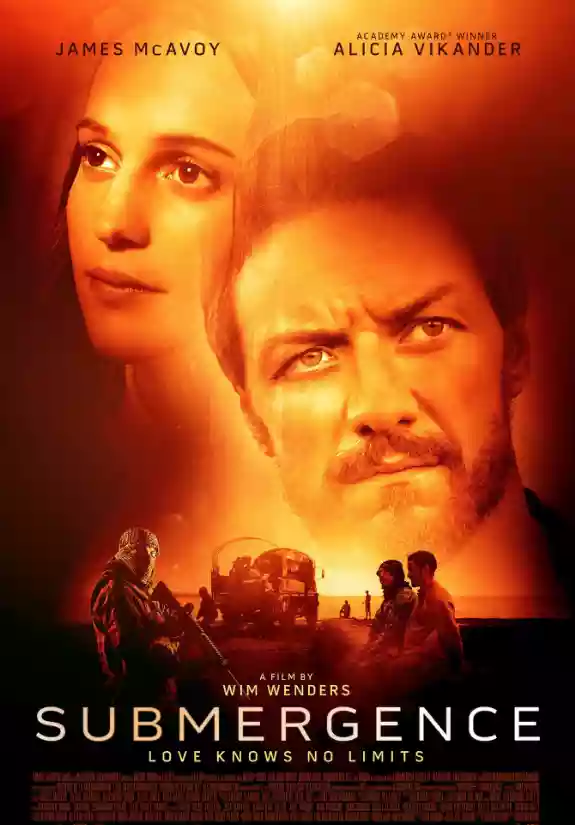
Before being accused of snobbery for this excursus into the art world, let me point out that I studied art history at an academic level and that Friedrich's painting plays a decisive role in Submergence, a 2017 film by Wim Wenders starring Alicia Vikander and James McAvoy, which I found digging through the archives of Prime, where hundreds of decent films lie dormant.
The plot is minimalist to the point of asceticism: Danielle, a biomathematician, and James, a secret agent, meet, fall in love, and challenge an uncertain fate. But the problems already begin with the protagonists' professions. The biomathematician is what laypeople might call a "marine biologist", but Danielle informs us with gentle academic superiority that her work is much more complex. She is searching for the origin of life in the ocean depths. James, on the other hand, is trying to stop already existing life from being blown to bits by terrorist organization. Two different approaches to the same problem.
The two, both endowed with a genetic patrimony clearly above average and shown in various stages of nudity, never vulgar (this is Wenders, not a porno), meet in a luxury resort on the Atlantic (certainly not an "all inclusive" in Ibiza) and fall in love within a few days. In that brief interval, they manage to do what is considered essential in romantic films of a certain calibre: philosophically discuss the nature of existence, stare deeply into each other's eyes and, between one metaphysical reflection and the next, get to know each other in the biblical sense as well.
Then they separate for their respective missions, and here Monk by the Sea makes its return. Wenders takes the metaphor, polishes it, and uses every last drop of it.
The tiny figure painted by Friedrich in front of the immensity of the sea becomes Danielle, enclosed in a metal sphere barely bigger than a wardrobe as she descends to three thousand meters deep. And it becomes James, buried alive in a makeshift terrorist prison.
In both cases, the human being is a fragile creature confronting something immensely greater than himself: the ocean, fanaticism, destiny or, if you prefer, Wim Wenders' screenplay.
Your enjoyment of the film depends on several personal factors:
- your tolerance for Wenders' proverbial philosophical slowness;
- your willingness to watch a love story in which ontology is discussed almost more than passion;
- your appreciation for truly splendid cinematography;
- a sincere admiration for Alicia Vikander and James McAvoy, who practically carry the entire operation by themselves.
However, I must point out two aspects that dampened my enthusiasm.
The soundtrack, composed almost exclusively of classical (or classical-sounding) music, is so insistent that it seems intent on reminding us every five minutes that we are witnessing a Deep work, with a capital D.
But above all, the ending.
It might satisfy fans of open endings, that category who loves leaving the cinema with more questions than they had at the start. Personally, after almost two hours in the company of characters trapped between oceans, terrorists, and existential musings, I would have preferred a less elliptical conclusion. Not necessarily happy. Not necessarily tragic.
Simply, a conclusion.
Loading comments slowly
Summary by Bot
This review explores Wim Wenders' movie 'Submergence,' focusing on its dramatic elements and overall execution. The reviewer provides a balanced critique, highlighting strengths and weaknesses. The film garners an average rating, suggesting some missed opportunities. Emotional depth is noted, but not fully realized. The review helps viewers decide if 'Submergence' fits their cinematic preferences.
Wim Wenders
Wim Wenders is a German film director, screenwriter, and photographer. A leading figure of New German Cinema, he won the Palme d'Or for Paris, Texas (1984) and the Best Director award at Cannes for Wings of Desire (1987). His work spans road dramas and acclaimed documentaries such as Buena Vista Social Club and Pina.12 Reviews
