
 •
Rating:
•
Rating:
THE REVIEW
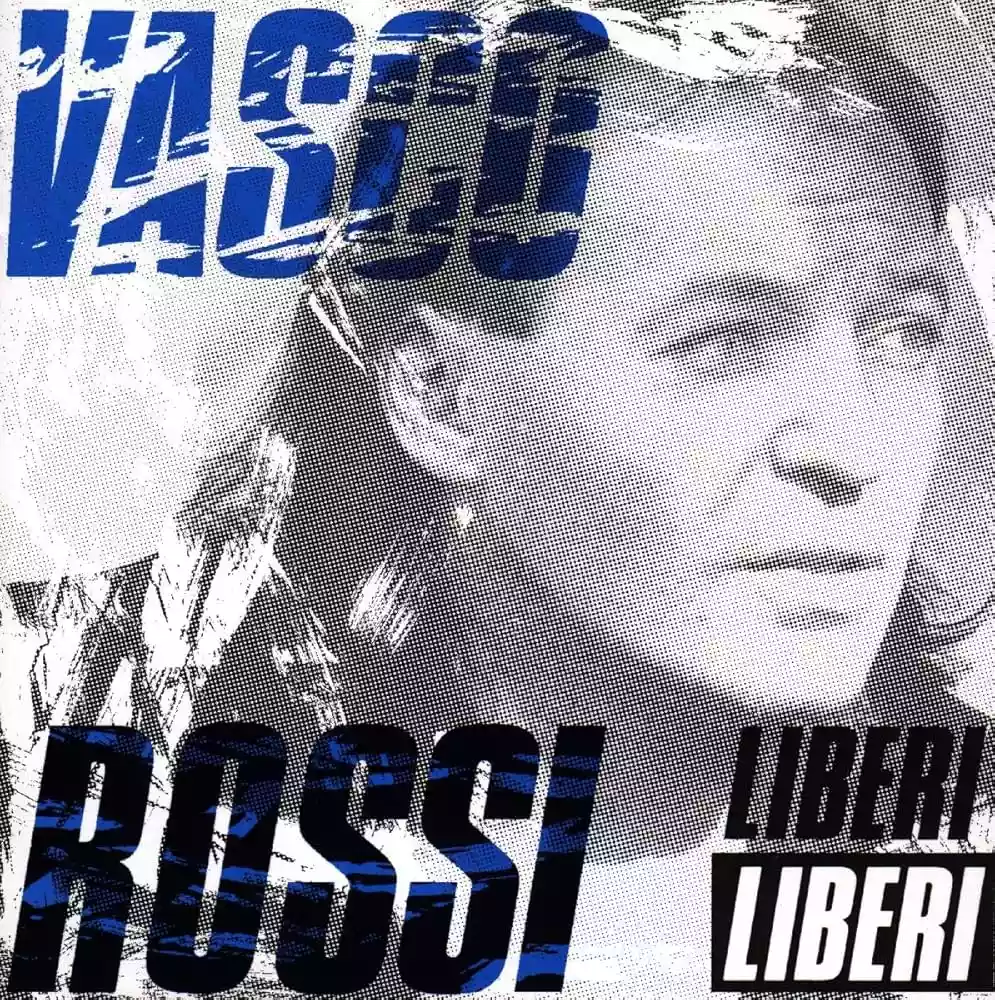
LIBERI... LIBERI (1989) 9.5/10
If "Non siamo mica gli americani", 1979, didn’t exist, this would, hands down, be Blasco’s best album, as well as the last truly accomplished one (in the ’90s, he would continue intermittently until the irreversible decline after 2000). And yet, not everyone likes it; many (even on this site) consider it a rather unsuccessful or overly “tamarro” record. In a way, it is, but it represents the apex of Vasco the entertainer, the one who knows perfectly how to please the most rowdy audience as well as those who prefer nocturnal, intimate ballads. Let’s proceed in order.
The previous "C’è chi dice no", 1987 (which I reviewed here, with many reservations), was a huge success and Vasco could count on the full band, but the Steve Rogers Band (apart from Solieri and Golinelli) wanted to take the leap: in 1988, they released as a solo group the infamous "Alzati la gonna" (a song for which, nowadays, they would at least be arrested), and even Guido Elmi, Vasco’s long-time producer, left. So Vasco is alone: faso tuto mì, as they say in Veneto. And, miraculously, everything turns out beautifully: he’s in an absolute state of grace, compared to the previous album he doesn’t miss a beat, especially musically, because it’s true there are certainly too many eighties sounds (which have maybe made the album age a bit, but not too much), but there are some guitar solos, a couple of bass lines worth memorizing (the one in "...Muoviti!" is fantastic), the charging drums by Lele Melotti ("Stasera!") and a series of slogans that, especially in the first side, are among the most fun and successful of the singer-songwriter from Zocca.
"Eh, come è simpatica/questa domenica, così complicata"; "Ormai è tardi/non si torna"; "Questo è un treno che non passa/che non passa più"; "Vivere senza te/è una libidine": these are practically the lyrics of a future live (which would later be the legendary "Fronte del palco", 1990) already with short and punchy words to be sung at the top of one’s lungs. The existential opposites that often coexist in Vasco’s albums are here summed up in a relationship with a woman twenty years younger, but more mature than him ("Domenica lunatica"), whom, perhaps, you’re better off without anyway ("Vivere senza te"), while still longing for those days gone by that will never come back ("Ormai è tardi"), but remember, always keep your eyes open because some trains might just pass again ("...Muoviti!"). Side A flows as smoothly as a stream’s water.
Side B surprises with that experiment, truly quite curious, called "Tango... (della gelosia)" which, even though it’s also a lot of fun, has always convinced me the least (hence the score for the album), a track where Vasco really does it all by himself (singing, playing, even doing the backing vocals). Then there’s the title-track. What can I say? A sax intro worthy of anthologies acts as a “preface” to Vasco’s first real self-analytic track, where he bares himself with respect to his age. It’s a song that makes you smile at 20, gets you down at 30, kills you at 40. Someone, back then, spoke of a crisis, to which he retorted sharply in the columns of La Stampa: "…Crisis? […] I’d call it change. I’m still myself, but being less young certainly means something. I have changed, like everyone else. I was out of my mind, I remain out of my mind but in a different way. These days, being out of one’s mind means not bowing to banality, to the nonsense they try to impose on us…". I think it’s Vasco’s most beautiful song, the first of many self-analytic introspections he would produce from here on (some of which, by the way, are excellent, see "L’uomo che hai di fronte", 1993).
Nocturnal and desperate is also "Dillo alla luna": another gem. Fast writing, a kind of slogan with no break, direct, and that final secular invocation "Maledetta, maledetta sfortuna" which would even enchant Mia Martini, who would record it in 1994 on her album "La musica che mi gira intorno" (then, about fifteen years ago, it was "butchered" by a clumsy contestant on X-Factor: for those with a strong stomach, the video is still on Youtube). The album closes by banishing the melancholy that had been the leitmotif of the previous two tracks: "Stasera!" chases away the clouds. "Liberi... Liberi" would be the breakthrough album: with over 1 million copies sold (only beaten that year by Zucchero with "Oro, incenso & birra") it flung open the stadium doors for him, in primis San Siro.
Loading comments slowly
Summary by Bot
This review highly praises Vasco Rossi's iconic album 'Liberi liberi,' emphasizing its lasting impact on Italian rock music. The author considers it a defining work full of emotional and musical power. The perfect rating reflects the album's quality and influence. 'Liberi liberi' is recommended as a must-listen for fans of heartfelt, classic rock.Tracklist Lyrics Videos
Vasco Rossi
Vasco Rossi is an Italian rock singer‑songwriter from Zocca (Modena), active since the late 1970s. Known as “Blasco,” he’s a central figure of Italian rock with enduring anthems and massive live shows.91 Reviews
Other reviews
By Vincenzo
Vasco has now reached the TOP of his maturation: aggressiveness and transgressiveness... give way to reserve and a certain resignation!
The title track 'Liberi... liberi' represents, as Vasco has repeatedly mentioned, the emblem of disillusionment!
By logan
"Vascone has never been a Lord of Music: he invented nothing, he never renewed a thing..."
"'Liberi, liberi' of 1989 is a disarming misadventure in the darker grooves of lowly ambition."
