
 •
Rating:
•
Rating:
THE REVIEW
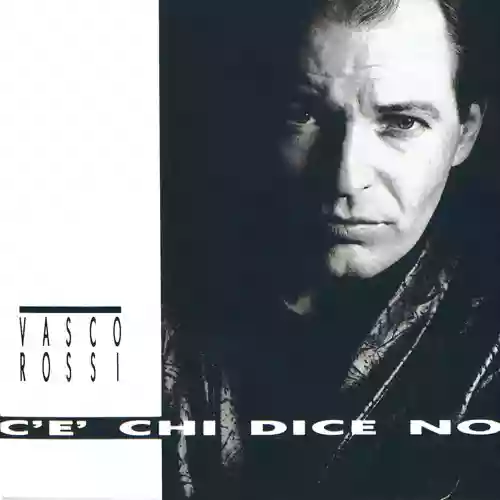
Nestled between two more successful albums ("Cosa succede in città", 1985, which, despite many flaws, I love viscerally and "Liberi Liberi", 1989, which I consider his masterpiece), "C'è chi dice no" (1987) I would have promoted it even if I hadn't listened to it again recently (it has many, too many tracks that all remind, to varying degrees, of each other), and yet, listening to it again after many years, it gives me the impression of an average album, more insufficient than sufficient. In short, to put it in two words, a very subdued Vasco. Despite that, it's an album that fans of Vasco beware of touching (oh dear, if you're a fan of Vasco, beware of touching everything) and it has many admirers, even non-"Vasco" fans.
We're in the late '80s, and the decade has already left indelible (and smelly) marks. Vasco is fatalistic: the millions and the concerts as stars of "ours" have worn him out, the anger of a few years ago has turned into disillusionment and nothing, the world seems to be going where it wants him and us here to follow hoping that, at least he, knows well the path to happiness. So, let him do it, we retreat into our daily, privately owned everyday dimension. And observe. The times when you had to "go to the max" were distant, today at most you go to collect SIAE proceeds. And in his long gaze, Vasco realizes that Bologna also exists seen from above (P.S.: I was born and live in Milan, but I've lived in Bologna for two very unfortunate years). Apparently reaching the height of San Domenico in Bosco, he realizes that below there is a microcosm that works, falls in love, gets angry, sleeps, eats, in short, lives. And with the help of a nice starting sax, he writes, and records, the opening track for the album: "Vivere una favola".
Let's say, this private dimension of Vasco says little or nothing to me: I preferred him angry. Very relaxed, "Vivere una favola" slips away without too much emotion on lyrics that should describe Bologna but are so vague that they could even describe Cinisello Balsamo. Do many people like it? I must be the one who's wrong.
The album has an annoying intimacy, and when it’s not Vasco, cunning as a skew-eyed weasel, tries to mess things up without great skill. "Blasco Rossi" is a big rock number actually umbilical: it takes on the village gossip (Blasco is how those who considered him "strange" in Zocca used to address him) until it again targets Nantas Salvalaggio, from "Vado al massimo" (1982), as if five years had passed in vain. It even makes you laugh, musically it's catchy, it's well-arranged (the brass above all) but it's very light, it flies away without leaving a trace. Just like when as a good (para)guru he throws to the fans yet another anthem to be sung by choir in a stadium dedicated to those who, he says, do not want to bow to rules and conformism: the title-track.
Then, the album isn't played badly, Massimo Riva does impeccable work, as does Guido Elmi in production. The work is well-packaged, it's superior (musically) to a lot of stuff that was coming out in Italy at the same time. With a lot of courage: in the (and the decade of) synthesizers Vasco doesn't give up on shrill guitars, on raw rock and a brass section among the most "vibrant" in our country at least at the time. It's just that what comes out is a bit predictable and well-known. You have a Ferrari and get stuck in traffic at 20 km/h risking blowing the engine.
Anyway, it should be noted, it's not to throw everything away. Side B opens with the irresistible "Brava Giulia" in which Vasco finally seems to regain the verve, and wit, of old times. Syncopated and very rhythmic, it is the song of perfect Vasco, the one in which, with few words (but all very calibrated), he portrays a rebellious and solitary girl, Giulia, who I believe everyone might have known in life (I know one, moreover, named Giulia). "Write it on the walls... If you want someone one day next to you who doesn't insist on being... the best". The girl of the '80s: here she is. And the sparkling "Non mi va", where again the irony goes hand in hand with the pressing rhythm, is a good example of what the album could have been if Vasco had focused more on irony and less on cosmic fatalism which he seemed, at the time, to be pervaded.
It goes at two speeds, and contrasting the whining "Ciao", a separate discussion deserves "Ridere di te", which is perhaps the album's masterpiece.
"[...] another crossing of viewpoints, perspectives, suggestions, in the underlying conviction that confronting men and women is as difficult as possible [...] The riffs and the intense melodious line by Maurizio Solieri contribute to making it a cornerstone in Vasco's songwriting" (Il Dizionario Della Canzone)
"[...] it has to be said that a lot of the material on the last record I wrote, so it's obvious there are no musical limitations as far as I'm concerned, I don't know, for example, "C'è chi dice no" and "Ridere di te" are songs I had written a few years ago, and if you listen to the demos there’s not much difference. Of course, the sounds are better on the record, there's some more harmonization, but the guitars are the same, the idea and melody have been preserved. In "Ridere di te" I was inspired by Dire Straits... and you can tell, since Mark Knopfler is one of my favorite guitarists; I was doing the solo like that already three years ago..." (Maurizio Solieri)
The best performance is from "Fronte del palco" (1990), but it's a wonderful song. Few words, a soft and (almost) relaxed music and the generational dilemma on love relationships. Who doesn’t see themselves in "Let it go that I’m a few years older, and thank goodness you’re right, I'm the same and I just wonder if sometimes I do wrong to laugh at you?". Each time an emotion. However, Vasco had us all, when we who believed that this song was dedicated to a girl (and I still think so, because I love dreams and want, as much as possible, to live in them) fell from our chairs just as he, in an interview, exclaimed: "But no, it’s dedicated to my mom." Oh no, Vasco, not this.
Loading comments slowly
Summary by Bot
This review critically assesses Vasco Rossi's 2025 album 'C'è chi dice no,' rating it poorly. Despite the artist's reputation, the album suffers from weak songwriting and lackluster production. The reviewer expresses disappointment in the overall quality and execution.Tracklist Lyrics Videos
Vasco Rossi
Vasco Rossi is an Italian rock singer‑songwriter from Zocca (Modena), active since the late 1970s. Known as “Blasco,” he’s a central figure of Italian rock with enduring anthems and massive live shows.91 Reviews
Other reviews
By KrYsTaL
"C'è chi dice no from 1987 is perhaps the last example of the true Vasco."
The rough sound, the eighties arrangements, the raw voice and disarming lyrics will make you see beyond the smoke screen of the hundred thousand plus of the various Imola and S. Siro venues.
