
 •
Rating:
•
Rating:
THE REVIEW
A saying from where I’m from goes, “There’s nothing worse than when someone is convinced,” used to stigmatize the narrow-mindedness of those who can’t change their minds. Yet, there’s a certainty I can’t give up: the Blues at the root of (almost) all modern music. But was Blues really the starting point for all pop music? Surely blues was one of the first contemporary American musical styles and nearly every genre originating in the United States evolved from it. But you can trace it even further back: there would be no blues without the old spirituals sung by slaves, and those wouldn’t exist without African tribal music. In the end, music builds upon itself. In the end, everything comes back to the first person who knocked two sticks together.
These thoughts were sparked by a long discussion with “the kid” who listens to trap. Thinking that trap is crap musically, that its lyrics are a rare example of emptiness, that it’s the death of creativity is, in fact, something understandable. It’s also true, however, that classical music lovers said the same things about jazz and blues; jazz and blues lovers said the same about rock’n’roll; rock lovers said the same about punk and new wave; punk and new wave lovers said the same about hip hop, … Certainly, today trap is alive as it speaks to an entire generation; it manages to transcribe their anxieties, fears, illusions, to reproduce their silliest and most unmentionable desires. To a more attentive eye, it shows the dynamics that decades and decades of consumerism have generated in all of us, all of us!
But what do you want, I still believe that without the Blues there wouldn’t even be trap. Even if the influence of blues in trap music is mainly thematic heritage, rather than direct musical influence. And I’m convinced that, in 60 years, no one will release an album of standards, whether well-known or obscure, of trap music. It’s something that, today, being in vogue, is enjoyed with as much pleasure as superficiality, both by those who perform and those who listen, as happens with any music that becomes a fad. But the Blues is not a fad; Blues is history!
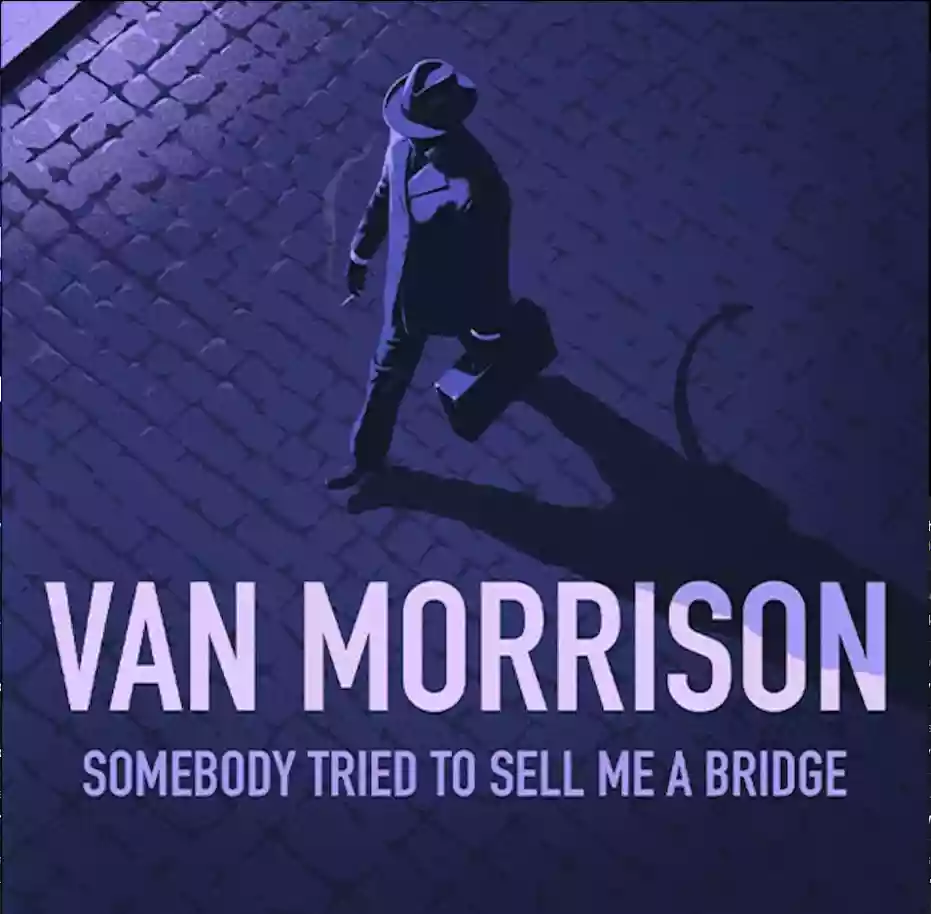
And, like me, Van The Man must think the same, who, after more than 60 years since his debut and having celebrated 80 cocuzze in August, continues unfazed to churn out records and, with “Somebody Tried to Sell Me a Bridge,” greets the new year with a wide exploration of 20 tracks dedicated to the Blues, the music that has always been a fundamental ingredient in his long story. The older fans (known as V.d.M. on the Deb) will remember that Morrison started as a blues, rock, and soul singer with the group Them, and even though over the decades he veered toward jazz, rockabilly, R&B, folk, pop, Celtic music, country, and skiffle, blues was often incorporated into his sound: you never forget your first love!
Luckily, the grumpy old man is in excellent form lately and, after his beautiful 2025 album “Remembering Now” where he tackled the genre on just some tracks, this substantial set focuses on those roots and sounds like an invitation not only to listen, but almost to join in a session where the old Blues masters are sitting in a smoky room corner, swapping riffs and anecdotes. While there are some originals dotted here and there, Morrison mainly digs into lesser-known selections by Eddie “Cleanhead” Vinson (opening with two big band versions of “Kidney Stew Blues” and “King for a Day Blues”), Sonny Terry and Brownie McGhee (“Can’t Help Myself” and a lively shuffle of “When It’s Love Time”), up to the closing “Rock Me Baby” by BB King with the extra warmth of Guy’s biting solo.
Yes, Buddy is here too, who’s stacked up 89 cocuzze, among a list of first-class talents called in to collaborate, including guitarist Elvin Bishop, who brought some zest to a sped-up version of John Lee Hooker’s “Deep Blue Sea,” giving a more boogie approach to this folk blues gem; Taj Mahal, whose voice and harmonica embellish “Can’t Help Myself”, and again Buddy Guy, whose talent helps create an outstanding version of Willie Dixon’s "I'm Ready." Alongside these sacred monsters are longtime Van collaborators like John Allair on keyboards, David Hayes on bass, Bobby Ruggerio, Mitch Woods, Anthony Paule with his “Soul orchestra” and drummer Larry Vann. The result isn’t so much a carefully mapped-out studio project as an improvised conversation between kindred musical spirits, produced with a respect for tradition that avoids tracing a dusty nostalgic trail. This spirit is embodied by the Fats Domino classic “Ain’t That a Shame”, which receives a radical reimagining: Morrison slows it down to a ballad tempo, powers it with one of his most emotional vocals, and adds female gospel choirs, making it almost unrecognizable in this new and extraordinary guise.
The fact that his own songs, particularly "Monte Carlo Blues," which highlights Van’s essential harmonica skills, and the enigmatic title track, can live side by side with such classic blues pieces is a testament to Van’s ability to inhabit the blues without saturating it with imitation. It’s not everyone who can assemble such a harmonious mix of walking bass lines, honky-tonk keys, sharp guitar solos, lively and sparkling harmonica, and above all, Morrison’s voice, mumbling and howling with a timeless strength, in the face of passing time. “Damn, if I play my cards right, I can bring everything back to where it all began,” he yells in his song “Loving Memories”: I want to believe it’s possible.
Tracklist
01. Kidney Stew Blues
02. King For A Day Blues
03. Snatch It Back And Hold It
04. Deep Blue Sea
05. Ain’t That A Shame
06. Madame Butterfly Blues
07. Can’t Help Myself
08. Betty And Dupree
09. Delia’s Gone
10. On A Monday
11. Monte Carlo Blues
12. When It’s Love Time
13. Loving Memories
14. Play The Honky Tonks
15. (Go To The) High Place In Your Mind
16. Social Climbing Scene
17. Somebody Tried To Sell Me A Bridge
18. You’re The One
19. I'm Ready
20. Rock Me Baby
Loading comments slowly
Summary by Bot
This review gives Van Morrison's 'Somebody Tried to Sell Me a Bridge' a solid 4 out of 5 rating, praising its musical depth and signature style. The critic discusses notable tracks and highlights Morrison's consistency as a veteran artist. Fans will find satisfying songs and the familiar mix of rock, soul, and poetic lyrics. The album is described as another worthy installment in Morrison's prolific career. Recommended for both longtime fans and new listeners.
Van Morrison
Van Morrison (born George Ivan Morrison) is a Northern Irish singer-songwriter and musician known for blending rock, folk, blues, jazz and soul across a long career beginning in the 1960s.34 Reviews
