
 •
Rating:
•
Rating: THE REVIEW
A few clicks of the mouse, pressing three or four keys on the computer, and we create music compilations. From home. Maybe in pajamas. Endless compilations, hundreds of songs, many of which we will never listen to. That's how it works TODAY.
Yesterday, actually the day before yesterday, it wasn't like that. We would leave the house, anxiously hoping that our trusted record store owner hadn't already run out. And when THAT album was there, we would take home a round thing, which meant 8 or 9 tracks. 40-45 minutes of the artist. On good days, 40-45 minutes of emotions. Extract the album from the sleeve... and do it gently to avoid scratching it... and then place the needle on the vinyl... a magical, exciting ritual. The curiosity to listen to the first notes of side A and understand if those thousands of lire were well spent.
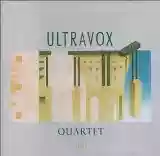
When I placed the needle on the vinyl of "Quartet" in late autumn 1982, I actually didn't even know what to expect from Ultravox. I knew something, but not enough.
It was a revelation, a violent and sudden adolescent love, irrational and domineering as only such loves can be. Only later, in becoming passionate about their music, did I delve into their discography, purchasing their previous albums. And I discovered that what I would have undoubtedly cataloged as a 5-star (maybe even higher) today is a 3-star.
It's not just a matter of changing tastes, nor merely greater musical and alas temporal maturity. It's a matter of emotions, punches in the stomach. In this sense, to remain in the "Ure" period, the previous "Vienna" and "Rage In Eden" are the top: surprises at every note, every sound, every sigh. And even the subsequent "Lament", more rock-influenced but also with balanced and never intrusive Celtic influences, deserves full marks. Conversely, I don't even consider "U-Vox", the last sad work before the 1987 breakup: I only consider it as the (off-key) swan song.
The sense of pleasantness of "Quartet" remains intact, even decades later, no doubt. Well-crafted electronic pop-rock, and NOT just techno-pop. Midge Ure in good shape, talented musicians, pleasant and catchy melodies (sometimes too much so), arrangements in line with the tastes of the period. Precisely. Here's the limit of Quartet. Those who prefer the early period (that of John Foxx, a romantic and hallucinated front-man, innovative and decadent) can hardly tolerate "Quartet", too commercial. But, for that matter, it's also boldly compared to other music of the period (to the early and underrated Spandau Ballet, and that's fine, but also to the groups and small bands of the era that climbed the charts with a single successful 45, easy refrain and some sprinkles of electronics).
Here, instead, we are talking about a band that has admirably combined pop, brit-rock, electronics, romantic violins (a bit of their trademark) but also distorted guitars, cold and obsessive rhythms but also brilliantly "easy" melodies. In a word, we are talking about a great band.
I'll avoid the track-by-track of the album. In my opinion, the best-achieved pieces, as often happens, are not the most famous ones (starting with Reap The Wild Wind, for example, which I find somewhat banal). But Hymn is still evocative and thrilling, and the very fast Mine For Life will take on heavy hues live.
Cut And Run, among the lesser-known tracks, is characterized by an interlude sung by Midge at high notes, while the chorus is modulated low, anguished, and deliberately breathless.
But the punch in the stomach - indeed, speaking of emotions - comes at the beginning of side B: Visions In Blue, nocturnal and dreamlike at first, then unfolds piercing and obsessive on a fantastic electronic backdrop.
That's it, the needle of my old turntable (strictly belt-driven) has practically worn out the vinyl of that track. And only later did I realize that what seemed like a perfect album was "only" a very good LP, far from the immediately preceding "5 stars" and the subsequent "Lament".
Finally, Quartet, never reviewed here and for this reason I chose it for my first Debaser review, is a work well representative of the era. But the little Scotsman Midge Ure, Chris Cross, Warren Cann, and above all the brilliant Billy Currie actually knew how to do even better: that is, albums that, conversely, made history.
Loading comments slowly
Summary by Bot
The review reflects on Ultravox's 'Quartet' as a well-crafted album that captures the essence of the early 80s synth-pop and electronic rock era. While it may feel more commercial compared to earlier works, it remains a pleasant and evocative listen even decades later. The reviewer shares nostalgic memories of the vinyl experience and highlights standout tracks like 'Visions In Blue' and 'Hymn'. The album is praised for its blend of pop, rock, and electronic elements, though it's considered slightly less emotionally impactful than prior releases.Tracklist Lyrics Videos
Ultravox
Ultravox are a British band associated with new wave and synth-driven rock. Early recordings (often credited as Ultravox!) featured singer John Foxx; from 1979/1980 the group fronted by Midge Ure achieved major commercial success, with “Vienna” commonly cited as their signature work.17 Reviews
