
 •
Rating:
•
Rating:
THE REVIEW
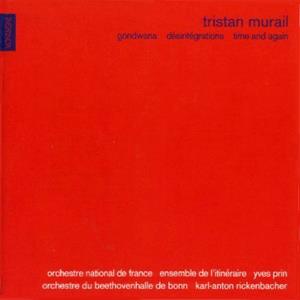
In the three orchestral pieces featured on this CD, we find music that is stylistically coherent yet always differentiated through subtle variations in texture. Three works by a composer of class, who seems to continue a certain lineage of French music: the one that began with Debussy and Ravel and continued with Messiaen and Boulez.
A mythical image, that of the primordial continent Gondwana, is the foundation of the first piece, written in 1980. Over the course of its 17-minute duration, the orchestra seems to reproduce a slow breathing in its moments of acceleration-deceleration, in the sound-noise dialogue: a pure and unaltered instrumental timbre and a consonant harmony, which is opposed by the noise of certain instrumental families (the bow rubbing on the strings in the strings section, blowing without producing sound in the winds) and especially the percussion (maracas, cymbals, snare drum, wood-block).
The subsequent "Désintégrations" of 1982 pairs a 17-member instrumental ensemble with synthetic sounds generated through electronic processing: Murail’s first experiment in this respect, and a very successful one. The orchestral sounds are composed using calculation processes (in defining pitches and durations, for example) and the electronic sounds use those of the instruments as models for constructing timbres, harmonies, forms. A fascinating idea, because it presupposes a continuous exchange and dialogue between the two sound sources, usually seen as two distinct worlds. And so the fusion of those two worlds occurs, their disintegration in a 22-minute piece that is very pleasant and brilliant to listen to.
The CD concludes with "Time and Again" for orchestra, from 1985 (the title is borrowed from a science fiction novel by American author Clifford Simak). A piece that at times is perhaps more aggressive than the previous ones, structured in layers of variable density. It integrates into the orchestral ensemble the DX7 synthesizer, very popular in those years. Like a time machine, the piece aims to make the listener jump forward and backward in a sequence (15 minutes in duration) of "flashbacks, premonitions, and loops," in the words of the author.
In this last piece, there are several references to the "Turangalîla-Symphonie" by Messiaen (Murail himself performed it several times as a soloist on the ondes Martenot, a curious instrument), and so we return to that line mentioned at the beginning, the Debussy-Ravel-Messiaen-Boulez line: in other words, refinement in music. To those names, we add Tristan Murail, a worthy continuator of that modern tradition.
Loading comments slowly
Summary by Bot
This review highlights the stylistic coherence and subtle textural variations in Tristan Murail's orchestral pieces Gondwana, Désintégrations, and Time and Again. The album marries acoustic orchestration with electronic elements, continuing the lineage of French modern music from Debussy to Boulez. Each piece offers unique conceptual and acoustic qualities, from the primordial imagery of Gondwana to the sci-fi inspired temporal layering of Time and Again. Murail emerges as a refined, innovative composer within this tradition.
Tristan Murail
Tristan Murail (born 1947) is a French composer associated with spectral music and the contemporary classical tradition.01 Reviews
