
 •
Rating:
•
Rating:
THE REVIEW
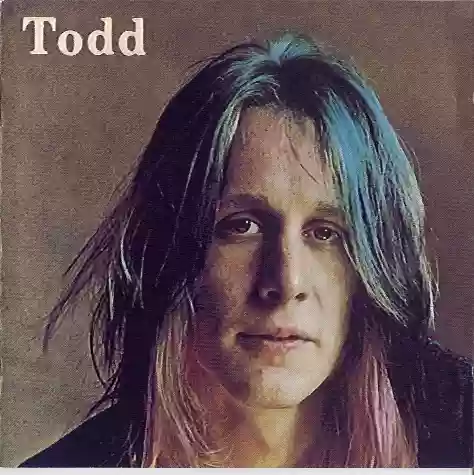
States of alteration, perception doors wide open, hyper-lucidity: you could focus, as if it were big and close, on the head of a pin ten meters away. You could lose yourself in conversations and notes, in the attempt to develop one hundred and ten percent of every idea, every intuition... Just like Huxley got lost among the pages and conversations, as he lost and made us lose hours describing the folds in Mother Mary's dress, as if it were the most important thing in the world, so, in 1974, Todd Rundgren weighs down the lives of his fans with this album.
Fresh from the magnificent and splendid "Something/Anything?" and "A Wizard, A True Star", weird, rich records that are, after all, perfect as they are, and having succeeded in creating a progressive rock project made in the U.S.A. with Utopia, the same year of his debut in a prog key, "Todd" also comes out. It is predominantly the classic misstep of someone who, having received too much acclaim - as well as being, in my opinion, afflicted by too much work - and self-qualified as "omnipotent," tries to reproduce the daring formula that worked so well in the previous two solo albums.
But there's half the inspiration, twice the fatigue, and about the skill... Well, should there be no skill in someone who has released nine records (one of which is double) in five years? Only "I Think You Know,” an enjoyable space ballad in the Ziggy Stardust style, "The Last Ride,” a slow à la Carole King, "Izzat Love,” an exemplary singable and clean, finally worthy of the best production, and the final "Sons Of 1984,” where it returns to typical sounds of some of his best soulful gallops among Chicago-style horns, are saved.
Half successful "A Dream Goes On Forever,” linear pop soul without surprises, but it would have looked entirely different if Todd had chosen a more traditional accompaniment and production. Just like "Number 1 Lowest Common Denominator,” a slow, sprawling blues with psychedelic refrains, or even "Heavy Metal Kids,” fiery but not very original hard blues. We also have the medley experiment, which is "Everybody's Going To Heaven/King Kong Reggae,” which starts in an instrumental prog rock style, where an excellent hard blues is inserted, in Jimi Hendrix style, with a very confused and exaggerated solo at the end of the singing, where "King Kong Reggae,” a hippie blues in Jefferson Airplane style, is inserted, that just after the beginning, fades... Boh?
Theatrical episode in "Lord Chancellor's Nightmare Song,” genius, or in the theme song for infant shows "An Elpee's Worth Of Toon,” less brilliant, but what does all this have to do with pop music? Other tracks that never take off, that have nothing relevant, some for the simple fact that, instead of lasting a minute and a half like in "A Wizard, A True Star,” they last six and a half minutes, like the overly stretched "Don't You Ever Learn.” Stretch and extend everything, every idea, even the most elementary one, it was said, making the tracks lose their catchiness, their pathos, their effectiveness. And the instrumentals, of course, exacerbate this. Virtually all unworthy of attention, made mostly to allow Rundgren to show us how good he has become in sound manipulation, how good the artist has become as a freelance (sound engineer) with a registered VAT, only saving the guitar at the end of "The Sparks Of Live” (it screams like a black backup singer of Zucchero at the sight of a mouse) and the first half of "In And Out The Chakras We Go.”
Five years after his debut, Todd Rundgren has released nine records, one of which is double. That's twenty sides of vinyl, and in total one hundred and twenty-one tracks. Many more if his medleys were broken into more songs. And who knows how much stuff was written but not published! The magic wand of Todd the wizard, due to a more than intensive use, "finally" broke.
Having reached the first misstep of his career, will he rest a bit? Will he allow himself at least a sabbatical year? Nah, 1975 will be the year of two more albums...
Loading comments slowly
Summary by Bot
The review assesses Todd Rundgren's 1974 album 'Todd' as a disappointing follow-up to his prior masterpieces. Despite Rundgren's proven skill and ambitious experimentation, the album suffers from fatigue, half-formed ideas, and overextended tracks. Some songs stand out, but most lack the inspiration and catchiness found in his earlier work. The album is seen as a classic misstep in Rundgren's otherwise prolific career.Tracklist Lyrics Videos
Todd Rundgren
Todd Rundgren is an American singer-songwriter, multi-instrumentalist, and record producer known for studio experimentation, eclectic songwriting across pop/rock/soul, and work both solo and with the band Utopia.25 Reviews
