
 •
Rating:
•
Rating:
THE REVIEW
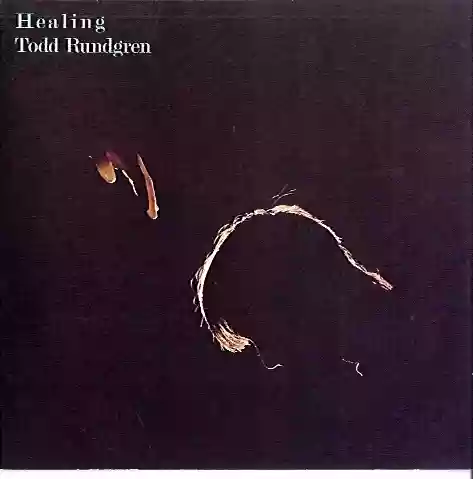
We can no longer say that Todd Rundgren is capable of consolidating a position... Maybe once. After the first live with Utopia, a second one followed for confirmation; after the first "Runt," another, even better one, followed; after the immense "Something/Anything?", came the complex and brilliant "A Wizard, A True Star"... But in 1981, a full three years after the splendid "Hermit Of Mink Hollow," could he ever replicate the success, perhaps retracing the same path with less originality but more clarity? Certainly not. So, what does he do? He revisits the abstruse and guru ambitions of the less successful "Initiation" from 1975 and plays the same cards again in the '80s...
That album, up until then the least convincing of his career, was acid and prog, with a "centerpiece" over half an hour long, divided into four chapters. In this "Healing," the acidic is banned; the late-70s "Indo" culture is ignored, but a certain prog flavor in a couple of episodes and the inevitable hope to improve the planet's fate remain present.
On a synthetic carpet, Rundgren starts to wink at the sounds of the '80s by attempting fewer mega-baggiani experiments, opting for more precision work. The production hand is heavy but "precise" as ever in an album nearly devoid of instruments and rhythm, with subdued and delicate tones. It's an attempt to simulate in the lab a world that adheres to new age life rules: Todd imbues it with his optimism, his light as "A True Star," but meanwhile, the minimalism of the arrangements and the synthetic nature of the sound put everything under vacuum pressure.
It is also such a presumptuous attempt, given that, originally (and very originally), there was no room envisioned for the single "Time Heals" (even though the title was thematic), whose video, incidentally, was the second ever aired in MTV's history. Certainly, there was no place for its B-side, "Tiny Demons", either. Only in later editions was it understood that one could, indeed should, insert those songs. And upon listening, although the first is more melodic and singable and the second darker and more sophisticated, there is a certain coherence with the entire LP: guitar parts aside (which are almost absent throughout "Healing"), the format is one of synthetic pop - not yet synth beat - without drums, with something muffled and artificial that beats but does not vibrate, does not move the air... And keyboards. Never "invasive" but in tonnes.
The opening "Healer" is the pop prog balancing act, while the most ingenious track is the following three-dimensional pop of "Pulse", amid a thousand ingenious sounds. Peaks of such stature correspond to moments of complete low, as in "Flash", a sort of prog rock jazz from a time that is devitalized... Having lost its nutritional value in the '80s, only the new age fiber remains. And due to the fiber, we could say the track does...
"Golden Goose" is his classic and inevitable vaudeville episode. This time the theater is of wanderers, folkloric and dead drunk. Usual prophetic pop piano and voice for "Shine", while "Compassion" is a good ballad in style, akin to the taste of an Alan Parsons coeval ballad. On side B, there's the infamous "long track", divided into three chapters. "Healing, Part I" is exhausting, synthetic, geometric, fake: you don't swim in a calm and tropical sea, but in a blue-tiled pool. "Part II" synthesizes new age landscapes. Melodic delicacy in the singing: the new era, if we want to live it, we have to go live it in another galaxy... The third part is the more accelerated version of the first, though it never quite takes off.
Compared to "Initiation" and all other unresolved works of his (up to that point) career, "Healing" has several interesting insights, and not just from a sound perspective, but especially thematically. The spiritual Rundgren of prog and arena rock works is softened and depowered. It's just a pity that, at the same time, it doesn't avoid flattening... But this is just one of many chapters in a very long story.
Loading comments slowly
Summary by Bot
Todd Rundgren's 1981 album Healing revisits his earlier prog and new age ambitions with a heavy emphasis on 80s synth sounds and minimalism. While the album shows precise production and thematic intentions, it often feels flat and synthetic. Highlights include inventive tracks like 'Pulse' and the historically notable single 'Time Heals.' Despite flaws, Healing offers intriguing insights into Rundgren's evolving style during the early 80s.Tracklist Lyrics
Todd Rundgren
Todd Rundgren is an American singer-songwriter, multi-instrumentalist, and record producer known for studio experimentation, eclectic songwriting across pop/rock/soul, and work both solo and with the band Utopia.25 Reviews
