
 •
Rating:
•
Rating:
THE REVIEW
And so at a certain point, Johan Edlund loses the magic wand; after all, it happens to everyone eventually, even the greatest, let alone the others.
The problem is that Edlund's brain fills completely with crap in a nanosecond, his music shifts from excellence to mediocrity in a single tragic leap: evidently, something happens between "A Deeper Kind of Slumber" and "Skeleton Skeletron," the spell is broken forever, so much so that in Tiamat's career, one can speak of a before and after "Skeleton Skeletron."
Not that Edlund ever wrote some exalted music, but his artistic journey had at least shone with foresight: if he has never been a virtuoso, if his pursuit was never truly refined, it is, however, true that within the narrow confines of extreme metal, he was among the most courageous, among the most visionary, among the most independent experimenters, if not able to coin a new style, certainly capable of venturing into territories previously uncharted by others, even just by mixing, even just by recycling and contaminating metal with other languages, even just by giving in to urges and tendencies that until a moment before seemed prohibitive for the prevailing metallic orthodoxy. And the progression that took Tiamat from a rough and impersonal death metal to that refined and beautiful psychedelic pop gem that was "A Deeper Kind of Slumber," after also revolutionizing the gothic/doom metal universe, is indeed no small feat.
The fact is that at a certain point, Edlund stopped making us dream, perhaps stopped dreaming himself. Maybe the mirage of large-scale success (within the limits of the genre, of course) led him to lose his mind (full of crap), to feel like a cool guy (on what grounds), to sacrifice everything that had constituted the raison d'être of his artistic dimension.
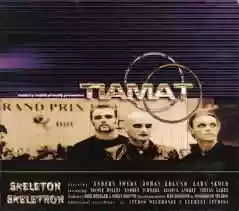
The fact is that in '99 "Skeleton Skeletron" is released, the band's first misstep after a growth that seemed unstoppable and promising unpredictable developments. Instead, in 1999 this little album of only forty-five minutes, only ten tracks, is released, with a title that couldn't have been conceived worse and a cover that already reveals the band's new attitude: minimal, modern artwork that frames the faces of the three lipstick and mascara-clad divas, the poster of a film that, however, announces itself as a flop already from the opening titles.
The opener "Church of Tiamat," admitted by Edlund himself to be nothing more than a self-celebratory manifesto to celebrate the band's first ten years of activity, revives the big guitars that were abandoned after the masterpiece "Wildhoney," the sound hardens, becomes heavy and evocative: evocative like the old Tiamat before the brave pop turn? Nothing could be further from the truth: only the distortions gain intensity, but the structures are elementary, Edlund's monotone voice does not rise from the context, he is probably not the charismatic crooner he believes himself to be; the metallic shell, the dark flair betray a childishness in writing that preserves the catchiness and simplicity of approach of pop but not the past research effort. The conventional bass lines of Anders Iwers and the academic drumming of Lars Skold are the simple framework supporting Edlund's faded creativity, divided between microphone, guitars, and keyboards, attempting to chase the genius factotum status but without the stature for it.
Moreover, adopting a power-trio model lineup, dispensing with Thomas Pettersson's providential lead guitar, to focus on impact and catchy melodies, reveals the underlying choice animating this work, which ultimately sins of the worst sin, that of predictability. A clumsy dive into the most obvious dark-wave empyrean, without shunning a propensity for bite-and-run rock'n'roll, which in Scandinavia was never truly taboo: that's essentially what "Skeleton Skeletron" is, and the single "Brighter than the Sun" is its sad prelude (accompanied by an horrific video in which a ridiculous Edlund as a toreador is repeatedly run over by a car driven by the beauty of the moment): hard rock riffs, dark booming voice, gospel choirs, and a strong desire to do dark and rock without being either the Sisters of Mercy (referenced more than once) or the Rolling Stones (even tributed with an avoidable cover). Nothing new, however, as something similar was attempted with "Cold Seed," which, by chance, was the dullest episode of the previous work (but at least at that time, exploring certain sounds constituted a groundbreaking gamble for Tiamat). And then almost all the electronics are gone, which could have been a fertile terrain to continue cultivating. But why, Edlund, did you renounce Pink Floyd? Why did you turn off your brain and start making this glossy goth rock like Him? Did you want to have more fun? Did you want to earn more? Did you want to get more action?
Whatever it is, the fact is that the only melancholic thing in this album is the realization that, track by track, what could have been another masterpiece by the Swedish band instead flows away. Not that it's all worthless, Edlund still seems to have two or three winning cartridges left, not coincidentally the slower, more reflective tracks that somehow recall the old Tiamat: "To Have and to Have Not," for example, is a ballad that, in the final coda, manages to masterfully re-propose those arpeggios, those keyboards, those sound layers we appreciated in the distinguished predecessor. "Best Friend Money Can Buy," opened and accompanied by a nice piano round, is a mournful blues that launches Tiamat into the fascinating territories of a Nick Cave-like songwriting (almost a plagiarism, in truth, of the celebrated Murder Ballads). Or the beautiful closing track, the unexpectedly overwhelming (after so much hip swaying) "Lucy," which does without guitars, building itself on a sound made of solemn orchestrations and a solid rhythmic base. A nice final hit, even though the previously trodden shores of excellence are distant, very distant, and certainly two or three dignified episodes do not raise the fortunes of an album that would so much like to appeal, especially to the nostalgic of certain sounds, but in the end, it exhausts itself in flat pieces, lacking punch, orphans of truly engaging choruses, despite the radio-friendly vibe (like "As Long as You are Mine," even opened by a club-like opening). A desolate landscape where not even the flashy cover of "Sympathy for the Devil" (long live originality, no one had ever thought of it, really!, you like to win easily, eh Johan?), a piece that would hold its own even at a middle school party, played by spotty pre-adolescent kids, manages to stand out.
But the biggest problem is that "Skeleton Skeletron" is not just a momentary blunder, but will over time become the framework on which subsequent efforts by the band will be developed, which unfortunately will not manage to get out of the mire of a decline that over the years will acquire the contours of a sad certainty. That's life: if fans are lost along the way, others will come, probably it's a calculation made beforehand. Even though the band will try, with partial steps back, without even too much conviction, to regain lost portions of its past (and its admirers). And as too often happens after a bitter disappointment, there is always the fan's hope to illuminate the path of the penitent sinner: every subsequent release, at the time of its release, will thus be overrated, preferred to the one immediately preceding it, which will, by magic, have meanwhile faded in its intrinsic and original mediocrity. And so "Judas Christ," which partially recovers the psychedelic vein, will be better than the blandness that was "Skeleton Skeletron," and "Prey," which even resurrects certain atmospheres of "Wildhoney," will be even better than "Judas Christ." But it will be only an illusion of a moment, because the sad reality is that all of them, including the very latest albums, are truly devoid of real substance, not even a shadow of the Tiamat we knew until "A Deeper Kind of Slumber."
In fact, re-listening to "Skeleton Skeletron" today, which at the time made me shiver so much, one realizes that certain moments aren't even that bad, and that perhaps today for Tiamat being able to have new songs at the level of a "Lucy" would truly be a godsend.
It was nice while it lasted. But now goodbye.
For real. Goodbye.
Loading comments slowly
Summary by Bot
This review critically examines Tiamat's 1999 album Skeleton Skeletron, highlighting a significant decline in creativity and quality compared to earlier works. It marks a shift from innovative metal and psychedelic pop towards predictable goth rock with weakened songwriting. Despite a few redeeming slower tracks, the album ultimately disappoints fans and sets a precedent for a downward trend in the band's future releases. The review reflects on lost potential and fading artistic vision.Tracklist Lyrics Videos
Tiamat
Tiamat are a Swedish band led by Johan Edlund, frequently described in the reviews as influential in the evolution of gothic metal, with early roots in Swedish extreme metal and later moves into psychedelic-tinged gothic and goth rock.13 Reviews
