
 •
Rating:
•
Rating:
THE REVIEW
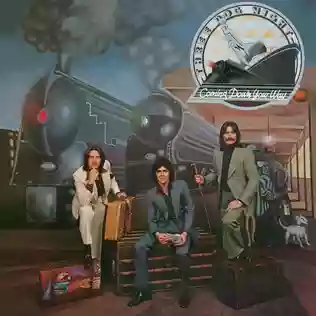
The musical formula of Three Dog Night continues undaunted, arriving at the exact midpoint of the seventies with this album, which shares the same underlying concept as their previous ones. That is, the lush personalization of a handful of songs written by others, fairly heterogeneous among themselves but all funneled into their melodic, highly vocal rock/rhythm & blues style.
The songwriters featured on “Coming Down Your Way” are, for the most part, habitués for them—Randy Newman, Dave Loggins, Allen Toussaint, Gary Stovall, Daniel Moore. The new names appearing on this album are Jay Gruska, Jack Lynton, Jeff Barry, and Gregory Grandillo (who? Maybe the very first James Gang guitarist). As is usual for their career, just one original track by the group is mixed in with the rest—this time it’s the moderately impactful “Night Flyer” by the latest addition to the band, keyboardist Skip Conte, coming from Blues Image.
Standing out in the batch is a song that would gain great success, but only years after its initial release. I’m referring to “You Can Leave Your Hat On” which, whether interpreted by its author Newman in 1972 or in this Three Dog Night version three years later, never found remotely the acclaim it received from Joe Cocker—once his rendition was included in the soundtrack during Kim Basinger’s striptease in the 1986 blockbuster “9½ Weeks”. Credit goes partly to Cocker, partly to the film, and a lot to Basinger—at least in my opinion. Still, the TDN version on this record is of good quality.
Another pleasant highlight is “Good Old Feeling”, a soul rock number where Cory Wells sounds like John Fogerty of Creedence, while in the powerful harmonies he organizes with his two buddies, it almost feels like you’re hearing an entire gospel section in action—with bellies, swaying, long churchly robes, raised hands and all.
“Kite Man” stands out for being very psychedelic, harmonically unusual and rich, but is partially marred by the poor use of the ARP synthesizer (which is nonetheless endearing, so vintage California ‘70s... but did they only sell this little contraption in Los Angeles?). The closing track, “Yo Te Quiero Hablar,” is cooler, with Chuck Negron performing the whole song in graceful Chicano Spanish.
All in all, this is one of the less impactful albums of their career, but I still cherish it in my CD collection, as it’s well above average. Three Stars for Three Dog Night, in this case.
Loading comments slowly
Summary by Bot
This review covers Three Dog Night's 1975 album 'Coming Down Your Way.' It gives the album a mid-level rating of 3 out of 5. The reviewer briefly discusses its place within classic rock and the band's discography. Strengths and weaknesses are noted, but the tone remains balanced throughout. It's an informative take for fans and newcomers alike.Tracklist
01 'Til The World Ends (03:31)
02 You Can Leave Your Hat On (04:11)
03 Good Old Feeling (03:09)
04 Mind Over Matter (02:56)
05 Midnight Flyer (Eli Wheeler) (04:33)
06 Kite Man (03:37)
07 Coming Down Your Way (03:09)
08 When It's Over (03:37)
09 Lean Back, Hold Steady (03:50)
10 Yo Te Quiero Hablar (Take You Down) (03:11)
Three Dog Night
Three Dog Night are an American rock/pop-rock group known for rotating lead vocals among three frontmen and for recording predominantly cover material, adapted into highly arranged, harmony-rich performances. Their best-known era is concentrated between the late 1960s and mid-1970s, with continued touring in later decades.12 Reviews
