
 •
Rating:
•
Rating:
THE REVIEW
Who could these fighters be? In my opinion, the fighters are all of us, because every day we have to face the innumerable problems that inevitably arise throughout our lives, which at certain sad moments might seem 'absurd', but nonetheless always remain a precious gift. Perhaps, if one commits wholeheartedly, constructively, and positively in any field, one can achieve a good personal result.
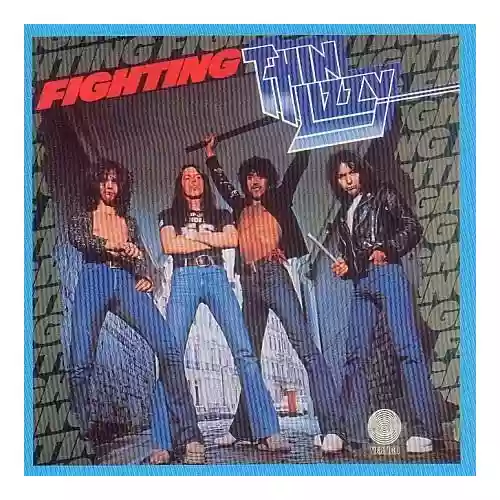
It is impossible to achieve an aim without suffering - è impossibile raggiungere uno scopo senza soffrire. Currently, I am not able to evaluate whether this sentence by the philosopher J G Bennet is correct or incorrect, I can only continue on my path trying to do my best. Obviously, this is my personal interpretation of the title of the Thin Lizzy album released in September 1975 and presented in this review in its remastered version from 1996 by Mercury.
This is the fifth album by Lizzy, always led by the charismatic P Lynott (1949-1986) bassist and singer, half Brazilian, and half Irish. It is certainly not the best work, partly because at times it still seems 'naive' in certain instrumental passages, and partly because, as noted in the booklet, the musicians at that time were still trying to meet each other, to understand what they could or could not achieve both artistically and compositionally. Despite everything, the album remains pleasant and well-played, almost never boring or repetitive, and with a particular sound, thanks also to Lynott's warm and sensual vocal performance. Thirty-eight minutes divided into ten tracks full of energy, also thanks to the presence of the two lead guitars of B Robertson and S Gorham. Even though Lizzy were not the first to present this type of formation, they still managed to develop, especially in later albums, a particular style (string arrangements, and slamming riffola) that will later be adopted by many bands of the '80s, who over time became more famous than Lizzy, but in my opinion, rarely manage to recreate that unmistakable musical charge.
Avoiding the much-maligned track by track, I would still like to highlight at least four tracks. "Rosalie", an excellent version of the song by B Seger, Phil was unsurprisingly a great fan of his. The unforgettable ballad "Wild One" the lyrics refer to: "the historical story of the Wild Geese, Irish soldiers, defeated at home in 1691 by William III who then elected to fight abroad under Louis XIV", powerful and melodic, certainly one of Lizzy's classics. "Fighting my Way Back" and "Spirit Slips Away", the former for its irresistible drive, the latter for its expansive and soothing atmosphere, excellent also the bass contribution by Lynott, often underrated. The booklet is decent, containing some interesting notes on the songs and the group, while, as often happens, there are no song lyrics. The cover, however, is the usual image depicting the group, definitely better those of the three subsequent albums made by J Fitzpatrick. Album rating 3.5 out of 5 (stars).
Loading comments slowly
Summary by Bot
Thin Lizzy's 1975 album Fighting offers energetic rock driven by Phil Lynott's charismatic vocals and dual guitars. Although not their best, it remains a solid work blending melodic ballads and powerful riffs. The album reflects the band's growth and sets the stage for their future unique style. Key tracks like 'Rosalie' and 'Wild One' showcase the band's depth and lasting appeal.
Thin Lizzy
Thin Lizzy were an Irish rock band formed in 1969, led by bassist and singer Phil Lynott. They became widely associated with a twin-lead-guitar sound and a blend of hard rock with melodic and Celtic-inflected elements, releasing a run of influential 1970s albums and later heavier early-1980s work before disbanding in 1983.13 Reviews
