
 •
Rating:
•
Rating:
THE REVIEW
Once, I often found myself having to explain to those who had never heard of them the absolute greatness of David McComb's Triffids, a greatness so evident and cross-cutting that it still leaves me in awe of their records. Today, unfortunately, no one asks me anymore who the Triffids were. They don't seem to interest even the brave Domino Records anymore, which some years ago embarked on a journey of fantastic retrospective reissues on CD, including the magnificent ten-disc box set "Come Ride with Me..." now impossible to find in these dire times of the Eurovision festival. The "triffids'" records are practically all out of print, but their value has not diminished by an ounce over time.
Rediscovering a true masterpiece like "Born Sandy Devotional" today means, first and foremost, paying homage once again to the genius and talent of David McComb. A tormented and extraordinary singer, musician, and author. Even today, David remains one of the most original, fascinating, and ultimately tragic frontmen in all music. Like all legends, David never saw himself age, perhaps because he was already so old and worn out inside when he left us at merely 36. Throughout his brief life, he suffered from various aches and addictions to a range of substances, including alcohol, amphetamines, and heroin; his alcoholism was probably the cause of his heart conditions, which eventually became desperate until a heart transplant was attempted to bring him back a future. Legend has it that the man lived a few more years before surrendering to his vices and torments, and his new heart eventually refused to belong to him. David was only 36 and left an unfillable void in all those who loved him, both as a man and as a musician. Fortunately, his visionary, epic, and unparalleled records remain. Apart from Nick Cave, Australia would never know such talent again.
In various interviews, McComb often talked about the autobiographical nature of Born Sandy Devotional. There is, first of all, a powerful sense of belonging to the land from which he comes, the coasts, the wind, the deserts, the sea. But it's a geography that is anything but celebratory. Here the sun is blinding and the dust annoyingly fills the eyes. The Australian "bush," where some time later the Triffids would record the offbeat "In the Pines," offers a post-apocalyptic vision that seems to come out of a Mad Max sequel. And the boundless horizon of the Antipodes stuns rather than rejuvenates. There is a sense of immobility that terrifies, where everything seems the same and unchanging for centuries.
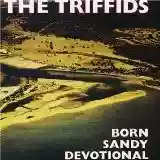
Within the space of 10 high-level songs in "Born Sandy Devotional," McComb confronts and unsuccessfully seeks to exorcise, accept, or deny the sordid and disordered details of his own life. And his band follows him, exploring without rhetoric certain themes beloved by the generation of punk survivors. Violence, death, commitment, infidelity, and isolation. Always, in the background, the desolation of a native Australia incapable of offering any comfort, only an eternal curse. References to the sea and the lost beaches of this country abound but offer no solace. Ever. As in the opening piece, the hypothetical Calypso of "The Seabirds," already unforgettable. The sound fills with strong lyricism and celebrates in its just under four minutes the epic of a man who will give his life as a gift to the seagulls, right on one of those sunny beaches photographed on the cover. Musically, I cannot precisely place the sound of the Triffids, so laden with both folk and rock influences that it is not easily classifiable. Sometimes they remind me of Simple Minds, suspended somewhere between Sons & Fascination and New Gold Dream; other times, and I know this is a bold statement, I even think of prehistoric Arcade Fire and their epic cavalcades, thirty years earlier... Difficult to make comparisons. Take the vaguely country tinge of "Estuary Bed" that brings with it that characteristic Australian sound, only found in some tracks by the Go Betweens. And I think of "Part Company" or "Man of Sand and Girl of Sea," just to make it clear. Have we ended up in the realm of Steve Kilbey's Church Jangle Pop perhaps? I don't think so... as immediately shown by “Chicken Killer," which is a hammer blow to the nape, à la "Birthday Party" of ink king. And what about the disorienting sweetness of “Tarrilup Bridge,” sung by Jill Birt with a tender and insecure voice to contrast with the almost baritone timbre of McComb that we had nearly become accustomed to. And then the crazy whirlpools of noise and the wailing echoes of "Lonely Stretch," where the music staggers like a ghost train at a very dark carnival. "Lonely Stretch," as will be on the B-side of the vinyl, the magnificent "Wide Open Road," is an atypical “road song” but here neither the driver nor the car survives the journey, in a parched and brutalized land, the same emotional ground as the narrator. The impact of the lyrics is decisive but the musical choices also prove original, allowing themselves never to follow a precise linear path. Sometimes the resulting sound recalls the "Big Music" of Mike Scott's Waterboys, but it allows nothing to the spectacle, though making grandeur an essential value. In "Born Sandy Devotional," keyboards often take over the songs; the pedal and lap steel guitars of Graham Lee punctuate the compositions consistently alongside Robert McComb's violin and Martyn Casey's pulsating bass. The same "opulent" production by pre-Pixies Gil Norton gives the album a rich sound, at times almost Spectorian. The songs are the best David McComb ever wrote and cover a wide spectrum of styles. Whether it’s the symphonic qualities of “Wide Open Road,” their most famous and celebrated piece, or the rolling keyboards of the driving blues of "Personal Things," my absolute favorite.
All these various themes return interwoven in "Stolen Property," perhaps the song that encapsulates all the emotional philosophy and complex sound of the Triffids, their essence. It’s a track that starts quietly and allows itself a devastating crescendo, with a funereal mix of keyboards and jagged strings, unshakable in its sense of despair, regret, anger, and loss. Beyond the absolute beauty of the piece, what emerges once again is the portrait of a young man (23 years old!!!) who evaluates how little he has achieved in life while struggling to cope with a sense of helpless loneliness. "Stolen Property" could be a testament, capable of being evocative and open to any other interpretations but laden with that sense of loss and despair that doesn't allow for remedies. In closing the album, there is still time for the brief and immaculate outro of “Tender Is the Night,” a gentle nursery rhyme that is a small pearl. Sung by Jill Birt in Moe Tucker mode, never so convinced, the outro of "Born Sandy Devotional" finally sheds a little light and hope after so much suffering.
The album is all here, and I assure you that in its roughly 45 minutes, it is of incomparable richness. Over 35 years since its initial release, "Born Sandy Devotional" remains, in my opinion, one of the truly underrated masterpieces of music. Epic in scope and flawless in execution, this album is at once distinctly Australian in atmosphere, yet universal in appeal, and it's no coincidence that, although written and conceived "down under," the record was then recorded in England, proving to be a wise synthesis between the roots of popular and rock music and the new trends of the eighties (post-punk, neo-psychedelia, electronic). From the day of its release, March 1, 1986, I always thought that sooner or later, it would be recognized as a masterpiece, a "Born to Run" of the upside-down world. David would have liked the comparison with the desperate and losing Springsteen, not with the millionaire one. Even McComb would have deserved fame and redemption as a little Boss, but instead, he died alone and almost forgotten in his Perth, a million kilometers away from here. Don't forget him.
Loading comments slowly
Summary by Bot
Born Sandy Devotional by The Triffids is praised as an epic and underrated masterpiece reflecting the troubled genius of David McComb. The album combines diverse musical influences and richly poetic themes rooted in the harsh Australian landscape. Its production, lyrical depth, and timeless appeal make it a compelling listen even decades after release. The review honors McComb's legacy, noting his tragic life and unique artistry.Tracklist Lyrics Videos
The Triffids
The Triffids were an Australian rock band formed in Perth in the late 1970s, led by singer-songwriter David McComb. Revered for cinematic evocations of the Australian landscape and emotionally charged songwriting, they released acclaimed albums including Born Sandy Devotional (1986), Calenture (1987), and The Black Swan (1989) before disbanding in 1989. Their signature song is Wide Open Road.03 Reviews
Other reviews
By fabiopao
"The Triffids describe with more passion than their compatriots the vast desert of the Australian outback and the equally vast desert of the human soul."
"'Wide Open Road' is not one of a hopeful future as in Springsteen’s 'Born to Run,' but a long strip of scorching asphalt of a present without expectations."
