
 •
Rating:
•
Rating:
THE REVIEW
It’s finally here! Now the hard part is sneaking it into the house without Sam noticing me.
Busted right away, oh well, never mind; I already know the first song I want to listen to, so I go straight to side B, first track: tan, tan, tan ...
No Sam, it’s not “Cuore Matto”—it’s “Keep On Running,” a historic track of so-called Blue-eyed Soul! The term was coined in the mid-'60s to describe white artists from the UK whose sound was similar to that of the black labels Motown and Stax: Dusty Springfield, Eric Burdon’s Animals, and Tom Jones were the first stars of this emerging style. Shortly after, other major representatives of blue-eyed soul included Van Morrison’s Them and the archetypal mod band, the Small Faces. But the record spinning on the turntable is by The Spencer Davis Group; though they never became rock stars, I’ve always thought they made a lot of music that helped create an exciting atmosphere for that era.
Ahhh, the Swinging London of the 1960s …
Not quite, you know, I’ve never been to England and I want to go there with you, and when we do, we’ll surely go to London, but I doubt we’ll visit Birmingham, where it all began for this band—if not historically, certainly seminally. It’s England’s second most populous city and was a major automobile production hub, employing tens of thousands of workers crammed into tower blocks that sprang up like mushrooms during the awful post-WWII reconstruction policies: industrial chimneys; motorways; and a downtown with a somewhat American look. Basically, a kind of Detroit in European style, the “Motor City” of the USA, which, between the late '60s and '70s, spawned key bands like the MC5, Iggy Pop’s Stooges, and Alice Cooper, defining proto-punk and garage rock.
Mauro, so, steel, bolts, and motor oil are the perfect humus for sowing the devil’s music?
Yes, that’s pretty much how it is, because Ozzy Osbourne and all the original members of Black Sabbath are from here. Members of Jethro Tull and Fleetwood Mac are from here. Robert Plant and the late John Bonham were Birmingham kids! And in Birmingham, on May 12, 1948, Stephen Lawrence Winwood—Steve, for short—was born. “You in the US have little Stevie Wonder, we in England have little Steve Winwood.” This quote, attributed to Chris Blackwell (founder of Island Records, the band’s label), highlighted that mid-sixties England had a white soul talent comparable, in intensity and artistic maturity, to the genius of Stevie Wonder: Steve Winwood. At age nine he played in his father’s jazz orchestra; at eleven, he led his own group; at thirteen he played in the “Muffy Woody Jazz Band”—a semi-professional group led by his older brother, bassist Mervyn “Muff”—thus becoming a blues/rock star already at 16-17 with the “Spencer Davis Group.” In short, a child prodigy who, beyond skillfully playing guitar and piano, composing and arranging, was (and is) gifted with a wonderful voice.
And Davis Spencer?
Spencer Davis (Swansea, July 17, 1939 – Los Angeles, October 19, 2020), known as the “Professor” in music circles (he spoke five languages fluently, sang, and was a good multi-instrumentalist and decent guitarist), used to perform in local folk-clubs in the evenings, where he met the Winwood brothers and decided to form a band with them. Well, nine years, in that particularly formative period of life between 15 and 30, is not a small gap, but it was immediately clear to everyone, even to the good Davis, that the leader was the kid with the multi-instrumental talents and a “black” voice, nurtured since childhood through listening to singers like Ray Charles, his main inspiration. He wasn’t a carbon copy—he had his own, personal style, distinct and with a slightly higher vocal range; he’d express himself with moans and scat on choruses and fades and, with the Spencer Davis Group, gained fame for his Hammond organ and lead guitar playing. A consolation for Davis was having the band named after him, but Stevie’s voice, already mature and soulful in his teens, was the band’s main strength.
But the liner notes list Jackie Edwards as the author; was he the fourth band member…?
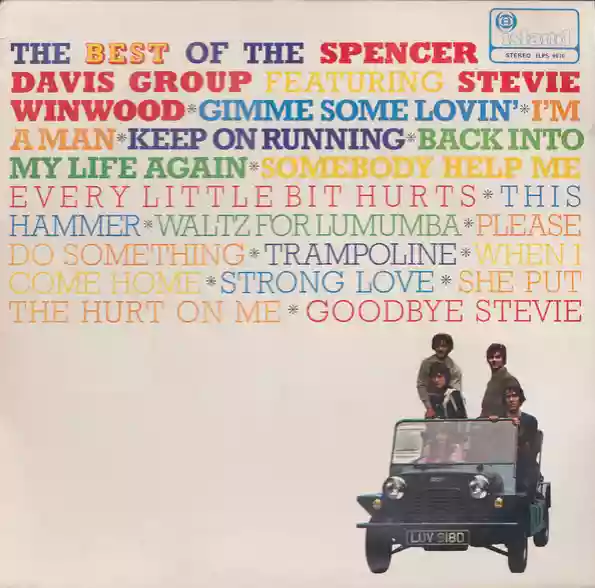
No, no: the original combo was completed by Pete York on drums. Jackie Edwards, instead, was born in Jamaica in 1938 and grew up there with fourteen siblings. Heavily influenced by Nat King Cole, he began performing at age 14. Edwards caught the attention of Chris Blackwell, who at the time had founded Island Records in Jamaica (1959) and was among the first to produce Jamaican pop music—what would later become known as ska. When Blackwell moved Island Records to London, in 1962, Edwards followed him, working as a singer and songwriter for the label. He wrote both “Keep On Running” and “Somebody Help Me,” which we’ll listen to. But now, I’ll flip the record and go through, in order, the sequence of originals and covers found on this Best Of, one of the few compilations in my collection. Despite some filler, the main hits are considered evergreen examples of 1960s blue-eyed soul. Take the opener “I’m A Man”—no, it’s nothing to do with Bo Diddley; this was written by Winwood and producer Jimmy Miller—its infectious, danceable rhythm and rich descending organ riff… doesn’t it remind you of Booker T. & The MG’s work?
Booker who?
Come on, the guys behind Green Onions …
Hey, I know that one, it’s by the Blues Brothers!
No, no, no—“Gimme Some Lovin’” is their song. Released in 1967 (yes, Stevie was 17, if you do the math), it’s an energetic, raw, and soulful blues-rock anthem. And with all the love I have for Belushi and the B.B.’s, the original version, marked by Steve Winwood’s incredibly powerful voice and the gritty Hammond organ riffs, is a raw gem blending soul with a heavy rock sound: for me, one of the best songs of the ‘60s. Not to mention…
Listen, I’m convinced: enough “dancing about architecture” (a saying from Frank she never forgot), turn up the volume and grab two beers.
Ok, ok, even though I come from a mutanghera family, when I start talking about music, I go overboard. My late grandfather, known in the tavern as “Battisilenzio”, must be turning in his grave. Just one last thing: even though I don’t usually like compilations, in this case, I think it’s the best choice. In fact, even though during the mid-‘60s British blues-rock/R&B boom Spencer Davis Group were one of the leanest and tightest bands of the era, it’s curious how their early records never sold as much or had the same recognition as the Rolling Stones’ or even the Animals’, probably because these guys were more of a singles band than an album band. So, welcome this very successful 1967 compilation—the year the Winwood brothers left (with Steve immediately forming another historic band: Traffic). And just think, two years later, after some lineup changes, the group disbanded. In essence, Winwood was the main architect of this historic group's success between the ages of 16 and 19.
Yeah, different times! But, the beers?
A1 I’m A Man - J. Miller, S. Winwood
A2 Gimme Some Lovin’ – Muff Winwood, Spencer Davis, Steve Winwood
A3 Every Little Bit Hurts – Ed Cobb
A4 This Hammer – Muff Winwood, Pete York, Spencer Davis, Steve Winwood
A5 Back Into My Life Again – J. Miller Written-By – Jackie Edwards
A6 Waltz For Lumumba – Steve Winwood
A7 Together Till The End Of Time – Frank Wilson
B1 Keep On Running Written – Jackie Edwards
B2 Trampoline – Steve Winwood
B3 When I Come Home – Jackie Edwards, Steve Winwood
B4 Strong Love – Malone/Silvers/Brown
B5 Somebody Help Me – Jackie Edwards
B6 She Put The Hurt On – L. Nelson
B7 Goodbye Stevie Written – Muff Winwood, Pete York, Spencer Davis, Steve Winwood
Loading comments slowly
Summary by Bot
This review celebrates 'The Best of the Spencer Davis Group featuring Stevie Winwood' as an essential collection of the band's classic hits. The reviewer praises Steve Winwood's distinctive voice and musicianship. Fans of 1960s rock and soul are encouraged to revisit or discover these timeless tracks. The compilation is held in high regard for both nostalgia and musical quality. Offers a sense of the group's influence on the era.Tracklist Videos
The Spencer Davis Group
The Spencer Davis Group were a British R&B/rock band formed in Birmingham in 1963 by Spencer Davis, with Steve Winwood, Muff Winwood, and Pete York. They scored major UK/US hits with Keep On Running, Somebody Help Me, Gimme Some Lovin’, and I’m a Man before the classic lineup split in 1967–69; the band reformed briefly in the 1970s and later toured in various lineups.01 Reviews
