
 •
Rating:
•
Rating:
THE REVIEW
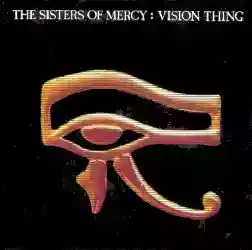
It seemed only right to close the studio album trilogy of the Sisters of Mercy with a review of what some considered as the only blemish in the band's career, that is the controversial "Vision Thing". After yet another line-up change, due to the departure of the captivating Patricia Morrison and her replacement on bass with Tony James, known for being part of Billy Idol's punk band, Generation X, at a very young age, Eldritch once again surprised all of his fans by offering them a very different album from the previous two. It was characterized by an almost total absence of electronic references and a significant reduction of the gothic character in favor of a more conventional rock sound, so much so that Andrew himself said at the time that he was inspired by the ZZ Top for some compositions.
Even the voice of the black angel itself in some songs is noticeably different from those from the past, as evidenced by listening to the title track that opens the album, where perhaps the most "angry" vocal performance by Andrew can be heard, accompanied by a guitar riff more rock than gothic, all masterfully produced by the genius known as Jim Steinman (noted for his collaboration with Meat Loaf). The following "Ribbons" is the darkest of the entire work and stands out for the relentless and obsessive rhythm of the drum machine (I remember that at the beginning Andrew played the drums but, due to his lack of skill and the lack of funds to recruit a real drummer, it was decided to buy an electronic drum set that was considered a real member of the band and was called D. Avelanche), the electronic sound of the guitars, and Andrew's voice, deep and cavernous as in the good old days. "Detonation Boulevard" faithfully reflects what was said about the new style of "Vision Thing". What is most impressive is its calmness as it is a song that is quite different from what one might expect, distinguished by a sound that has lost all dark references, and indeed, it can rightly be said that it is a light, almost carefree song. Next comes "Something Fast", a melancholic ballad, where the more romantic aspect of Andrew's voice is predominant, accompanied only by an arpeggio on classical guitar. "When You Don’t See Me" continues the discussion of "Detonation Boulevard", this time in a hard rock key. Calm atmosphere, subdued but engaging choruses, well-played track. With "Doctor Jeep", the obsessiveness of the drum and the endlessly played guitar riff resumes, but unlike in the past, even in this song, the atmosphere is not gloomy but almost relaxed. The highest point of this "Vision Thing" is reached with "More", where once again Steinman's production influence is felt. A rock gallop characterized by the perfect mix between the hard sound of the guitars, the powerful stride of the keyboards, Andrew's superb voice contrasted with the pomposity of the choruses. The album, and unfortunately the studio recording career of the Sisters, closes with the ballad "I Was Wrong". What is most moving about this song is the deep contrast between its serenity, which leaves the listener with the idea of continuity and artistic evolution of the band towards a sound different from the past, and the harsh reality represented by the awareness that "Vision Thing" represents the last chapter in the group's history.
In conclusion, even though "Vision Thing" disappointed many fans of the time, in my opinion, one cannot avoid listening to the work in question to fully understand the maturation which, sadly, stopped at that point.
Loading comments slowly
Summary by Bot
The review explores The Sisters of Mercy's 'Vision Thing' as a controversial yet mature album marking a major shift from gothic rock to a more conventional rock sound. Highlighting the influence of Jim Steinman's production and Andrew Eldritch's evolving vocals, the album blends hard rock energy with melodic ballads. Despite disappointing some fans, the reviewer sees it as an essential listen to appreciate the band's artistic evolution and final studio work.Tracklist Lyrics Videos
The Sisters of Mercy
The Sisters of Mercy are an English rock band associated with gothic rock and darkwave, formed in Leeds and led by vocalist Andrew Eldritch. Reviews highlight their signature use of drum machine Doktor Avalanche and their classic run culminating in albums like First and Last and Always and Floodland, followed by the more controversial Vision Thing.11 Reviews
