
 •
Rating:
•
Rating:
THE REVIEW
One of the most sinister and fascinating personalities of the entire dark movement is undoubtedly represented by Andrew Eldritch (born Andrew William Harvey Taylor), otherwise known as the Messiah of Gothic, and his (or rather her) The Sisters of Mercy (a name taken from a song by the famous American singer-songwriter Leonard Cohen).
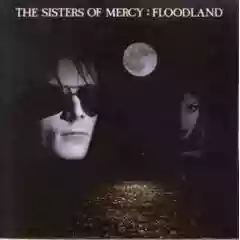
After the release of that gothic music masterpiece known as "First and Last and Always," the band seemed on the verge of disappearing due to the departures of guitarist Gary Marx and bassist Craig Adams, founders of the band along with Eldritch, who subsequently gave life to the excellent Mission. What followed was a very turbulent period for the gothic vampire, torn between his problems with alcohol and drugs and the long dispute with the former members to determine who, in the future, would be able to bear the name Sisters of Mercy. Once these issues were resolved and the charming rock witch Patricia Morrison was hired on bass, Eldritch in 1987 released "Floodland," another immense record, which achieved unexpected commercial success, so much so that it gradually climbed the UK charts settling at the seventh position.
Compared to the previous studio album, this "Floodland" features marked electronic contaminations and a sound that is overall more gothic rock. The opener "Dominion (mother Russia)" faithfully reflects what has been said. An absolute masterpiece of gothic rock characterized by a pounding drum and bass rhythm that mark the time, hypnotic guitars, contrasts between Andrew's deep voice and the female one (Patricia's great voice as well), in a fascinating and enveloping mix. The following "Flood 1" is as dark and gloomy as can be imagined. Eldritch's voice, instead of waking us from a sound nightmare, pushes us into it body and soul, a voice sharper than a razor that gives no escape to the listener. We then reach the apotheosis, that is, "Lucretia (my reflection)," distinguished by one of the most beautiful bass lines of the entire genre. The following "1959" (cover of the Stooges) is perhaps the most moving ballad ever composed by the group. Only the melancholic tones of Andrew accompanied by the gentle sound of a piano can be heard. "Flood 2" is the worthy sonic continuation of "Flood 1," although this time the keyboards and vocals, instead of pushing us into total desolation, try to make us see the light, even if faint and distant. "This Corrosion" is the most electronic song of the entire album, where synthesizers dominate its body, then explode into the "corrosive" chorus of Eldritch and Morrison. The one-way journey continues with "Driven Like the Snow," characterized by the icy pace of the bass and the dark melody of the keyboards, with "Neverland," of an almost suffocating darkness, and with "Torch," a song that sounds almost hinted at and, for this reason, very effective. The album closes worthily with the obsessive and oppressive "Colours" which, in the rhythmic parts, recalls "Ribbons" from the subsequent "Vision Thing."
What can I say in conclusion, except that it would be a crime not to listen to this "Floodland" which constitutes, in my opinion, the highest point of the band's discography and, perhaps, of all dark rock.
Loading comments slowly
Summary by Bot
Floodland by The Sisters of Mercy marks a high point in gothic rock, showcasing Andrew Eldritch's deep voice and electronic elements. Despite band conflicts, the album achieved UK chart success. Key tracks like "Dominion (Mother Russia)" and "This Corrosion" exemplify its dark atmosphere. The review praises it as a genre masterpiece and essential listening for dark rock fans.
The Sisters of Mercy
The Sisters of Mercy are an English rock band associated with gothic rock and darkwave, formed in Leeds and led by vocalist Andrew Eldritch. Reviews highlight their signature use of drum machine Doktor Avalanche and their classic run culminating in albums like First and Last and Always and Floodland, followed by the more controversial Vision Thing.11 Reviews
Other reviews
By Conteverde
Floodland stands as a monument of gothic rock.
The album’s atmosphere flows like a dark river, hypnotic and grand.
