
 •
Rating:
•
Rating:
THE REVIEW
"Please allow me to introduce myself
I'm a man of wealth and taste
I've been around for a long time
stole many souls and took much faith from men"
A tribal drumming that lasts for 6 minutes and 23 seconds, animalistic and unsettling screams. Jagger's voice and Hopkins' piano. Four chords. A blazing yet calm beginning that in an instrumental and vocal crescendo explodes into one of the best electric guitar solos by Richards and in rock as a whole. And it fades slowly...
This is how "Beggars Banquet" opens, the best, the most varied, the most innovative, the most scandalous and shocking album by the Stones: with "Sympathy for the Devil"; is there really a need to translate it? The Devil, personified by an ever-luciferian and sarcastic Jagger, presents himself to the world. And he does so with great courtesy and a hint of presumption, boasting of his numerous successes and pointing the finger at men, engaged through the centuries in fighting and dying "for the gods they themselves had created". He was there, when Jesus Christ wandered in doubt and pain, and personally ensured that "Pilate washed his hands, thus sealing His fate"; he was around St. Petersburg when he saw that "it was time for changes"; he was there at Kennedy's death. Is it a world dominated by evil? Surely dominated by a superior entity, which clearly is not the one expected by the religious and believers. This "demonic sabbat" created a lot of uproar in its time and was censored multiple times. And the Stones were accused of satanism and whatnot. It is truly said that ignorance breeds terror and fanaticism...
A sweet acoustic guitar opens "No Expectations". It's a "ballad" with a much calmer rhythm than the previous track. The "tough and dirty" Rolling Stones demonstrate here more than in other compositions their value as "songwriters" and their ability to easily step out of the pure and raw "rock song". Jagger's voice is more melancholic and of incredible depth, the piano inserts dialogue with the guitar in a heavenly union. It's about love, broken love, fickle love, love "like water flowing over a rock". A love disappointment, then. A love disappointment that needs healing. "Help me please doctor! Can you put my heart back in place?". The 3 minutes and 24 seconds of "Dear Doctor" lead us towards similar but more ironic themes, highlighted by a more "sing-song" sound and a spectacular falsetto voice halfway through the track. The Richards-Jagger vocal duet works very well and is accompanied by a simple acoustic guitar riff that is engraved in the mind at first listen and a perfectly fitting harmonica.
The following "Parachute Woman" is one of the less successful tracks of the album. A pounding rhythm of guitar and harmonica accompanies Jagger's voice which ranges between high and low tones. The brief harmonica "solo" at the end is worth noting. Of a completely different caliber is "Jigsaw Puzzle", one of the best tracks on the album. The ever-present Hopkins’ piano plays a fundamental role here and matches perfectly with Richards' slide. The lyrics are a collection of hallucinated visions, linked together without an apparent logical thread.
We are halfway through the album. The themes and tones have been many and manifold. But let's not forget we're in the summer of '68, the year of protest, clashes, occupied universities. "It's the right time for fighting in the street, boy" (but is it really so...? ). "Street Fighting Man" gives voice to the youth movement of that time, with considerable musical energy but with a hint of regret. Because in "sleepy London" there's no more place for a "man fighting in the street". The only alternative to rebel against the system and scandalize the bourgeois and the prudes is to sing things in a rock band that were previously unsayable. And that's exactly what the Stones did. And they did it excellently. Just look at the lyrics of "Stray Cat Blues". Musically, the song adds nothing new to the Stones' sound. Blues influences and hard rock anticipations, classic chord progression, distorted guitars and Richards' final solo. It's the lyrics that are the real novelty. Of unprecedented violence and rawness. Who is speaking is none other than a pedophile addressing a boy no older than fifteen. "Oh yes, you're like a stray cat... I bet your mother doesn't know you scream like that... doesn't know you spit like that... doesn't know you bite like that... you're so far from home but your mother doesn't care that much...".
The elegy of "Factory Girl" brings us back to calmer themes, though not without a certain "social protest". The girl mentioned works in a factory, has no money, her trousers are torn and her clothes are stained. The album closes with the chorus of "Salt Of The Earth, a toast to those who are part of this world but are excluded from it, to the workers, the regular soldiers and their families. A choral prayer, an anthem of hope, a glimmer of light. Hopkins' piano is sublime, Richards' slide is engaging, Jagger's voice is moving. The worthy conclusion of a timeless album.
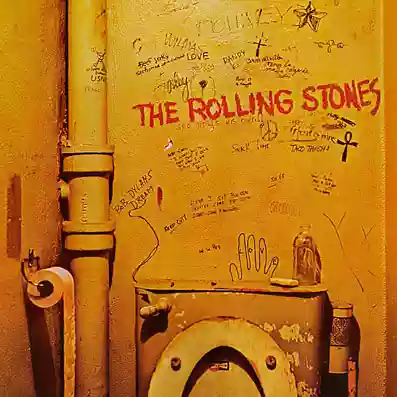
I don't want to linger any longer praising the musical and historical importance of this album. I'd rather spend a few words on the cover. At its time, it was obviously a scandal. Nothing more than the wall of any public bathroom, covered with anonymous writings. But is it really just this? Personally, I see in this image an "ode to the ugly", a work worthy to stand alongside the great masterpieces of pop art (not for nothing the cover of another Stones album, "Sticky Fingers", was designed by Andy Warhol) and at the same time a highlight of the loss of values of the time. It reads: Bob Dylan's dream, LOVE, the peace symbol. But where are they written? On a squalid wall of an even more squalid bathroom. It's the destruction of the hippie myth "peace & love", reduced to mere writings and juxtaposed with symbols of questionable taste. The "swinging sixties" are nearing their end… but that's another story.
Loading comments slowly
Summary by Bot
This detailed review praises The Rolling Stones' 1968 album Beggars Banquet as their best and most innovative work. It highlights the iconic opening track 'Sympathy for the Devil' and discusses the album's range from raw rock to melancholic ballads. The reviewer emphasizes the social and political context of the album, its controversial themes, and its lasting impact on rock music. The cover art is also noted as a striking pop art statement. Overall, the album is celebrated for its musical diversity and historical significance.Tracklist Lyrics Videos
03 Dear Doctor (03:25)
09 Factory Girl (02:10)
11 Jumping Jack Flash (original Mono mix) (03:41)
12 Highway Child (Keith, Mick & Charlie Rock Out) (05:05)
13 And I Was a Country Boy (instrumental) (04:26)
14 Family (acoustic version) (04:14)
15 Blood Red Wine (05:21)
16 Downtown Lusie (Rough mix of This. Metamorphosis Track) (03:46)
17 Still a Fool (09:46)
The Rolling Stones
English rock band formed in London in 1962. Key long-term members include Mick Jagger and Keith Richards. Known for blues-influenced rock, enduring live performances and a prolific discography.81 Reviews
Other reviews
By the clash
The Rolling Stones are the emblem of defiance and rebellion, facing old age with energy and will to live.
"Sympathy For The Devil" is provocative and bizarre, defining the Stones as revolutionaries shaking up the system.
By Missing
The Stones experienced an awakening: being hippies wasn’t in their nature.
'Sympathy For The Devil' makes this track an epic and terrifying contribution to the pages of Rock History.
