
 •
Rating:
•
Rating:
THE REVIEW
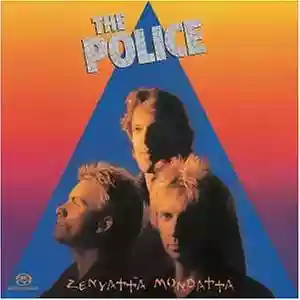
Well, I boldly review perhaps the weakest point in the Police's production. Perhaps. Because in this album, you can find very interesting cues and notable gems.
After the great worldwide success of Reggatta, the Police found themselves playing for a world tour of considerable size (Police Around The World, if someone helps me find this rare video, I thank them...). Success, covers, lights: the band perhaps begins to "unravel", Sting finds himself catapulted into the star system, and his creative streak suffers from it. And yet... despite the inevitable dilution heard in the tracks of this album, it's worth pointing out true "classics" of undisputed quality.
"Driven To Tears" is a little gem in dub, with a bitter lyric and a Summers solo that testifies to recent re-frequentations with his friend Fripp. Copeland is always a guarantee, a true "lord" of the cymbals. "When The World..." follows closely: a disorienting funky, with an insistent rhythmic march, and the guitar... we're always there, Summers manages with just three, super-harmonized chords to create a fabulous harmonic base. "Voices..." seems to be a faded copy of "Reggatta De Blanc", an anthem which, when listened to carefully, reveals a pretty decent tribal march.
Two reggae-ska episodes, cute but rather weak ("Canary In A Coalmine" and "Man In A Suitcase"), the sadly famous "De du du du...", definitely represent the weakest point of the album: little pop tunes thrown in without much thought, and without notable arrangements.
The album greatly improves with "Shadows In The Rain": a fantastic dub track, with a reverberated sound that envelops everything, doing some justice to the inventive capabilities of the trio. You even hear a stick strike from Copeland, perhaps a mistake (deliberately left?).
All in all, an album that if it had been conceived and produced more calmly, or perhaps without pressures from the record label, could have yielded better results. Let's say an unfinished work...
Loading comments slowly
Summary by Bot
This review examines The Police's third album, Zenyatta Mondatta, as the band faces stardom pressures impacting creativity. Despite some diluted songs, the album features notable classics such as 'Driven To Tears' and 'Shadows In The Rain.' Certain tracks fall short, seen as weaker pop attempts. The reviewer considers the album an unfinished work that could have been stronger without outside pressures.Tracklist Lyrics Videos
The Police
British rock trio formed in 1977 (Sting, Andy Summers, Stewart Copeland) known for blending rock, reggae and new wave and for hits such as "Every Breath You Take".35 Reviews
Other reviews
By claudio carpentieri
Try listening at full volume to those eight initial snare drum beats in "Driven To Tears," and you’ll understand why even today, when people talk about The Police’s sound, it is done by appreciating that magical sense of novelty.
"Zenyatta Mondatta" can be considered a sunny sonic document that aptly represents the transition from the ’70s to the ’80s of one of the most extraordinary ensembles the multicolored universe of rock music has ever had.
By wardrobeOFdeath
The tracks have a concise and well-accentuated rhythm (clearly of reggae origin), yet they are not for dancing, they are for listening.
The last song is 'The Other Way Of Stopping', a thrilling, somewhat dark progressive piece... That said, it concludes one of the best pop albums I have ever heard.
