
 •
Rating:
•
Rating:
THE REVIEW
The die is finally cast.
Two years ago, myself and my colleague JonatanCoe had planned to write a review together on the album Gold Afternoon Fix by the Australians The Church. The writing collaboration, mostly due to me, was then shelved, put aside. Suddenly, a few days ago, we reconnected, and this time everything went well. And this is the result.
The Church came out of the eighties grandly; an album, Starfish, that finally rewarded the band after years of struggling and not much recognition, especially in terms of sales and worldwide acknowledgment. After a few months of rest at the end of the promotional tour, the Australians are ready to start again, to give a worthy follow-up to the previous masterpiece. They will succeed even though the final result of Gold Afternoon Fix won't reach the stratospheric levels of Starfish.
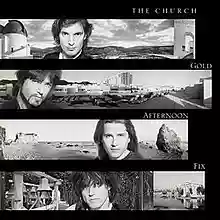
Steve Kilbey has always stated that he didn't like their first work of the nineties too much; the reasons lie in his heroin addiction of that period and the record label's production choice. In fact, the Arista label wanted to play it safe, to replicate the generous successes and substantial profits of Starfish; and that's why the helm was handed over once again to Waddy Wachtel, even though the band had even considered involving a certain John Paul Jones. During the recording of the songs, Steve once again claimed himself as the father-master of the Church; the tension rose to a level that led to the first major defection in the group's history. Indeed, the drummer Richard Ploog suddenly left his companions, greeted the astonished colleagues, and abandoned the Church. His drumming will only be heard on three tracks of the work, while in the remaining eight, they will even resort to a drum machine. In my opinion, Gold Afternoon Fix does not suffer from these negativities because it is a highly valid product; deserving four stars from the Debaserian point of view. Starting with the beautiful cover (how I miss those so eighties hairstyles...!!): photographs, images of the four members combined with backgrounds of their imaginative land.
The introductory "Pharaoh" seems like an appendix to Starfish, an eleventh track after "Hotel Womb," which reduces two years between the two works to just a three-second pause. Kilbey's voice is the same with its disarming melancholy, while the guitars tear you apart as they caress you. Fascinating electric ballads, direct like "Metropolis" and "Russian Autumn Heart," provide a somewhat unusual, lively briskness, also appreciable in "Terra Nova Cain," which travels decisively and at times vaguely mystically in its spatial flutters ("Terra Nova, I need you again, protect me from the meteor shower..."), constantly seeking protection and comfort, rebuilding a lost world (or a lost love?). Of the same tenor are "Essence," a manual exposition of rock precepts that today seem forgotten, "Fading Away" with its theological perplexities, and "City" which, along with "Laughing," flows without too many pretenses in a sweet pop ballad lacking significant jolts but with the same heartfelt lyricism that explores existential dynamics, severe and gray as a Monday ("Monday Morning").
The album maintains a constant emotional tension, allowing no hesitation or faltering, both in the instrumental parts where Koppes and Willson-Piper with their guitars weave the sonic garments with sartorial skill, and in the lyrics rich with food for thought and citations/homages to writers like Oscar Wilde in "You're Still Beautiful" (a singular resonance with "How Beautiful You Are" by the Cure, also dedicated to a writer, in this case, Baudelaire). "Transient," a ride with reminiscences of the stupendous "North, South, East And West" from the previous album, is another delightful gem nestled in this surprising album that is half vibrant but devoid of significant shocks and with a continuous, subtle line of unease, and half essential and intimate; a sensation heightened in the parts where the sounds and production become increasingly polished, at times ethereal like "Disappointment" and the concluding "Grind."
The lyrics and the sound of Gold Afternoon Fix, a very clean rock-pop (perhaps too much so) meticulously curated in every detail, trace, like in all Church's albums, the geographical boundaries of their Australia, running along the deserts and the desert cathedrals of this faraway and fascinating corner of the world.
Unfortunately, the sales did not satisfy the record label, marking the beginning of the decline that led in 1994, after the collaboration for Priest = Aura, to an inevitable separation. The Church, despite minor bumps in the road (in 2013 Marty Willson-Piper left the band), continue to be assiduously prolific with a qualitative standard like few others, although, to be clear, that appeal from the 80s and 90s can no longer materialize. Every phase of life contemplates a magical period, and theirs is still there, in the same place, on the shelves of a record store, in the selections of a nighttime radio program, in a car with the window slightly open amidst the pouring rain, in the room that was ours yesterday, on the front of a music cassette, written with an indelible pen and an adolescent passion, on a day you don't remember, perhaps in a "golden afternoon."
Ad Maiora.
Loading comments slowly
Summary by Bot
Gold Afternoon Fix is a thoughtfully crafted follow-up to The Church's breakthrough album Starfish. Despite internal tensions and lineup challenges, the album offers emotionally rich rock-pop with polished production and imaginative lyrics. It captures a unique Australian atmosphere and showcases the band’s consistent artistic quality. While it didn't match previous commercial success, its subtle depth earns it a four-star rating.Tracklist Lyrics Videos
The Church
The Church are an Australian rock band formed in 1980, widely associated with dreamy, psychedelic and jangle-leaning alternative rock. They are best known for the song “Under the Milky Way” and for albums such as Starfish.13 Reviews
