
 •
Rating:
•
Rating: THE REVIEW
1979. Or the year after. The year after the cosmic success of the debut album, the live shows in the USA, the fans sneaking into your dressing rooms, the music videos... The year after you've become a star. When the band is young, the year after, they need to make another album, people must not lose interest: they haven't yet become accustomed to your style, and just as you've emerged, you could return to the nothingness from which you came.
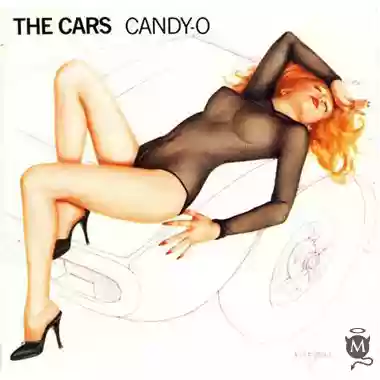
1979. 'Candy-O'. The album of confirmation. "Let's Go" is exactly what you expect from a band like the Cars to start an album that "promises" to replicate the same formula as the previous one. The keyboards are already clearer, and the guitars even more gentle: forget about raising the wall of sound!
"Since I Held You" has a nice start and then becomes a charming little march. A good chorus for a very inspired song with a finale crescendo of choirs and guitar. "It's All I Can Do" has very airy keyboard parts, elevating the vocals. So far, they haven't missed a beat, and upon reflection, the simplicity and simultaneously the stylistic perfection of Ric Ocasek is nothing short of maddening. And again "Double Life": two chords simpler than you can imagine, a piece with guitar and drums... and (almost) that's it... It works, perhaps repetitive, perhaps with a bit more variety it would better support the "psychological wall" of the 4 minutes. From its fading comes "Shoo Be Doo": try to imagine it played by Suicide and not by a rock-wave band. It starts here, rather, from this minute and a half, the different Ocasek, the one who will work with Suicide, who will form brotherly friendships with Alan Vega, who will become a minimal artist, who will end up recording albums like Negative Theater, Getchertickitz and producing only alternative bands to (launch into) the mainstream.
"Candy-O" is the strongest episode of the album. The dark atmospheres originate from that part of the stomach from which "Moving In Stereo" was born the year before, but the rhythm has grown; the guitar-bass syncopation is great, Orr sounds like Ocasek when he hits low notes. Here the wall is raised, indeed! Perfect.. Imagine that it will be covered by none other than the sweet Melvins (staying very faithful to the original, unlike "Venus In Furs" by the Velvet Underground). The desire for "darkness" continues with "Night Spots", certainly not as immediately impactful as the previous one, with feverish keyboard and guitar work, for an almost punk (seventies) chorus. It's the antithesis of Ocasek's metropolitan protopunk, someone who at that time should have made four albums a year (plus one solo) to freely unleash his compositional capabilities and visions, yet "he will try," more and more in the years to follow, to converge all this within the Cars container, not always succeeding fully, a container that one day will end up "falling apart."
With "You Can't Hold On Too Long" we return to where we left off before "Shoo Be Doo": simple plots. The voice is still low, almost "tested" by the previous triad, almost convalescent. Perfectly returning to health with "Lust For Kicks", the easiest to listen to, absolutely disarming, straight out of a 60s juke box. Warning: I'm not saying it doesn't work, or that the 60s surf-pop from a Hawaiian shirt can't be yet another good idea by Ocasek, but after hearing what they're capable of in "Candy-O"... At least in "Got A Lot On My Head" there's a good guitar ride. "Traditional" finale with this track and with the "classic" of the Cars repertoire "Dangerous Type", similar in setting to the "colleague final song" of the previous album, which is "All Mixed Up". Ocasek still sings, although the piece requires more pathos, and perhaps not only for this reason does the piece seem less dreamlike. Finale without the splendid sax solo, as it was for "All Mixed Up".
If they had to confirm themselves, then "the album of the year after" by the Cars hit the mark. Everything that was expected is fulfilled... The fact is, the Cars seem to have emphasized the importance of their task (to ensure a solid base of fans as large as possible in the shortest possible time)... In fact, to be radio friendly, there's no need to lower the sound wall to zero... Repeating the same things and the same loops for the listener to memorize the song after 30 seconds can be a good thing, but also a bad thing, as those who learn it after 30 can also get tired of it after 60, due to too much predictability. To justify them, we could argue that they felt too strong a need-hope to establish themselves at all costs.
But then, if that were truly the case, how come tracks like "Shoo Be Doo" and "Night Spots" (I'm not saying "Candy-O" because a great song is a great song, so good it gives the title to the album, and also because it directly inherits from "Moving In Stereo" of the previous LP)?
This dualism will become even more pronounced when Ocasek transforms into a conceptual synth-beat author, even a year later, with the arguable album, "Panorama".
Loading comments slowly
Summary by Bot
Candy-O, the 1979 follow-up to The Cars' successful debut, solidifies their style with clear keyboards and gentle guitars. Ric Ocasek's songwriting showcases simplicity and perfection, mixing radio-friendly sounds with darker moments like the title track and Shoo Be Doo. The album balances repetition with innovation, confirming the band's place in the new wave scene and revealing Ocasek's evolving artistry.Tracklist Lyrics Videos
The Cars
The Cars are an American new wave and power-pop band formed in Boston in 1976. Led by Ric Ocasek with co-vocalist/bassist Benjamin Orr, they broke through with the 1978 debut and singles like Just What I Needed and My Best Friend’s Girl. Heartbeat City (1984) delivered major hits including Drive and You Might Think. They disbanded in 1988, reunited in 2010–2011 for Move Like This, and were inducted into the Rock & Roll Hall of Fame in 2018.08 Reviews
