
 •
Rating:
•
Rating:
THE REVIEW
Between 1968 and the early seventies, almost all of the most renowned west coast root artists found themselves in a whirlwind of country rock, especially the Byrds, who between '68 and '70 released the supercountry "Sweetheart Of The Rodeo," the half-country half-psychedelic "Dr. Byrds & Mr. Hyde," the country rock/folk rock works "Ballad Of Easy Rider" and "(Untitled)."
Already in my review of this latter work, I allowed myself to accuse McGuinn and company of lacking originality, if not perhaps cowardice, although, precisely on the front of compositional courage, within the Byrd family at that time there was even the name of a man against all odds like Kim Fowley. Well, even the historic producer of the Byrds, Terry Melcher, grew tired of "his" band and its way of playing, and while the boys were on tour, what did he do? He took the material on hand, summoned arranger-companion Paul Polina, explained his plot to him and... zap! Partial death to country rock!
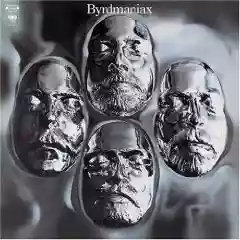
In June 1971, unbeknownst to the musicians and later, when it was too late, against their expressed will, "Byrdmaniax" was born, the first "black" album of the Byrds.
Melcher took material from three different recording studio sessions: June and October 1970 for the first two and January '71 for the last. Since the previous album, "(Untitled)," was released in September '70 and recorded between May and June of that year, and considering that by the time "Byrdmaniax" was released, the band was still on a promotional tour for "(Untitled)," it is clear that much of this tracklist comes from the sessions for that album, essentially making the tracks on "Byrdmaniax" mostly leftovers. If we then consider that much of "(Untitled)" in turn derives from the ashes of a never-born musical, it's quickly said.
Just like the album from the previous year, then, "Byrdmaniax," its natural discard, from a compositional standpoint, exhibits the same characteristics: McGuinn/Levy for the musical's leftovers, Battin/Fowley for the rest. Overall, the predominant pair is without doubt Melcher/Polina.
The country version of the famous "Glory, Glory," thanks to the two, returns to being spiritual, only tinged with pedal steel guitar; McGuinn-style country "I Trust" first becomes a gospel, then a 45, and finally a flop; the country trick "I Wanna Grow Up To Be A Politician" at some point is grafted with a tune from Sgt. Pepper's Lonely Hearts Club Band. On the Battin/Fowley front, in "Tunnel Of Love," there are too many keyboards, the brass rising almost leaves you stunned, and when the brass arrives, it no longer surprises because the track has already turned into a boogie fit for Fats Domino emulators. "Citizen Kane" seems more like a glam piece, and Fowley's crazy hand, always a deconstructor, is felt heavily.
But there are songs that even the most skilled producer and the most experienced arranger can't modify, even if they share the same intent, such as "Pale Blue," an acoustic folk piece so standard that any different version would become ridiculous, or the confidential country, all in a whisper, of "Absolute Happiness," a gem by Skip Battin and Kim Fowley, truth be told a bit too reminiscent of certain melodies by Cat Stevens.
To blues it, to dip it in sepia black, to further stuff such inevitably and irreversibly "white" songs means to sully them, although there is no potential masterpiece at stake here, quite the contrary. Moreover, doing it all underhand, unbeknownst to the involved parties... Without their support, Melcher could only hope to rearrange what was there and what could suffice for the purpose. Certain songs "untranslatable" into the language of soul needed to be replaced altogether, but there were no songs to serve as replacements, and the band, knowing nothing, couldn't produce any. Thus, the project becomes doubly unsuccessful because firstly it only "physically" succeeded halfway, that is, only for half of the songs on the setlist, and secondly because the little that did succeed turned out rather poorly.
"Americana" is generally a term that, in the musical sense, now encompasses an entire style resulting from a mix between rock, country, folk, root... The one in question would instead be "black Americana," born from the orgy between soul, gospel, spiritual, blues... I am convinced that Melcher was right with this idea of "continuity" in the name of American music, all things considered.
In conclusion, I believe that the idea of a turn, and a decisive one at that, wouldn't have been so bad. But to make such a significant turn, four leftovers are not enough, of which only half undergo a stylistic conversion, and it is not enough for the project to come to life artificially, independent of inspiration.
Loading comments slowly
Summary by Bot
Byrdmaniax is a controversial album by The Byrds released in 1971, marked by producer Terry Melcher's unsolicited reworking into a soul-influenced sound. The album largely consists of leftover material, resulting in a disjointed and unsuccessful stylistic shift. Despite some redeeming acoustic and country elements, the excessive arrangements damaged the overall feel. The project failed to deliver the intended impactful change, leaving it as an artificial and poorly received effort.Tracklist Lyrics Videos
The Byrds
The Byrds were an American band formed in Los Angeles in 1964, widely credited with shaping folk rock via Roger McGuinn’s 12-string Rickenbacker sound and electric interpretations of Bob Dylan. Their catalog is frequently discussed as moving from early folk-rock hits into psychedelia and later country-rock, notably on “Sweetheart of the Rodeo” with Gram Parsons.15 Reviews
