
 •
Rating:
•
Rating:
THE REVIEW
Thoughts after listening.
Why did Dylan never truly want to contribute to the immortality of the generational film "Easy Rider"? Was it to avoid witnessing a temporary overshadowing of his own celebrity, eclipsed by the shiny chrome of the motorcycles? Simply to allow the film to shine on its own? To let "Easy Rider" be not the film with Bob Dylan's song, but rather the movie "of the bikes," "with Captain America," "of the hippies," "the one with the song 'Born To Be Wild,' that they sang... Who sang it? Well, surely not Bob Dylan..."
It is said that Dylan didn't like the ending of that film, just as I didn't. I would have preferred an ending, so to speak, "metaphysical," with the two modern wandering knights that yes, appeared, but in truth do not exist, never existed, and will not exist, embodying the image of a generation that seemed to be, but at the end of the summer of love was no longer. And if you are not something forever, for me (and for Dylan?) it's as if you never were.
There are those who say he preferred to step aside in that case to favor his friend Roger McGuinn, who had been abandoned by the public for some time, not understood by the critics of the time, and even abandoned by his inspiration in the previous "Dr. Byrds & Mr. Hyde," as well as dumped by Gram Parsons and Chris Hillman. Was Bob supposed to write the ballad for the film? Instead, he sketches the first notes, "instructs" his friend-disciple properly but confidentially, and tells the production, "don't worry if I only have the beginning of the song. Give it to Roger McGuinn: he will know what to do with it."
The production must have said, "Roger McGuinn? And who is he?"... "Ah, the one from the Byrds." "But isn't that David Crosby?"... "Ah, I get it, the one with the tambourine!"... "No? You say that was Clark?" "Ahhh, yes, now I get it, the one with the strange Rickenbacker! But can you imagine a movie with an unreleased Dylan song, and not by this 'McGuinness'? A guaranteed success!"
In short, the idea that emerges is of a Dylan halfway between a cocky star and a benefactor of valid but disgraced artists. Specifically, McGuinn and his Byrds regained commercial success and visibility.
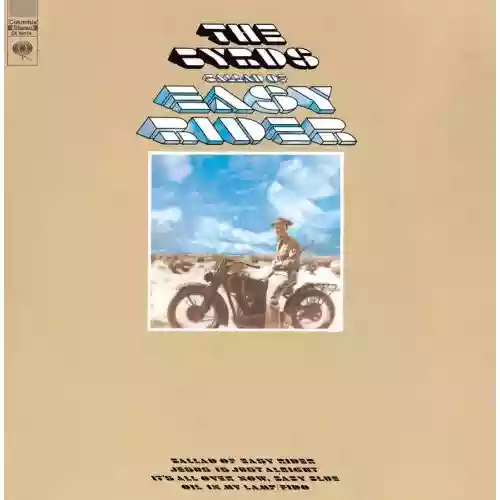
As can be seen from the title of the album, which is not the movie's soundtrack but a whole Byrds record, what Dylan discarded, McGuinn seized with both hands, diving right in to the extent that this album is called what it is.
Roger must be credited with another achievement: arranging a traditional medieval piece, giving it a drama that only rock can hope to achieve. And this was a year before Led Zeppelin's "Gallow Pole".
In addition to the new rhetorical-American figure of the easy rider, this album, anything but monothematic, also calls upon the stereotypes of country antiheroes, namely the lonesome traveller of "There Must Be Someone (I Can Turn To)" and the deportee of "Deportee (Plane Wreck At Los Gatos)." For the later Byrds, there is no difference between contemporary and past iconography, there is no winner between old and young if both are losers, there is no generational gap, nor geographical boundary between country and rock. "Americana," it is called.
Country rock travels well in the original songs, born to be so; when it comes to covers, rock is a good idea only for "Oil In My Lamp," "Tulsa County," and of course in the other Dylan piece, this one entirely his and already published, "It's All Over Now, Baby Blue," already covered by the Byrds in '65.
In "Jesus Is Just Alright," a cover of Arthur Reynolds, country was already mixed with spiritual. What McGuinn does is transform country into country rock, to mix it with the black chorus.
"Gunga Din" is spectacular, with all those arpeggios... It's signed by Parsons, but this isn't Gram; it's the new drummer Gene. One deduces that even the last of the session men of the time would have been able, with a little more consistency and dedication, to make music that a good part of today's musicians can't help but recognize their own inferiority to and decide to die struck by lightning in the rehearsal room, with consequent fire and destruction of said room.
The only real flaw of the album—aside from its title—is simply entrusting the dream of Cosmic American Music to the concluding—also a cover—"Armstrong, Aldrin And Collins," a track that fades out immediately... Since this is already the longest Byrds album up to that point, why make the track only a minute long?
If this album works better than the previous one, it is also thanks to the songwriting, which, covers aside, is the result of the formers' hands and not McGuinn's. They have decidedly more cohesion and surpass their own standards.
But how can one still trust the formers if they have previously failed, and not more than a few months ago? And the beauty is that it worked.
Loading comments slowly
Summary by Bot
The review delves into the backstory of Bob Dylan's partial contribution to the Easy Rider film and how Roger McGuinn and The Byrds took the lead with the Ballad of Easy Rider album. It highlights the album's blend of country rock and Americana, the revitalization of McGuinn's career, and the strong songwriting behind it. Despite minor flaws, the album is praised for its cohesion and musical depth.Tracklist Lyrics Videos
The Byrds
The Byrds were an American band formed in Los Angeles in 1964, widely credited with shaping folk rock via Roger McGuinn’s 12-string Rickenbacker sound and electric interpretations of Bob Dylan. Their catalog is frequently discussed as moving from early folk-rock hits into psychedelia and later country-rock, notably on “Sweetheart of the Rodeo” with Gram Parsons.15 Reviews
