
 •
Rating:
•
Rating:
THE REVIEW
A double album, moreover, seemingly and perhaps also materially very confusing, conceived at the beginning of the decline, under the psycho-financial profile, of the group, also thanks to the curses of the perfidious Yoko Ono and the disasters of Apple "a company making everything", loudly summoned by the taxman.
The genius, however, thank God, was always diligent in his duty, imparting directives to the Beatles for the creation of absolutely extraordinary pieces. See "While my guitar gently weeps", one of the most beautiful rock songs ever written, molded by an electric guitar written by Harrison for his friend Eric Clapton who plays it masterfully. It really seems as if the guitar is weeping through a metallic and desperate wail that stands out especially in the final solo, where beyond Harrison's painful evocation accompanying the notes, some more attentive listeners can even discern a well-interpreted sob during the fade-out. The sweet "Mother Nature's Son", the explosive "Back in the USSR", the touching "Blackbird", the tender "I Will" belong to the high peaks of the album. Sound techniques unknown at the time blend with the fluidity of the music even when they become heavy. See "Helter Skelter", which besides being the first heavy metal track in the history of rock, anticipated the hard rock genre, shortly thereafter picked up and developed by Led Zeppelin. "Yer Blues", another track with a heavy tone, characterized by riffs that are dirty but not overly so and essential bass lines. The rather gloomy lyrics become even more shocking for posterity, as Lennon screams about wanting to die at all costs, a prophecy damnably enacted by fate just over a couple of decades later. Furthermore, Lennon will venture into tracks ranging from ironic (The Continuing Story of Bungalow Bill, Everybody's Got Something to Hide Except Me and My Monkey, Cry Baby Cry) to provocative (Yer Blues, indeed, I'm So Tired, Revolution, Glass Onion, Sexy Sadie), through the beautiful rock ballad "Dear Prudence" with Paul on drums and the wonderful "Julia" dedicated to his mother.
The other members will follow his same footsteps by planning a set list suitable to touch any possible genre, even innovative. Tracks like "Why Don't We Do It in the Road", perhaps considered useless at the time, will inaugurate advanced branches over time with "I Want You", this time very remarkable, "Check My Machine" (McCartney II), insipid. Moby, who will wisely orchestrate them making them commercially appreciated, will treasure this through electronic manipulations. They will touch the political sphere with tracks like "Piggies", and "Revolution", of which I prefer the B-side of the single shared with the timeless "Hey Jude", much more spirited and explosive compared to the one recorded on the album which appears sluggish and with an uncertain metric. They will also dock at the pier of the experimental genre with "Revolution 9", an interesting mixture of phonemes and voices, of difficult et colorful interpretation (Franco Battiato will use it during the seventies in tracks like "Ethica fon Ethika" and "Nel cantiere di un'infanzia"). Melancholic 1920s radio portraits with "Honey Pie", simple country with "Don't Pass Me By" and marvelous pre-bedtime narratives like "Good Night", characterized by such an unusual yet stunning vocal interpretation by Ringo Starr.
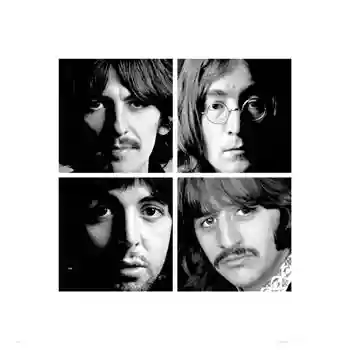
The "White Album" is undoubtedly a magnificent work, of excellent artistic value, certainly confused, acidic, ferrous, overshadowed by some low blows almost fortunately concealed by other finely crafted tracks. Leaving aside the Charles Manson affair, another shadow cast on the album by the mass media, the only double album by the Beatles once again conquers the top of one of the highest mountains in the world: music.
Loading comments slowly
Summary by Bot
The Beatles' White Album is a complex and brilliant double album blending various rock genres and innovative sound techniques. Despite tensions within the band and external challenges, it features outstanding tracks such as "While My Guitar Gently Weeps" and "Helter Skelter." The album's mix of emotional depth, experimentation, and political commentary makes it a landmark work, overshadowing controversies and securing its place as a masterpiece of music history.Tracklist Lyrics Videos
The Beatles
The Beatles were a British band formed in Liverpool in 1960 by John Lennon, Paul McCartney, George Harrison and, from 1962, Ringo Starr. They revolutionized popular music through songwriting, studio innovation and cultural impact, releasing landmark albums from Rubber Soul and Revolver to Sgt. Pepper’s, the White Album and Abbey Road before disbanding in 1970.173 Reviews
Other reviews
By Il Tarantiniano
This great double album is thus the result of what the four Beatles brought out unbeknownst to each other, and the fascinating thing is that it impresses.
With this album, they have proven to be ahead, turning music into simple and pure art, even simply playing with experimentation and the simplest rock.
By Rax
This is the best description one can give of this (controversial) album. Because it is indeed a masterpiece; but it is a masterpiece in potential.
George Martin said: 'I didn’t want them to release a double. I told them to make a single album with 12 great songs.'
By zaireeka
For those who are already well acquainted with this album, white album, white review.
For all others, there’s the first version.
By AxGx
A cult object, a manual, a bible, a totem.
If you listen to records before the White Album and after—the difference is there, and you can touch it.
